Showing posts with label Creativity. Show all posts

Monday, January 9, 2017

"Depressed? Just Shake it Off!" says my Brain (OR Lessons from Sabrina Benaim's Poetry)

Today we discuss Sabrina Benaim...


Explaining my Depression to my Mother.

Whoa.
This was the subject of our last fellowship.
I am told.

I am told because I was crying alone in my bedroom.
I was crying alone in my bedroom because I couldn't get out of my bed.
I couldn't get out of bed because my depression was sitting on my chest like a demon.

I could not attend fellowship.
In lieu of that, I write this because we all need better stories.
I was the kid who couldn't get out of bed due to depression.
Now, I intend to be the kid who attends fellowship through his depression.

The performance.

I love this girl; I think she has some serious chops.
Her poetry is moving and interesting, always coming back to the mother image and describing in simple terms her depression.

However, I do not dig her performance.
It is very raw, very faltering.
She takes a bunch of catch breaths because she cannot support the long and lengthy thoughts that she so well articulates in her writing.
Nevertheless, the passion she drives home over and over carries her through to the end where she ends with:
"Mom still doesn't understand! Mom, can't you see that neither can I?"

The depression

That, for me, is the crux of it.
Even if I stand here and describe every sensation of the night that I experienced, I don't think that I will ever truly understand this heinous beast inside of me.
I will never understand my depression.
It is a chimera
"Some days it is a bear holding a butterfly/Some days it is the bear!"
 So here are some actual texts from the night of fellowship:
-I'd like food
-But prefer to make it together
-But prefer to be left alone till I've eaten
-But can't bear the silence
-But can't talk
-I would have preferred to have been part of the [fellowship]
What can you or your loved ones do with that laundry list?

I have been told that depression is sometimes described as the porcupine disease because it is very hard to love someone with thorns.
The more you hug them, the more they hurt, but the more they need it.

 The anxiety

"Anxiety is the friend that depression felt obligated to bring to the party and I am the party, Mom"
I don't know why they seem to be so interconnected.
Depression and Anxiety.
Almost everyone I know with one has the other to some extent.

Why is that?
I really don't know.
Maybe there is someone out there who can explain it to me.

All I know is that when I am feeling low, I am also feeling anxious, hyped up, worked up to such a degree that I can barely sleep at night.
A week ago, I spent the entire night playing through an entire game of Portal 2 in one sitting.
Yesterday, I knew I was doing better because it took me three sittings to beat Dante's Inferno.

Some days I use my anxiety to be productive.
On the same night I beat Portal, I stayed up till seven in the morning rewriting a script and reformatting it in its entirety.
That should be up on my Patreon soon.
And why?
Because I had time. Because I was tired at not going to bed and feeling like I hadn't done anything.
When other people started getting up for work was when I realized that I had a problem.

No.
That isn't right.
I knew I had a problem in hour two of playing.
When I realized that I was tired, but wasn't nodding off.
I knew that I had a problem when I got to the point I wanted to stop and still did not stop.
I knew that I had a problem when I beat the game and still did not stop.
I know that I have a problem.

But, what am I to do with knowledge?
If knowledge is power, then why am I still sinking instead of swimming?
Because knowledge means nothing without practical application and how do you apply what you have learned against the instrument where you learn?
How do you build up a foundation under a crumbling mind?

The mother

I cannot divorce this poem from my own relationship with my own mother.
I was shocked at this poem because it is eerily similar to conversations that I have had with my own mother. 

The sad part is, I don't even blame my mother for not understanding.
How can anyone else understand mental disease if they have never experienced it when those who are suffering cannot find ways to articulate it outside the realm of art? 
So I point to my art.
I point to other people's art and hope that a sliver of a flicker of recognition passes through others and they say: 
"Oh, I get it."
In lieu of that, I have this suggestion:

The answer


Neil Hilborn. Joey.

"If you remove money from the equation, Joey would have been painting elk on cave walls. People would have fed him and kept him away from high places because god damn, look at those elk. I think that the genes for being an artist and mentally ill aren't just related, they are the same gene, but try telling that to a bill collector."
All that separates us from the Stone Age in Neil's poem is money.
I love that.
Everything about civilization is about the money, but at the heart of the human condition is

  1. Community
  2. & Art
This guy is my superhero.

I mean that literally.
He has other poems and there are other stories of people who don't want medication for their mental illness.
You know why?
Because they do not see themselves as mentally ill.
They see themselves as super-powered.

  • They can see alternate planes of existence
  • They can hear the thoughts and minds of others
  • They can sense or go places no one else can
Those are the powers of superheroes. 
Characters such as Francisco Ramon: 

Source

OR Jean Grey:

Source 

OR Kurt Wagner:

Source

DISCLAIMER: 

I am not arguing against treatment for mental diseases.
I am not arguing for the abandoning of mental institutions or mental care or medication. 
World governments are doing that en masse, and although not the subject of this article, are absolutely the subject of a future one where we look into just how much we care about people mentally.

What I am arguing for is a change in perspective.
I know of no artist that doesn't suffer from mental illness.
Think about actors:
  • We work 60 hour weeks
  • for a job with no set pay/benefits
  • for a limited time (anywhere from 4-12 weeks)
  • where we are unemployed at the end of it
  • where we can be fired at any point for any reason
  • & is actively under/unregulated
It would take a particular type of person to want to go into that profession.

Nevertheless, these jobs are important. 
To quote everyone's favorite teacher John Keating: 
"We don't read and write poetry because it's cute. We read and write poetry because we are members of the human race. And the human race is filled with passion. And medicine, law, business, engineering, these are noble pursuits and necessary to sustain life. But poetry, beauty, romance, love, these are what we stay alive for."
-Dead Poet's Society (1989) 


Art is necessary. 
It is so, so necessary.
I know because it keeps me alive. 
Every day when I think about going walking until my legs fall off, of vanishing into the dark where no one can find me, these tales, these stories, sometimes my own are the things that pull me back from the edge. 

To paraphrase Neil Hilborn again:

  1. At the heart of humanity is community.
  2. And at the heart of community is art.
  3. And at the heart of art is the artist.
If Joey were born in a different time, then he would have been taken care of.
People would look at him and think him inspired by the gods, or the muses, or whatever else is out there.
People would have looked after him because he was a holy man or a shaman or a dream interpreter or a doctor of the ragged edge of society. 

That is what artists are. 
That is what those suffering from mental illness are. 
We aren't mentally ill, we're just magic. 
We spin something out of nothing and sometimes we pay a price for it. 

I'm tired of paying alone.
Sometimes I just want to be kept away from high places.
Sometimes I just want somebody to say: look at those elk. 
That is the best I can offer coming out of an episode. 
Take care of yourself.
And take care of your sha-persons. 
They need it. 
How do you do that?
*shrugs*

Wednesday, September 28, 2016

The Seed to the Craft of Art is The Art of Going Insane (And Other Acting Tips)

Today we discuss madness.


Nope, not that.


Yep.


Yep. That.
There, that is better.
Or worse.
I can never tell.
And that is really the subject of this post.

"There are no sane characters. "
-Miles Boucher
What do I mean by that?
WHAT I SAID!
(hint: that was for dramatic effect)

But, seriously, there are no sane characters.
Rather:
There are no reasonable people in drama.
Don't believe me?
Look at Oedipus:

Cast Study: OEDIPUS

That right there is a King of Thebes...

Oedipus meets his father Laius on the side of the road and what happens?

  1. Oedipus's father Laius tries to murder Oedipus
  2. Oedipus murders his father
  3. Oedipus marries his mother and becomes king of Thebes
  4. His mother has four of Oedipus's children
  5. Thebes suffers plague
  6. Oedipus curses himself (unknowingly)
  7. Oedipus banishes his brother Creon and the prophet Tireisias
  8. His mother Jocasta finds out he is her son and hangs herself
  9. Oedipus gouges out his own eyes AND is banished
Why?
Why does this happen?
Because Oedipus's father Laius is told by a prophet that someday his son will murder him.
So what does he do?
  • Laius sends his son away to die on the mountainside.


I would call that an unreasonable response.
Just the all of it.
Because really what it came down to was the fact that a blind hermaphrodite tells a king that someday his newborn son will kill him and that is all it takes for him to order his son to die.
Everything that follows stems from that moment.
Arguably Oedipus is a complete innocent.
But, the Greeks really don't seem to care about secular morality.

Okay. 
That is an extreme case.
But, that was the Greeks.
They worshiped dirt. 
That couldn't happen in a reasonable society.
Like the Elizabethans in England?

Case Study: HAMLET

This may seem like easy picking.
Hamlet and Horatio certainly talk about death and madness a lot.

Hamlet: Does this seem healthy to you?
Horatio: No.
Gravedigger: No.
Hamlet: I was talking to the skull.
Ophelia does literally go insane:

The King is like get this crazed bitch out of here!
Hamlet certainly feigns madness in the play scene where he woos the spurned Ophelia discussing lying between her legs and then does it!


And then of course, Hamlet speaks to a ghostly vision that no one else can see save Hamlet and the audience....scholars still debate that one.

Seriously, look at that shadow. That is my Father!
So some would say the play is filled with madness.
I would argue that they are right.
Yet again the:
  1. Hamlet spurning Ophelia
  2. Hamlet murdering Polonius
  3. Claudius's banishment of Hamlet
  4. Claudius's orders to execute Hamlet
  5. Laertes's rebellion
  6. Ophelia's insanity
  7. Ophelia's apparent suicide
  8. Hamlet's return and subsequent jumping into Ophelia's grave and fighting Laertes in it
  9. Their duel
  10. The accidental poisoning of the Queen
  11. The accidental poisoning of Laertes
  12. The deliberate poisoning of Hamlet
  13. The deliberate poisoning and the subsequent stabbing of Claudius 
All of this, all of this, all of this stems from:
  • Hamlet believing the Ghost who said:
    • I am thy Father's Spirit AND
    • Your Uncle killed me
That is it.
That is all it took to convince Hamlet that it was all his Uncle and everything that followed stems from it.
Who does that?!
Crazy people do that. 

But, those were from the Renaissance.
They did more drugs than the Flower Children.
They drank ale instead of water.
Shakespeare probably smoked cannabis.
Of course their characters were crazy.
We couldn't have that today...
(it's a leading line of thought, but still)

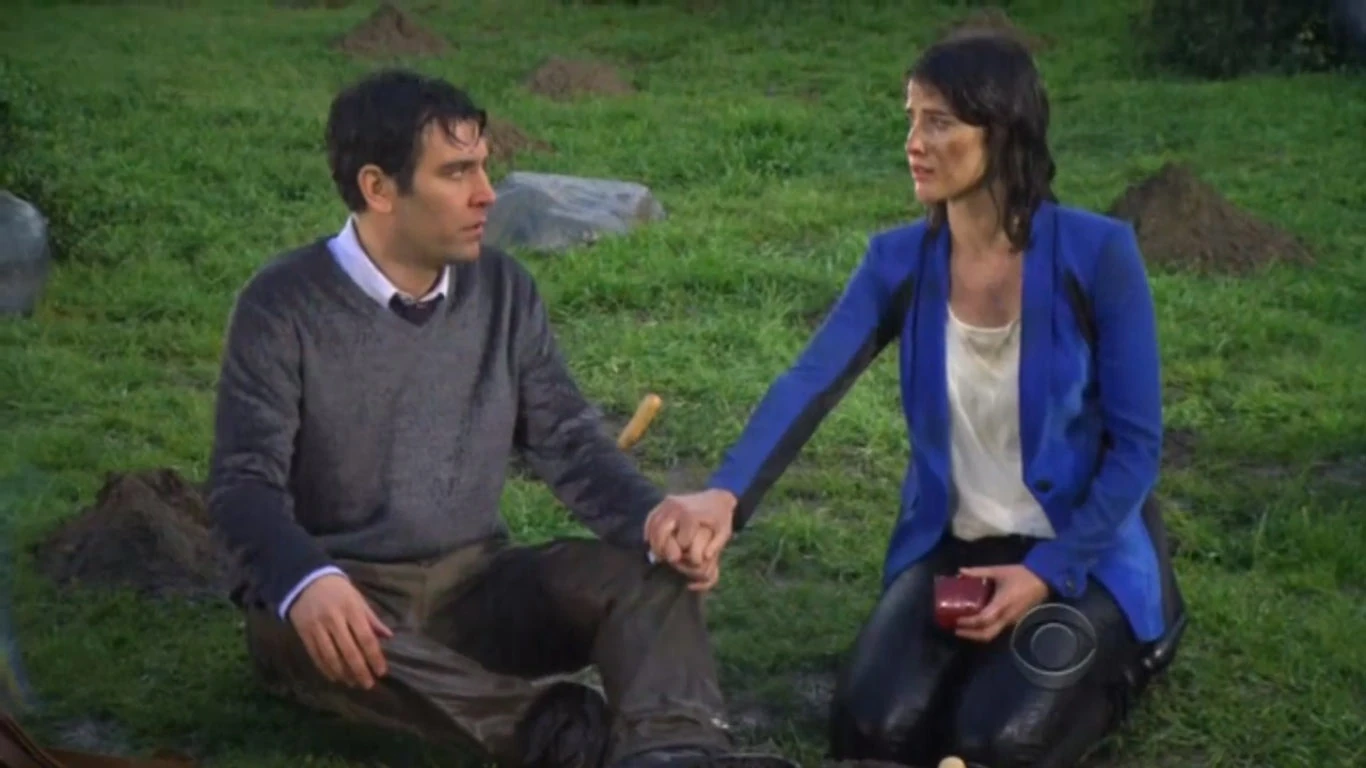
Case Study: HOW I MET YOUR MOTHER (or any sitcom...Scrubs/Friends/New Girl/Cheers)

*SPOILERS*
Meet Ted:

Aww early Ted is the best Ted!
Ted is a psychopath.


Crazy eyes! Crazy eyes!
Ted meets a girl named Robin:

Her name is literally Smulders...
The entire first season is about them getting together.
Second season is about them falling apart.
Third season is about them working on being together (Friends w/Benefits)
Fourth season they break up; Ted gets desperate.
Fifth season is art.
Everything after is just a sorry excuse.
And then Ted finally meets up to his promise and meets the Mother of his kids:

Sup!
And it was good.
Until she dies.

WHY?!
So sad.
And in the end, we find out that all of this is just an excuse to chase Robin.
AGAIN!
He literally asks his kids if it would be okay to date Robin after the death of his wife.


Now, here is the sanity:
It is very healthy to talk to your kids about dating again.
They are a part of the relationship and can and probably should be consulted.

But, Ted literally tells them everything about his sexual history, his conquests, his travails, his foibles.
They know Ted & Robin have the unhealthiest relationship.


That is not the action of a sane and healthy individual.
Ted is the most obtuse individual when it comes to self-awareness and self-control.

And here is the thing...
It's what we love about him.
NOT ALL THE TIME!


Oh shut up!


She is engaged bro!
To name a few.
But, there are so many precious, beautiful moments that we love.

His apparent disassociated moments with his students:


The fact that Ted made it rain for Robin:


The fact that he would have stolen an entire blue orchestra:


These are still the acts of a crazy person.
But, we can and do find them endearing.
There are reasons explored actually within the series, but are not the subect of this article:


The point is:
All drama is filled with crazy and that is what we love.

Case Study: YOUR FAVORITE STORY

Think of your favorite story.
Okay?
You have a story?
You got it in your head?
Know all the back story?
The ups? The downs? The surprises?
Good.

Now, really examine those characters.
Examine their behavior.
Examine their responses.
Are they responding reasonably?
Dare I say sanely?
I'd argue probably not.

Now, here is the thing.
EVERYONE WANTS TO BE SANE.
So far as I have been able to gather.
However, I would contend:

Art is Insane

End stop.
Art is Insane.
It is what we love about art.
People do things we would never do.

  • Ted Mosby loves in spite of love kicking his ass.
  • Hamlet goes off the word of a spectre and his whole family ends up murdered and his kingdom overthrown.
  • Oedipus ends up blind, childless, and cursed.

We like watching these stories.
We like watching characters get kicked and getting back up again
And why?
Because it is crazy to do so!
So why is the first critical response I hear always, always, always:
  • It was so real!
  • That is exactly how I would respond!
Really?
Really?!
Would you really?
Would you really kill your father, mother, nieces, nephews, and children?
If so, I may want to have you committed.

Now, to be fair, it may say something about the human condition.
Namely: we are all insane.
But, that is the subject of another post.
Here is my point:

Artists are trying to make their characters sane

It is the biggest tragedy to art I see right now.
People are trying to make their characters 'real'. 
And that means by toning down their responses.
That means that instead of tearing up the contract, characters are politely saying, "No, thank you."
Instead of throwing pies in each other's faces, we see them tersely eat dinner for a half hour scene.
This is not an overall trend.
In fact, many modern comedies embrace the insane quite well: 
  • Death at a Funeral
  • Hot Fuzz
  • Shaun of the Dead
  • At World's End
  • Ted
  • Rush Hour
  • Tommy Boy
To name but a few. 
But, if you are stuck, if you can't quite figure out why a scene isn't working, consider that maybe you or your partner or the situation isn't quite crazy enough.

Questions to Consider

  • Who is right in this situation?
  • Who is wrong in this situation?
  • Can I make them wrong?
    • How?
  • Am I acting unreasonably?
    • Can I act more unreasonably?
    • How?
  • What would an insane response be?
    • Why am I not doing that?
      • Is the reason: to be liked?
      • Is it because I would "never" do that?
        • What is wrong with doing it?
  • What is the most I can get away with?
  • What are the consequences for my current action?
    • Is it imprisonment?
      • Why not?
    • Is it lower than imprisonment?
      • Why?
I'm not saying everyone needs to go to prison or murder someone.
That would be formulaic.
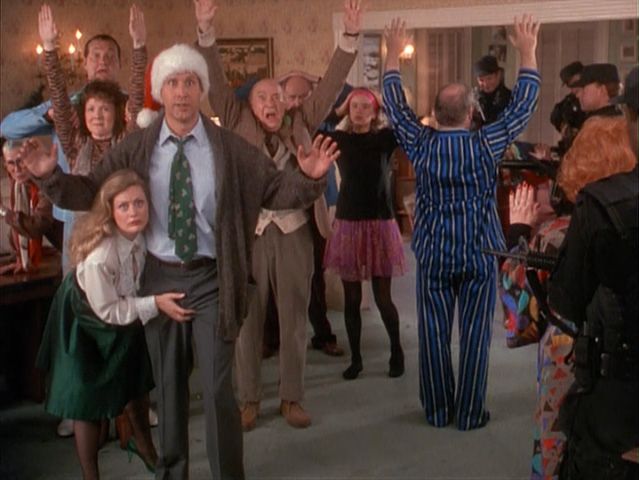
But, the number of comedies that have a prison sequence is as high as the wedding:

National Lampoon's Christmas Vacation

Bridesmaids

So if you aren't risking something in the scene.
If you aren't gambling on going to prison in your play or screenplay or novel at some point.
Then, I don't think you are writing drama.
Because your characters aren't insane.
And that really makes all the difference.

Tuesday, August 23, 2016

A Sex Lesson from the Future (And Why I liked it!)

Today, we discuss the first fellowship I hosted:


This.
This is Sarah Jones, one of the most brilliant performers I have ever seen.
In it, she performs as multiple personas given life through her theatrical device: BERT.
OR
Bio-Empathic-Resonance-Technology.
B.E.R.T.

B.E.R.T.

It is brilliant.
The idea is that in the near future, human technology is able to accurately record, and then recreate the emotional response inside of the originator.
As a device, I cannot emphasize how effective this is.
Josh Daniel Palmer said it best:
"That is, quite simply, theatre."
In theatre, that is what we do.
We attempt to recreate an empathic response in our audience.
By drawing attention to this simple truth in theatre, Sarah Jones is able to create a beautiful relationship with her audience.

The Setting

The talk is set in the far distant future and our near future is being taught as a history lesson.
This setting acts as another layer of theatrical device.
It lets Sarah Jones's character of Teacher act as an "objective" third party to our very emotional history.
It lends perspective if not a sense of objective truth to it.

That was as far as we got in our discussion.
Her performance and text are so dense.
We mostly discussed that at our fellowship.
And the repercussions of those simple ideas

  1. What would a future like that be like?
  2. How might we achieve such a future?
  3. And how long might it take?
The idea of the technology was so interesting and compelling that we didn't even get to the content

The Content

So, this is where Sarah Jones's work really shines.
She is able to slip in and out of character so quickly and so easily that it is completely transformative.
And then, she is able to appeal to many sides of the argument.

Her first character, an elderly woman views sex work as a mechanization/industrialization of the human experience of "making love"
The second is a college age feminist who finds the work empowering, but has no interest in performing it herself.
The third is a sex worker who wants the right and ability for economic empowerment.
The fourth was a sex worker from a very young age having been forced into it by her husband's debts and viewed it as a business filled with lost souls without tether.
The fifth and final one presented was a male who was getting married, attending his bachelor party, discussing freedom of choice for women who want to be in the business for positive, empowering reasons.

She indicates that her show SELL/BUY/DATE has additional roles, additional viewpoints, but already we have a wildly eclectic view of a single topic:
Sex Work.
And what does it mean?
By giving us so many perspectives and so many rich stories and encouraging us to feel empathetically with each viewpoint completely, Sarah Jones is able to weave together a very rich tapestry of views and conversations into a single whole. 

I think this work is some of the best I've seen.
I think she is one of the best performers I've seen.
I see no clear answer or way through this issue and I don't think that that is the point.
I am heartened by the historical context that she presents: 
Somehow, some way we get through this time of strife.
We come to a new understanding that is filled with rich words like "gender spectrum". 
I hope for a future where we can experience our ancestral history as a part of our growing understanding of our world.
Maybe it already exists in our theatre as exemplified by Sarah Jones. 
I hope that I may experience more theatre like it. 

Wednesday, August 3, 2016

Drawing Pictures of God (Why Ignorance is Hell/Bliss)

Today, we discuss ignorance.
Nope.
Although I do have an article about the Drumpf nightmare somewhere....
*digging around sounds*
Here it is!

But, that is not the ignorance of which I am speaking.
I am speaking of the ignorance that stems from artistry.
Something I don't talk about enough is process.
Mine specifically, other artists, maybe (though I can't exactly speak for them, just anecdotally).

I don't speak of it often because I assume (rightly or wrongly) that nobody wants to know these things.
Also, it has been ingrained in me that the work should always stand for itself.
Full stop.
"Shakespeare doesn't give talkbacks."
Was an actual quote in my undergrad classes.
But, then again...why do we have talkbacks?
Isn't it to share with audience and with the artists making the art?

So...my process/ignorance:
I'm starting writing poetry.
Check out my poetry/novel blog here. 
I have always felt completely out of my depth when it comes to rhythm, rhyme, and everything to do with poetry/songwriting.
The reason for it is because I have a very ingrained sense of authority/hierarchy in the arts.
Theatre is dancing somewhere near the bottom, whereas recognized art forms: music, opera, and writing are dancing somewhere near the top.
Those are professions that require craft and specialization.

So I am the ignorant country bumpkin, trying to create something in an art form for which I have no experience, but a whole soul filled with appreciation.

And yet!I have always prized ignorance in others.
At least when it comes to artistry.
And why?
Too often I hear students/learning artists say:
I don't know enough. I don't know what I'm doing. I don't know how any of this is supposed to work.
And I congratulate them.
They look at me confused, mortified even.
It is better to know nothing when it comes to art.
It is better to be ignorant when it comes to art. 
There, I said it.
Why so?

Children know nothing about art.
They simply draw.
Children know nothing about play.
They simply do.
And that makes them artists.
Unquestionably.

You can argue about the level of craft of their compositions or details, but one of the fundamental things about children as artists is they do it.
They make an impressive body of work.
My childhood portfolio is filled.
I would bet that anybody could say as much.
What about as an adult?
Is anyone nearly so prolific?

Ignorance is no bar to artistry.
In fact, I maintain that it is helpful.
And why?
Sir Ken Robinson ladies and gentlemen!
The story goes:
A kindergarten teacher was observing her classroom of children while they drew pictures. Occasionally she would walk around the room to see each child's work. There was on little girl who hardly ever paid attention in school, but she was busy working on her drawing. "What are you drawing?" she asked the little girl was was working diligently at her desk. The girl replied, "I'm drawing a picture of God." The teacher paused and said, "But, nobody knows what God looks like." The little girl replied, "They will in a minute."
 Ignorance is not a bar to artistry.
It is about the most helpful thing in the world.
Children are ignorant and are able to draw pictures of God.
And why?
Because they do not have a preconceived notion of their limitations.
It is no stop to them or their abilities.
Adults who perceive themselves to be ignorant have a worse time of it because it does bar them and their ability to create.

For many years I have been the teacher in the joke, hopelessly afraid of writing anything.
But, I never viewed my lack of formal education as a blessing.
I have no scruples or understanding about how writing works.
I am free to make any sort of art that I can conceive.

So that is what I am currently doing.
My first novel is an experiment in long-form internal monologue.
The narrator is untrustworthy and will probably continue to be throughout the entire story.
I am no longer breaking it down into chapters, but chimes, drawing a direct narrative parallel between his experience of a year, a day, and a moment atop a hospital, but also the marriage bells.
Form influencing content and content influencing form.
I wouldn't think that that was an acceptable prose form were it not for the fact that I have never had anyone tell me not to do it.

My next novel is being written in tandem, two columns of material side by side for comparison or whatever the audience pleases.
To be fair, I have seen something similar.
Much of my prose is influenced by the work of Mark Z Danielewski.


House of Leaves is a bear to read.
And this:
Only Revolutions.
Both of these works couldn't be told in the classical novel-form.
But, they are still very much novels.
He is one of the most daring novel writers that I have ever seen.
And I want more books to be like this: experimenting with form.
Since, I haven't seen it, well, I may as well write it.
One of the best anecdotes I was told by someone I care about very deeply was:
You know how C.S. Lewis and J.R.R. Tolkien got their start? They were tired of the fiction being written at the time and decided to write what they always wanted to read.
That is bad ass.
I would like a little more badassery in fiction and in art.
So ignorance and lack of formal training being no bar, let's do it!
Let us, each of us, make the art that we wish to see in the world!


Saturday, April 4, 2015

Learning & Creativity: How Babies Rule the World (3:13)


Creativity is the most valuable resource we have available.
It is the foundation upon which both the arts and sciences are established.
There is no situation in the world where the phrase, "Oh, what a predictable solution!" is considered praise.
And yet, institutions, I would say categorically kill creativity in youth.
Sir Ken Robinson makes one of the most compelling appeals to redeveloping the school model in order to capitalize rather than economize our growing workforce in an ever-changing world:

If you don't have time to watch the entire TED talk (which is brilliant) here are some key points:
  • Creativity (defined) is the ability to come up with new ideas that have value
  • Creativity is impossible without the ability to fail or to make mistakes
  • Failure and mistakes are precisely the thing schools stigmatize every day
  • Creativity is not learned, but natural, and can be schooled out of children
Don't believe me?
Here is a chart of the Scientific Method:
I've made it color coded for convenience and to be less scary.
It is a flow chart, essentially you come up with an idea, draw on past experience, test it, figure out of it is working, and if it is, draw conclusions, and finally share that with others.
Now this chart daunts middle/high schoolers of all ages.
AND YET! AAAAAAND YET!
Babies do this.
That's right.
Fucking babies:
Babies perform research.
They have rich, detailed ideas about how the world works, and when it doesn't fit into their mold, they engage with it, expecting further discoveries.
Creativity and research go hand in hand since we are infants.
To squash one will kill the other.
It is so innately human to be curious about the world, to feel awe in the face of wondrous objects, and to search for truth and replicate it.
And yet we deny children and teenagers the ability to search for their own unique perspective on the world: schools cut funding to sports and arts programs, colleges are reduced or combined, and parents and teachers tell children that their hobbies are not careers.
This is the single greatest calamity to happen to the education of our youth, a remnant of the Industrial Era where our education system is lodged, where children are run with factory bells to train them (can you say: Pavlovian conditioning?), where maths, sciences, and finally the humanities are given importance, rather than equal or individual study.

Keith Johnstone, an improviser and theatre teacher, says this in his seminal work Improv:
I once had a close rapport with a teenager who seemed 'mad' when she was with other people, but relativly normal when she was with me. I treated her rather as I would a Mask--that is to say, I was gentle, and I didn't try to impose my reality on her.
I'm remembering her now because of an interaction she had with a very gentle,  motherly schoolteacher. We were in a beautiful garden (where the teenager had just seen God) and the teacher picked a flower and said: 'Look at the pretty flower, Betty.'

Betty, filled with spiritual radiance, said, 'All the flowers are beautiful.'
'Ah,' said the teacher, blocking her, 'but this flower is especially beautiful.'Betty rolled on the ground screaming. Nobody seemed to notice that she was screaming, 'Can't you see? Can't you see!'
In the gentlest possible way, this teacher had been very violent. She was insisting on categorising, and selecting. Actually it is crazy to insist that one flower is especially beautiful in a whole garden of flowers, but the teacher is allowed to do this, and it is not perceived by sane people as violent. Grown-ups are expected to distort the perceptions of the child in this way. Since then I've noticed sch behavior constantly, but it took the mad girl to open my eyes to it.
I say let us be gentle with one another, let us not insist or push our own realities on one another.
In so doing, I hope that we can understand one another and learn from one another.
No one can teach you to be creative, no one can teach you to be an artist, no one can teach you to be a scientist; you already are one.
And no one can take that from you.