Showing posts with label Value. Show all posts

Monday, January 9, 2017

"Depressed? Just Shake it Off!" says my Brain (OR Lessons from Sabrina Benaim's Poetry)

Today we discuss Sabrina Benaim...


Explaining my Depression to my Mother.

Whoa.
This was the subject of our last fellowship.
I am told.

I am told because I was crying alone in my bedroom.
I was crying alone in my bedroom because I couldn't get out of my bed.
I couldn't get out of bed because my depression was sitting on my chest like a demon.

I could not attend fellowship.
In lieu of that, I write this because we all need better stories.
I was the kid who couldn't get out of bed due to depression.
Now, I intend to be the kid who attends fellowship through his depression.

The performance.

I love this girl; I think she has some serious chops.
Her poetry is moving and interesting, always coming back to the mother image and describing in simple terms her depression.

However, I do not dig her performance.
It is very raw, very faltering.
She takes a bunch of catch breaths because she cannot support the long and lengthy thoughts that she so well articulates in her writing.
Nevertheless, the passion she drives home over and over carries her through to the end where she ends with:
"Mom still doesn't understand! Mom, can't you see that neither can I?"

The depression

That, for me, is the crux of it.
Even if I stand here and describe every sensation of the night that I experienced, I don't think that I will ever truly understand this heinous beast inside of me.
I will never understand my depression.
It is a chimera
"Some days it is a bear holding a butterfly/Some days it is the bear!"
 So here are some actual texts from the night of fellowship:
-I'd like food
-But prefer to make it together
-But prefer to be left alone till I've eaten
-But can't bear the silence
-But can't talk
-I would have preferred to have been part of the [fellowship]
What can you or your loved ones do with that laundry list?

I have been told that depression is sometimes described as the porcupine disease because it is very hard to love someone with thorns.
The more you hug them, the more they hurt, but the more they need it.

 The anxiety

"Anxiety is the friend that depression felt obligated to bring to the party and I am the party, Mom"
I don't know why they seem to be so interconnected.
Depression and Anxiety.
Almost everyone I know with one has the other to some extent.

Why is that?
I really don't know.
Maybe there is someone out there who can explain it to me.

All I know is that when I am feeling low, I am also feeling anxious, hyped up, worked up to such a degree that I can barely sleep at night.
A week ago, I spent the entire night playing through an entire game of Portal 2 in one sitting.
Yesterday, I knew I was doing better because it took me three sittings to beat Dante's Inferno.

Some days I use my anxiety to be productive.
On the same night I beat Portal, I stayed up till seven in the morning rewriting a script and reformatting it in its entirety.
That should be up on my Patreon soon.
And why?
Because I had time. Because I was tired at not going to bed and feeling like I hadn't done anything.
When other people started getting up for work was when I realized that I had a problem.

No.
That isn't right.
I knew I had a problem in hour two of playing.
When I realized that I was tired, but wasn't nodding off.
I knew that I had a problem when I got to the point I wanted to stop and still did not stop.
I knew that I had a problem when I beat the game and still did not stop.
I know that I have a problem.

But, what am I to do with knowledge?
If knowledge is power, then why am I still sinking instead of swimming?
Because knowledge means nothing without practical application and how do you apply what you have learned against the instrument where you learn?
How do you build up a foundation under a crumbling mind?

The mother

I cannot divorce this poem from my own relationship with my own mother.
I was shocked at this poem because it is eerily similar to conversations that I have had with my own mother. 

The sad part is, I don't even blame my mother for not understanding.
How can anyone else understand mental disease if they have never experienced it when those who are suffering cannot find ways to articulate it outside the realm of art? 
So I point to my art.
I point to other people's art and hope that a sliver of a flicker of recognition passes through others and they say: 
"Oh, I get it."
In lieu of that, I have this suggestion:

The answer


Neil Hilborn. Joey.

"If you remove money from the equation, Joey would have been painting elk on cave walls. People would have fed him and kept him away from high places because god damn, look at those elk. I think that the genes for being an artist and mentally ill aren't just related, they are the same gene, but try telling that to a bill collector."
All that separates us from the Stone Age in Neil's poem is money.
I love that.
Everything about civilization is about the money, but at the heart of the human condition is

  1. Community
  2. & Art
This guy is my superhero.

I mean that literally.
He has other poems and there are other stories of people who don't want medication for their mental illness.
You know why?
Because they do not see themselves as mentally ill.
They see themselves as super-powered.

  • They can see alternate planes of existence
  • They can hear the thoughts and minds of others
  • They can sense or go places no one else can
Those are the powers of superheroes. 
Characters such as Francisco Ramon: 

Source

OR Jean Grey:

Source 

OR Kurt Wagner:

Source

DISCLAIMER: 

I am not arguing against treatment for mental diseases.
I am not arguing for the abandoning of mental institutions or mental care or medication. 
World governments are doing that en masse, and although not the subject of this article, are absolutely the subject of a future one where we look into just how much we care about people mentally.

What I am arguing for is a change in perspective.
I know of no artist that doesn't suffer from mental illness.
Think about actors:
  • We work 60 hour weeks
  • for a job with no set pay/benefits
  • for a limited time (anywhere from 4-12 weeks)
  • where we are unemployed at the end of it
  • where we can be fired at any point for any reason
  • & is actively under/unregulated
It would take a particular type of person to want to go into that profession.

Nevertheless, these jobs are important. 
To quote everyone's favorite teacher John Keating: 
"We don't read and write poetry because it's cute. We read and write poetry because we are members of the human race. And the human race is filled with passion. And medicine, law, business, engineering, these are noble pursuits and necessary to sustain life. But poetry, beauty, romance, love, these are what we stay alive for."
-Dead Poet's Society (1989) 


Art is necessary. 
It is so, so necessary.
I know because it keeps me alive. 
Every day when I think about going walking until my legs fall off, of vanishing into the dark where no one can find me, these tales, these stories, sometimes my own are the things that pull me back from the edge. 

To paraphrase Neil Hilborn again:

  1. At the heart of humanity is community.
  2. And at the heart of community is art.
  3. And at the heart of art is the artist.
If Joey were born in a different time, then he would have been taken care of.
People would look at him and think him inspired by the gods, or the muses, or whatever else is out there.
People would have looked after him because he was a holy man or a shaman or a dream interpreter or a doctor of the ragged edge of society. 

That is what artists are. 
That is what those suffering from mental illness are. 
We aren't mentally ill, we're just magic. 
We spin something out of nothing and sometimes we pay a price for it. 

I'm tired of paying alone.
Sometimes I just want to be kept away from high places.
Sometimes I just want somebody to say: look at those elk. 
That is the best I can offer coming out of an episode. 
Take care of yourself.
And take care of your sha-persons. 
They need it. 
How do you do that?
*shrugs*

Tuesday, August 2, 2016

My Friend Bevin is a Digital Yogi! (How Can we Best Help Each Other?)

Today we discuss our digital self:


This is seriously one of my favorite things. Ever.
We are conscious of ourselves; social media is the market’s response to a generation that only wanted to perform. So the market said, “Here, perform EVERYTHING. To each other. All the time. For no reason.” And we do. It is audience and performer melded into one. It’s prison. It’s horrific. What do we want to do more at the end of the day than to sit down and watch our lives as a satisfied audience member.
Everyone is a performer in this day and age. Social media demands that we be. Demands that performers are no longer just performers in their work, but in everything they do:
  • where/how they eat, 
  • how they dress, 
  • what they wear, 
  • where they go, 
  • who/what they see, 
  • who/what sees them. 

Look at Lin Manuel Miranda and his legions of Twitter followers to feel inspired and uplifted, only to realize that you don't have that many friends.
To realize that nobody cares what you have to say outside of your social sphere.

My generation, and by that I mean I, was taught to think I was special, to think that my opinion mattered.
That I would one day be like Lin Manuel Miranda.
"I have a privileged life, and I got lucky, and I'm unhappy. "
 Truer words were never spoken by a white, cisgender male.
So what do we do?
You’ll notice the audience doesn’t answer.

In the tradition of Bevin Bell-Hall’s spirit jams on social media, let us ask questions and hope for response (because that is the truth, we never know if we will have a response/impact or not; every day is a leap of faith. I know, I asked Bevin):

In an age where more emphasis is placed on social media and the visual information, how can we best help each other? 


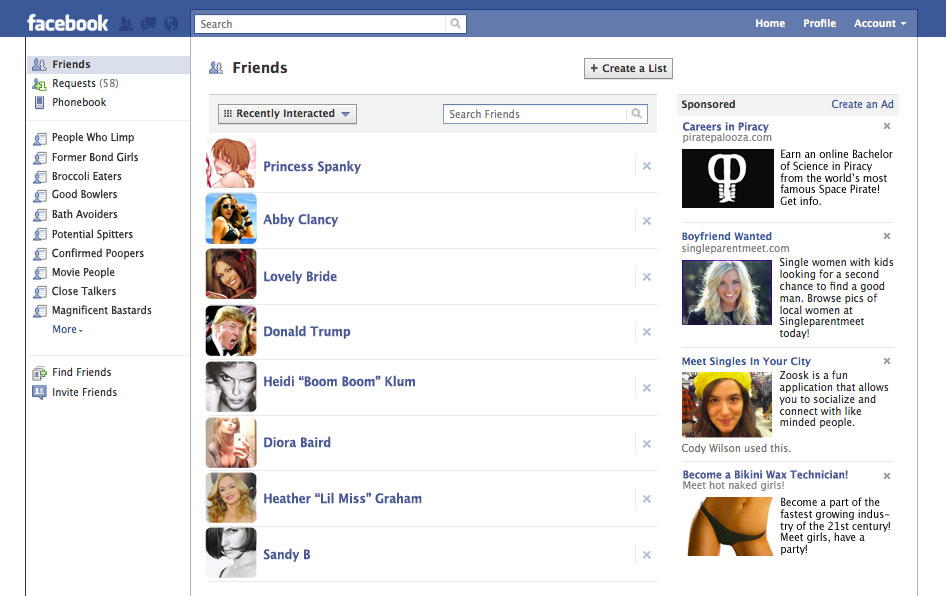
In an age where the friends you have are the friends you never really knew, how can we help one another?:

Donald Trump & Princess Spanky are my homies!

What can we do?
How do we help one another?
Speaking personally, I get depressed.
Like seriously. wretchedly depressed looking at my feed.
But, not even just my feed, posting to my professional page:
  • When viewership goes down.
  • When the number of clicks plummets
  • When the number of people I may or may not know anonymously click on an article I have written and don't leave a comment, they become a single tick mark on the social media machine that tells me nothing about the beautiful, wonderful, individual souls that pass through my digital hall for a brief span of this precious life.
What can I do?
What can they do? 
What can we do?

When Instagram is the dining experience as opposed to the DINING EXPERIENCE being the dining experience:


Visual media and sensory information is becoming the dominant.

I feel compelled to chronologue every excursion, every event, every single fucking thing.
And why?

Because how do I know if I lived a life?
How do I know if what I did mattered?
How many people care about me?
Do you?
Does anyone?
How do you know?

Twitter tells you.
Facebook tells you.
Instagram tells you.


Unless you are completely switched off, which is possible, possibly even preferable these days, there is an objective tick counter that tells you how many people like whatever you are posting.

There is a way to find and support almost anybody anywhere at anytime.

But, this is our digital world.
And it is a reflection of our real world.

My very best friend Bevin, says that there must be a spiritual side to the digital landscape.
And I, for one, support her in that idea.
The digital sphere is what we have made it.
It doesn't have to be.

Because there are any number of ways that the digital sphere has been supportive and wonderful.
Her spiritual jam sessions where Bevin asks thought-provoking questions are just one.
As a political platform, it is unquestionably valid.
The democracy of the internet is unquestioned.
Everyone has access to the same internet so long as they have a connection.
(there are socio-economic concerns there that are not the subject of this article, e.g. access to poor/disenfranchised areas being less prevalent than our 5G enabled megatropolis of the United States)

Point being: WHAT CAN WE DO TO HELP ONE ANOTHER.

For me?

Letter writing.
Studying the art of letter writing.
In an age where everything is public, where everything is vocal, and loud, and noisy in our digital space, we need a chance to be quiet.
A chance for kindness and dialogue and helping one another.

Why?
Because we perform. ALL THE TIME.
The feed is like the town square. It is a place where people shout to be heard, discuss prices, dinners, bargains, news, stories, experiences, in loud voices with other people possibly watching and listening too.
We need places and experiences to not do that.
Writing letters is one.

They are a physical, tangible way to show how much you care.
The require time and crafting to be made manifest.
But, they need not be purely physical.
Writing digital messages in a bottle and sending them off is wonderfully cathartic for me.
Apologies, love letters, congratulations, and calls for help to friends past, present, and future creates a digital landscape that I find spiritually and socially satisfying.
I wish that I could just have the Messenger without the Facebook feed sometimes.

Finding one's tribe in a digital landscape is what I think it is all about.
Exposing oneself to different ideas is the ideal, but creating/paving the way for thoughtful, powerful experiences digitally is how I know best to help one another.
SO I write letters.

  • I write thank you letters to people for helping me out of bad situations
  • I write apology letters to people that I have wronged or felt that I have
  • I write celebratory letters to people that seem in need of uplifting or joy
  • I write letters for me so that I know somebody does.
I don't send all of them.
Most haven't because they take time and they take craft.
But, they are there. 

I guess the biggest thing that I take away from it all is thoughtfulness.
In a sea of information, I don't feel like a drop in the sea, or a part of the ocean. 
No.
I feel like a drowning man in the middle of a tempest without so much as a plank.


Every day is a hard fight to breathe and post something that is meaningful.
Not just to me.
oh no.
But, to everyone.
And that is where the feeling comes from.

So maybe the better term is deliberate.
I aim to move towards a deliberate digital presence, a deliberate spiritual practice that can influence not only mine, but others as well.

This letter is one of the first to be made public.
It is to my dear friend, Bevin and to any and all who read it.
I hope you find it worthwhile.
I hope it helps and expands the conversation.

Too often, I find social media to be the last place where anybody wants to engage in political debates.
Mostly because the ability to offend through a purely textual medium is easy.
It doesn't allow for positive rhetoric or affirmations of the quality of the ideas.
Bevin manages to do it in her Facebook feed.
She can and should be thanked.
Thanks Bevin for all your hard work and bringing people together.
It really means the world.
It can be hard to engage because you never know if what you're saying has any meaning.
I hate ascribing meaning to Facebook's "like" button. 
So, for me, personally, I'd like to burn that bad boy.

But, that being said, it brings me to my final suggestion.
How we might best help one another:
Show the love.
I know everyone is doing it all of the time.
And that is part of the problem of social media: Too much lovers, not enough time to love.
I have too many friends to individually like and comment on everything they post.
Same is true for me.
Facebook cherry picks what I see.
Already we have some people who are not seen in feeds nearly as much.
Content that gets passed over. 
It can be very scary.
And very daunting.
The silent few who don't get noticed.
  1. Please notice them.
  2. Help them where you can.
  3. Message them.
  4. Write a couple letters to people that you remember after years of not talking.
And finally:
Think about the kind of digital life you would like to have. 
If you would like for it to happen, try doing it for someone else.
And ask.
Always ask for it to be returned. 
Maybe not right away, but soon.
You deserve it.
We all do deserve that much. 

Sincerly,
Your Friendly Neighborhood Artist.

Saturday, June 18, 2016

Best First Day & Hogtied by Children (What is Busking?)

Today, let us talk about busking:


What is busking?
According to Merriam Webster:
A person who entertains in a public space for "donations" [quotations added for ironical effect]
A bit too clinical, but it gets the point across.
I prefer this...

According to Dictionary.com:
  1. To make money by singing, dancing, acting, etc in public places in the hopes of "donations"
  2. To sell articles/obscene ballads, perform music, or improvise in a theatre queue in the hopes of "donations"
  3.  Buscare (Italian): to procure, get, gain; Buscar (Spanish): to look for, to seek
  4.  To "cruise as a pirate"
So we perform in the hopes of donations.
According to this definition, we possibly started in theatre queues while people were waiting for their tickets or for the house to open.
Performers would entertain and hope for patronage.
My personal favorite is to cruise as a pirate. This may be the origin of working on cruise lines, entertaining as a profession on ships.

The biggest things these definitions have in common:

  1. In Public 
  2.  Performance
  3. Hope
  4. "Donations"
But what is busking really?
I didn't really know until I performed.
Try it!

Public

So what do we mean by public?
Well...public.
It can be literally anywhere.


I have seen performers in almost any setting.
Now, for it to be legal, certain restrictions should be observed.
For example, one of my friends invited me to come with him to New York, spend a day with him on the subway, asking for donations while we perform scenes from contemporary plays for the waiting audience.
This sounded like a lot of fun...

(Excuse me! Ladies and Gentlemen! May I have your attention? Please!) 

Until I rode a subway and realized that that was inappropriate as fuck.
People on subways just want to get home. Or to work.
They are unphased by panhandlers and solicitors.
And what is more, it is illegal to do on public transit.


Now, that being said, you can do it in places of public transit and meeting, like this train station and net a tidy sum if you are particular about what you perform.

Performance

What type of performance should busking be?
If you believe the dictionaries, it almost always comes down to music.
But it could be...

Whatever this guy is doing. Zyle? Can you help me out?


Weight sharing


A quartet (with an mother-flipping accordion!)


Circus


Unicycling


Traditional dance


Point being. 
It can be anything.
Anything that you desire your street performance to be.
Busking is flexible enough to cover pretty much all of it.

Hope

I leave this one to people far better equipped than I.

"Donations"

I dislike this word.
Mostly because donations
The act of giving to a charity, especially a sum of money
It equates performance with charity
PERFORMANCE IS NOT CHARITY.
Therefore, why would you donate to one?
PERFORMANCE IS A JOB. IT IS A CAREER.
Plenty of people make wildly successful careers off their performance and their art.


Amanda Palmer survives on people giving to her on a monthly basis.
Check out her Patreon here.


Or Beyonce?
Quick price search of her tickets is wow!
$114-2700
at the time of this article.
Do you consider that a donation to the Beyonce charity?
Some people would argue hers is a religious experience, so the case could be made, but I do not consider it charity.
Beyonce has worked and hustled hard and found overwhelming success.
So no. Not charity.
And not donations.

Patronage

Patronage is 
support given by a patron
What is a patron?
someone who gives support to an institution, individual, or artist.
It doesn't have to be in arts.
The sciences have patrons all of the time.
They often thank them for their kind donations.
And that is fine.
Some people don't have the dislike of the word that I do.
But, I prefer patronage.
The financial support of persons who appreciate what artists do and wish to see them succeed at this crazy little thing called art.

That is the lifeblood of busking.
Patronage.
This is what lets people make careers out of it.
And it all starts with the hat.


Or guitar box.
Those also seem to be super common.


Point being, there is some way to receive patronage.
And the art is what is given back.
And often a thank you.
There is often something intangible about art. 
It is ephemeral, hard to pin down, difficult to figure out.

It is easiest when something tangible exchanges hands. 
A CD, a painting, a sculpture, a sketch.
When these pass to people, they are able to give immediately.
Oh, the CD is five quid? Sure, I'll take two, give one away as a gift.
It becomes a simple, monetary transaction.
I give you goods, you give me money.

But, busking and performance is harder because it is performative.
No goods exchange hands.
So it becomes a little bit scary when your busker looks like this:


See! There is the chalice! Go drop in the dollar bill so he can pay rent this month.
And there is no goods that can exchange hands at the end of the performance (like a CD)
Yeah...
So it becomes just a little bit thornier.

Point being, it is a scary prospect to stop and watch a busker perform.
It can be scarier to donate because it is such a new and wondrous thing.
  • This person is asking for money simply for performing?
  • She isn't donating to a good cause?
  • She isn't starving?
  • She isn't telling me about how her mom is in the hospital and if only she could get on the bus?
  • What is this remarkable event?
Performance.
We're poor as dirt, but we have dignity.


Well...some of us do.
Point being, I promised I would bring it up and I will.
There is this video.

Playing a Stradivarius. 
In DC Metro.

The Argument

  1. He is one of the preeminent musicians of our generation
  2. performing six Bach pieces over 45 minutes
  3. The equivalent of what people could expect to pay hundreds in a concert hall
  4. He performed for FREE 
  5. Only 7 people stopped to listen
  6. 2 donations of a dollar
THE UNCULTURED SWINE.

I refute this.
Amanda Palmer in her Art of Asking says look at the relationship differently, and from a busking scenario you have to.
Joshua Bell, with all due respect, has illustrated in one act, what I learned from a single performance of busking.
I imagine he learned it too.

What I learned from busking.

You have to earn your audience.

So I am from a classical acting background. 
Which is a bit of an institution. 
The audience, like cattle, are corraled into a seated posture, facing the stage. The lights are dimmed and they are forced to stare at the only illuminated part of the stage. The actors are presented. And we beg the audience not to use cell phones as it may distract from the art. It is a little...prepared. A little...full of rigor...rigor-ful? 
Looks like this:


Now, this is not every theatre, but for the sake of time, let us say that it is.
Classic performance models will almost always adhere to this rigid structure.

Now, busking is a public performance model.
So crowds can come at you from almost any angle.
This can be purely physical (it rarely is)


More likely it will include an emotional aspect (look how happy everyone is on their way to work)


It can even be openly hostile (GET A REAL JOB!)


These can be extreme examples.
But, if you are willing to take a little eyebrow raises, a few heckles, a few shouts you can really command an audience.
Either through silence (mime) or through presence (dance) or through good old fashioned soundscape (barker).
If you have a routine or something remarkable, something people are willing to watch or find genuinely joyful you can turn the tide of the physical/emotional landscape to one of wonder and/or compassion.


If you are telling a story, people may even route for you.


That sounds nice.
But, more commonly you will have to deal with this:


The backs of heads.
Because...

Your relationship is only temporary

As good as you may be, as good as the performance is, you are performing in a public place.
That means that people will come and see you perform.
They will enjoy it for however long they have time.
And then they leave.

This is one of the harder ones to deal with.
The rejection.
Except it isn't. 
Because people do not have time to stay does not mean that they don't have time for you.
And it does not mean that you have to pull them back in.
It isn't a commentary on your performance or your self-worth if people leave.
That is just the nature of the beast.

When you have an audience, keep the audience

Meaning, unless you have a remarkable act, in between the sets is where it gets dangerous for audience attendance. 
Particularly for my performance, which we will get to in just a moment.
See, people's time and money is valuable.
It should be treated as such and
I believe performers do honor that value.
However, when you are setting up, moving between acts, or otherwise crunched for time:
Audience attention wanes.
And it wanes fast. 
So after the dancers would end their fabulous performance and the sound system was getting broken down and I was setting up to go on, people would leave.
That big, healthy audience we had built would disperse. 
I didn't take it personally, but suddenly I realized I would be playing to this:


This scared me.
To no end. 
Because, I have only ever had audiences come see me.
I have never had to drudge up an audience.
New skill set!
This is where Joshua Bell and myself fall flat on our faces:
We have never had to create our own audience. Therefore, we have none of those skills in our artistic toolbox at the ready.

What I did on my first day busking

I did what anybody in my position would do.
I started barking.
I think I did a literal "Hear ye, hear ye" I kind of blacked out for a minute there.
I asked everyone to applaud for the wonderful dancers and then wait a moment while I steeled myself for a presentation of what I called
FIRST DAY.
Why did I call it that?
Because it was my first day.
And I was terrified.
I knew of only one other scenario that was like that.
School.

Doesn't matter what school you go to.
Doesn't matter what age.
First days are awkward.
They are about making friends and making them fast.
So you are willing to do anything to try anything.
So that is what I did. And I decided to perform it.

Give yourself permission to play

Really I needed that more than anything.
I needed time and space to play.
Essentially, permission to fuck up.
Which I did. A lot of.
I entered the playing space and there was a single child sitting in the front row.
I waved.
He waved.
He smiled.
I smiled.
I waved.
He waved.
He smiled.
I smiled.
We did this for a full minute.
Eventually I moved a box that was six sizes bigger than me, and invited him into the playing space.
Him and one or two other children.
They all hopped onto the box.
I had no idea my plan to make friends would go so well!

And then they turned to me.
They were confused.
Nobody had ever done this before.
I had them in the playing space.
But, we weren't friends yet.
Because we weren't playing.

I initiated some mime, but they weren't having it, they thought it was weird.
I asked what they wanted to do.

  • They said sit down.
  • Go back to their seats.
  • Grow up.
This broke my heart.
So I encouraged them to do it.
And as each one left, I gave out a scream like the mortally wounded.
My friends were leaving!
They were amused. Amused and terrified.
They decided to help me down off of my box.
I proved too afraid.
Then, the one most anxious to grow up, the most disillusioned with my performance told me I needed to get over my obsession with this box. 
He literally pried me off of it and stuck me to a wall.
So I was stuck to a wall as he was king of the box.

The others didn't dare to challenge his authority. 
He chased me away from the box when I tried to approach, screaming like a feral tiger as I cowered against the wall.
They tried pulling me away from the wall and after that, I was stuck to the wall.
The King rolled up his sleeves and shouted I shouldn't be so attached to things.

Eventually they tied me to a telephone pole. Literally with my tie.
And then I was rescued by a girl passing by, who brought me back to the box.
And the whole thing repeated over.

That is when I learned

If you can capture the imagination of the children, you've got an audience.

They were a wonderfully attentive audience.
Clever, insightful, ready to keep playing, keep performing.
They were a lot of fun.
It broke my heart to call an end to it all.
To say we had to move on to the next act.
I think they were a little crestfallen too.
There was no big climax.
Nothing to tell us we were done.
I felt like a huge letdown.
But, we had played.
We had had fun.
We were friends.

So that was my first day.
And my first piece. 
Called First Day.
It wasn't a raucous success.
But, it wasn't a failure either.

And the moment that stuck with me was after.
A girl came up to me and asked when I was performing next.
She said she had watched her brother have so much fun and wanted to see me perform again so she could get a turn.
I had a fan.

If you perform truthfully and well, you've got a recurring audience.

And that touched me more than words can say.

For the best book on busking, asking, and the art of, check out Amanda Palmer's
Available wherever they sell books and stuff.


Friday, November 27, 2015

How Value Judgments Ruin Conversation (Why I Never Answer: "Did youLike It"?)

"But, did you like it?"
Or
"What did you think?"
These questions, I hate.

They ask too much of me as audience.
They put the emphasis on my experience rather than on the merit of the art.
I can respond and reflect on what I have witnessed through the lens of my experience.
Here is how I prefer to do it:

Step 1:
Respond with statements of meaning.
(Unhelpful Grandma): I liked it when she woke up!
Versus:
e.g. I found the moment where she was woken with a kiss very meaningful because...
This puts emphasis on what I have seen and how powerfully it moved me.
The more powerful the moments, the more meaningful the show.
Note: this does not presuppose good/bad only meaning and meaningfulness.
A show completely devoid of meaning can still have meaningful moments. But, then we would need to have a conversation about it.

Step 2:
Respond with questions for the artists.
(Unhelpful Grandma:) I didn't like/believe it when everyone fell asleep for a hundred years!
e.g. Why didn't everyone age while they slept under the enchantment for a hundred years?
This puts the emphasis on the artist and what they were trying to accomplish/achieve with their work.
Then, the audience can reflect on this information and how well it was accomplished.
Note: this does not presuppose good/bad only whether or not the artist achieved their intent.

Step 3: 
Respond with questions for the audience.
(Unhelpful Artist): What do you think about the moral?
e.g. What do you think of the struggle between humans and fairies?
This puts the emphasis on the audience's participation with the artistry.
Note: This does not presuppose good/bad only whether the audience appreciated what the artist was trying to accomplish. i.e. what "read"

Step 4: 
Weighted opinions.
This is the opportunity for saying whether someone liked a thing or not.
But, not even that.
At this point (Unhelpful Grandma:) stands up and says: I didn't like the fact you weren't in togas.
But, that is not the point, not even close, of weighted opinion sharing.
Versus.
e.g. I thought the story could have been better told if you tried to emulate period dress.
A bit wordier and more thorny, but it doesn't have the same slap in the face effect.
It allows the artist room for response.

Because really that is what I think everyone is looking for.
Let me say it again.
Room for response.
We all want it.
So how do we get it?
Following the steps listed above has been the most rewarding for me.
I would love to hear what others have found to work.

I use it during every talk back, moderating when needed.
Because "I liked it" is just as dangerous as "I didn't like it"
It isn't helpful, it isn't supportive of the artist and the art.
It doesn't unpack the conversation that boils underneath those loaded statements.
And that is almost always a conversation worth having.
So try it, see what you get in response.
It will often surprise you.

Two productions I have done this year: 4:48 Psychosis and Faust(us)
Two of the most heavily collaborative/devised works I have done in my career.
We had several moments where the audience was asked to cooperate.
In 4:48 we had the audience sit in a circle and read fragments of poetry written by our suicidal protagonist.
The image we were working with was the poems came out of a particularly dark episode.
The actress playing the lead fed one person several pieces in a row ending with the final page that was wholly redacted.
It looked like a black sheet.
One night the audience member scanned the whole page and looked flabbergasted.
The actress said the line: Breakdown. And the audience nodded.

In Faust(us) we had a demon parade.
Everyone was a participant, some more participants than others.
We had a series of demons, all portrayed by one actor.
One demon was a flower girl that force smelled flowers at the audience.
The actor would "sleep" between demons and sometimes would be on audience members.
One of the demons was a foot smelling demon. As in he tore off people's shoes and smelled the deepest whiff I have ever seen from a human.

In both instances I was terrified as an artist.
I saw distaste and scorn and contempt on all the audience's faces.
As if they were speaking with one voice: How dare you do this to us!
But, I insisted we make it through a preview and a talkback before I would change anything drastically.
And time and time again, when it came for my turn to ask, I always asked about the audience participation:

  • Did you appreciate it? 
  • Was it too much? 
  • Is there something you would have done differently?
Unanimously the audiences said no. No, they would not change it. No, they did not feel uncomfortable. No, they did not feel unsafe. No, they did not feel it went "too far".
Consistently my fears have been assuaged by audience love and support in the form of these discussions.
I don't know if I could have had that level of support or assurance if the conversation had stopped at:
I liked it.
I didn't like it.