Showing posts with label arting. Show all posts

Sunday, September 4, 2016

Sleep No More Changed Theatre (And You can too)

Today we discuss a spirit jam:
"How do you see 'the theatre of the future'"
The idea of a "theatre of the future" is a tricky one.
What would it look like?
Would it have cooler designs?
Better interfaces?


More impressive/realistic projections?


Be terminally consumed with comfort?


In order to engage with this idea, I would contend we need to think less about a "theatre of the future"
Because I believe theatre is of the now. This. The present this.
There can be no future for theatre; it is dying even as it lives, much like all of us.
So there is no future theatre to which we can speak.
Instead, I would suggest that we discuss "the future of theatre."
That can be guessed at, hinted at in our present time.

With that in mind:
I believe the future of theatre is moving further away from the idea of comfort, emulating cinema and their palaces of comfort.
We cannot compete

Cinema

Cinema has supplanted theatre as a means of entertainment:

  • The seats are luxuriously comfortable
  • The ticket is always a fair price point (usually under $10)
  • The food is convenient and allowed into the theatre proper
Theatre has very little of that these days.
  • The seats are usually fold out or worse.
  • They are often cramped being a hundred years old.
  • The tickets sky rocket to $25-250.
  • Food and drink are highly discouraged.
In almost every respect theatre loses to the cinema when it comes to convenience, price point, and quite honestly, quality of content.

However, not all is lost, not all is bleak.
Theatre has some remarkable experiences going for it. 

Theatre is becoming what the critics call "immersive" and that I believe is the future of theatre.

Immersion

To define immersion:
Merriam Webster defines "immersion" as:
the act of immersing or the state of being immersed, as:

  • baptism by complete submersion of the person in water
  • absorbing/complete involvement
  • instruction based on extensive exposure to surroundings or conditions that are native or pertinent to the object of study

The idea is that it can be

  1. a physical act of immersing the senses in something
  2. a mental act of engagement with their surroundings
  3. a learning process through the first two definitions in order to learn something that otherwise they wouldn't be able
This can be applied to the type of theatre that is growing more and more popular.
I will use Sleep No More as a case study.

Sleep No More

Sleep No More is a dance piece that takes place inside of a six floor hotel.
First floor is tickets, coats, merchandise, pick up, and drop off. 
Second floor is a flow blown bar and jazz lounge.
Floors three through six are the play.
What play?
Macbeth and Hitchcock's films (Rebecca and Vertigo) in a kind of weird synthesis that (in my humble opinion) doesn't really make much sense, but lends to the creepy hotel vibe.

Why is Sleep No More so successful?
I maintain because the audience engagement is so fierce right from the start.


When you enter the second floor, through a dizzying labyrinth of ill-lit corridors, you find the jazz lounge.
And it is breath taking.
Filled with a complete bar, you can find your seat, order food, live up the high life in wonderful turn of the century fashion. 
It is a dizzying spectacle right from the get go.
Entertainment plays all night, the bar never closes, and the food is fair.
You could literally spend the whole night enjoying a jazz experience with friendly faces, a live band, a bar, and catered restaurant.
And some people do.
And that is okay.


Then, there are the other floors.
They are filled with unbelievable artistry and attention to detail.
This is the apothecary, filled with drying/dried herbs and flowers.
Dead things are preserved in jars along the walls...snake skeletons and things like that.
And this is just one room over many many floors.
You can spend literally the entire night exploring rooms filled with stuff you can lift and touch and play with.
And some people do.
And that is okay.


Then, there is the performance, which is so difficult to describe in words.
Everyone is granted a mask before entering the playing space.
Each mask provides a sense of anonymity.
They encourage exploration and interaction, but are very cognizant of safety.
The actors physically stop audience members from getting too close or interfering with the action of the drama.
You could literally follow one person, one character through the entire hotel up and down four flights and into countless changes/scenarios, into secret areas/wings.
And some people do.
And that is okay.

The reason that I think Sleep No More and shows like it are the future of theatre is because they immerse their audience wholly in the experience.
  • They encourage free exploration.
  • They create a dynamic, free-flowing atmosphere where audience can seamlessly go from one stage to another in an instant. 
I remember crawling down after the second repetition too tired to stand and in sore need of a piss, wandering into the rest room as a guy with a drink was coming out.
He appraised me, and with a shrug of his shoulders that said, "Once more?" he downed his drink, put his mask back on and headed for the portal I had just vacated. 
There was a sense of camaraderie with that audience that I have almost never felt with another before or since.
And I think it came from that sense of play.
There was a freedom to the experience; the creators had designed a beautiful playground in which we could lose ourselves in almost any of it.

Now, I say seamless. 
There were clear holes in the work:
  • A drawer full of lost rings that were all the same size bands of brass
  • Plastic plants that were meant to be exotic fixtures
  • Sterilized patches of art
I didn't begrudge the experience for the gaps in the design like so many other productions that I see.
Because in other productions those things are glaring.
It is clear and immediate what is wrong with the whole.
In Sleep No More, I had to literally search for those types of things. 
And why?
Because the rest of it was so compelling, so nuanced, so interesting.

So that is the trend that I am noticing in contemporary theatre that I wish to be built upon and be the foundation of future endeavors: 
The future of theatre will be built on the experiences that are only possible in the immediate present with bodies sharing space and breath within a singular theatrical design.
And you can see the trend developing with theatre companies like:
Slipstream Theatre Initiative:


 Or Nerve: 


Where immersion, where experience is the name of the game.
Where audiences are not told what to feel or how to interact, instead they are given ever more carte blanche to write or even change the experience because they are willing participants in the action. 
It is daring, new, exciting, and dare I say, slightly medieval.
The practice of throwing rotten vegetables is an age old way for the audience to show appreciation for the action they are experiencing and to interrupt it, if they so desire.
So maybe the future of theatre lies in its origins.
But, that is another tale.

Tuesday, August 23, 2016

A Sex Lesson from the Future (And Why I liked it!)

Today, we discuss the first fellowship I hosted:


This.
This is Sarah Jones, one of the most brilliant performers I have ever seen.
In it, she performs as multiple personas given life through her theatrical device: BERT.
OR
Bio-Empathic-Resonance-Technology.
B.E.R.T.

B.E.R.T.

It is brilliant.
The idea is that in the near future, human technology is able to accurately record, and then recreate the emotional response inside of the originator.
As a device, I cannot emphasize how effective this is.
Josh Daniel Palmer said it best:
"That is, quite simply, theatre."
In theatre, that is what we do.
We attempt to recreate an empathic response in our audience.
By drawing attention to this simple truth in theatre, Sarah Jones is able to create a beautiful relationship with her audience.

The Setting

The talk is set in the far distant future and our near future is being taught as a history lesson.
This setting acts as another layer of theatrical device.
It lets Sarah Jones's character of Teacher act as an "objective" third party to our very emotional history.
It lends perspective if not a sense of objective truth to it.

That was as far as we got in our discussion.
Her performance and text are so dense.
We mostly discussed that at our fellowship.
And the repercussions of those simple ideas

  1. What would a future like that be like?
  2. How might we achieve such a future?
  3. And how long might it take?
The idea of the technology was so interesting and compelling that we didn't even get to the content

The Content

So, this is where Sarah Jones's work really shines.
She is able to slip in and out of character so quickly and so easily that it is completely transformative.
And then, she is able to appeal to many sides of the argument.

Her first character, an elderly woman views sex work as a mechanization/industrialization of the human experience of "making love"
The second is a college age feminist who finds the work empowering, but has no interest in performing it herself.
The third is a sex worker who wants the right and ability for economic empowerment.
The fourth was a sex worker from a very young age having been forced into it by her husband's debts and viewed it as a business filled with lost souls without tether.
The fifth and final one presented was a male who was getting married, attending his bachelor party, discussing freedom of choice for women who want to be in the business for positive, empowering reasons.

She indicates that her show SELL/BUY/DATE has additional roles, additional viewpoints, but already we have a wildly eclectic view of a single topic:
Sex Work.
And what does it mean?
By giving us so many perspectives and so many rich stories and encouraging us to feel empathetically with each viewpoint completely, Sarah Jones is able to weave together a very rich tapestry of views and conversations into a single whole. 

I think this work is some of the best I've seen.
I think she is one of the best performers I've seen.
I see no clear answer or way through this issue and I don't think that that is the point.
I am heartened by the historical context that she presents: 
Somehow, some way we get through this time of strife.
We come to a new understanding that is filled with rich words like "gender spectrum". 
I hope for a future where we can experience our ancestral history as a part of our growing understanding of our world.
Maybe it already exists in our theatre as exemplified by Sarah Jones. 
I hope that I may experience more theatre like it. 

Thursday, August 11, 2016

Finding your Way (Getting Lost & Why it's Good for the Soul)

Today, is a spirit jam:
"What do you do to feel free?"
I don't know.
I really don't.

One of the hardest questions I have been asked in a while.
The other being:
"What do you do for fun/play?"
I was without answer then as well.

Art is hard.
And by that, I mean the artist life.

Enter the Slings and the Arrows

Meet Slings & Arrows.
One of the scariest portrayals of artistry that I have ever seen.
Mostly because it is too real.
Mostly because it is too art.
Meaning, it is a show about a Canadian Shakespeare Festival that is run by incompetents, the insane, and all around artists.

It revolves around the travails of the festival and the man on the left, Geoffrey Tennant.
Who, in the first season, ignores his mentor until said mentor commits accidental suicide by pig truck, only to have Geoffrey haunted by his ghost/hallucination in a Kafka-esque/Family Guy question: IS THE GHOST REAL? IS HE NOT?
Oh and Geoffrey is the Artistic Director of the festival...meaning he runs the whole things.
For those not in the know, a synonymous theatre festival's budget was approximately 57.4 million dollars last year. 
He is the CEO of a multi-million dollar corporation!

Artists love this show.
I love this show.
As evidenced by this video:


Stuff people say at a Shakespeare Festival:
"This is exactly like Slings & Arrows. This is just like Slings & Arrows. It's better than Slings & Arrows! We're just like Slings & Arrows!"
Over and over again, classical companies compare themselves to this show.
And why?
Because it is a great show that makes you want to be a part of a festival.
It is also psychotic, maladjusted, and lacks any semblance of communication.
At one point, Geoffrey stabs his artistic rival Darren Nichols in a duel. Twice.
It makes for great television, but why do we love to compare it to our lives?
Maybe because it is a little bit true.

That while we get to wake up for work every day and go in and do sword fights and play...well, maybe that is actually really hard work.
Yes, there is an incredible pay off.
Nevertheless, that is work.

The reason I bring all of this up?
There is a wonderful scene where one of the characters is getting audited.
She has no idea what to do, so she goes to her acting friends.
They tell her:
"Claim everything. Make up, skin cream, shampoo. And every book you read and every record you play. We, as actors, have to be in touch with the zeitgeist."
This did something very interesting to a young and burgeoning artist such as myself (me).
It taught me that every single thing that I do is a part of what we might call: research.
This does wonders come tax season, not so great for my mental health.
And why?

Well, damn near everything that every reasonable person does for fun or as a hobby now becomes an exercise in futility and a drain on energy for me:

  • reading
  • writing
  • walking
  • hiking
  • exercise
  • cooking
  • nights out
  • nights in
  • move nights
  • learning skills
  • whittling wood
All of it becomes character work.
All of it is transformed from play into something that is done for the benefit of the art.
Which is really, really hard, because they are fun activities that I enjoy. But,...
It is really hard because I burn out very quickly with no sense of play or rest.
So what do I do for play?
I consider almost synonymous with
What do you do to feel free.
Because I am trapped in a world of work.
I have to work to play.
I have to work really hard to feel free.
So I find I often have to trick myself.
So I start with a common hobby that I have turned into research: walking.
And I keep doing that.
I keep doing it and keep doing it, exhausting myself.
And then I find myself in a new place.
A new experience.
Usually on accident.
Something unexpected works its way into the exercise and I am given a choice, embrace it or keep going with the exercise.
If the prospect is free and a lot of fun, I go with the flow.
If it isn't, I often have to wrestle myself into it for a while.
Point being you can keep walking/running:

Joy.
 Or join the lantern festival you didn't know was happening downtown:

You wanna set fire to the night?
So to come back full circle...
What do I do to feel free?
I get a little lost.

It is one of the hardest things to do in this day and age.
We have enough distractions, mini maps inside our pockets, and enough social media events happening pretty god damn constantly.
But, it is worth it to get a little lost.

Wednesday, August 3, 2016

Drawing Pictures of God (Why Ignorance is Hell/Bliss)

Today, we discuss ignorance.
Nope.
Although I do have an article about the Drumpf nightmare somewhere....
*digging around sounds*
Here it is!

But, that is not the ignorance of which I am speaking.
I am speaking of the ignorance that stems from artistry.
Something I don't talk about enough is process.
Mine specifically, other artists, maybe (though I can't exactly speak for them, just anecdotally).

I don't speak of it often because I assume (rightly or wrongly) that nobody wants to know these things.
Also, it has been ingrained in me that the work should always stand for itself.
Full stop.
"Shakespeare doesn't give talkbacks."
Was an actual quote in my undergrad classes.
But, then again...why do we have talkbacks?
Isn't it to share with audience and with the artists making the art?

So...my process/ignorance:
I'm starting writing poetry.
Check out my poetry/novel blog here. 
I have always felt completely out of my depth when it comes to rhythm, rhyme, and everything to do with poetry/songwriting.
The reason for it is because I have a very ingrained sense of authority/hierarchy in the arts.
Theatre is dancing somewhere near the bottom, whereas recognized art forms: music, opera, and writing are dancing somewhere near the top.
Those are professions that require craft and specialization.

So I am the ignorant country bumpkin, trying to create something in an art form for which I have no experience, but a whole soul filled with appreciation.

And yet!I have always prized ignorance in others.
At least when it comes to artistry.
And why?
Too often I hear students/learning artists say:
I don't know enough. I don't know what I'm doing. I don't know how any of this is supposed to work.
And I congratulate them.
They look at me confused, mortified even.
It is better to know nothing when it comes to art.
It is better to be ignorant when it comes to art. 
There, I said it.
Why so?

Children know nothing about art.
They simply draw.
Children know nothing about play.
They simply do.
And that makes them artists.
Unquestionably.

You can argue about the level of craft of their compositions or details, but one of the fundamental things about children as artists is they do it.
They make an impressive body of work.
My childhood portfolio is filled.
I would bet that anybody could say as much.
What about as an adult?
Is anyone nearly so prolific?

Ignorance is no bar to artistry.
In fact, I maintain that it is helpful.
And why?
Sir Ken Robinson ladies and gentlemen!
The story goes:
A kindergarten teacher was observing her classroom of children while they drew pictures. Occasionally she would walk around the room to see each child's work. There was on little girl who hardly ever paid attention in school, but she was busy working on her drawing. "What are you drawing?" she asked the little girl was was working diligently at her desk. The girl replied, "I'm drawing a picture of God." The teacher paused and said, "But, nobody knows what God looks like." The little girl replied, "They will in a minute."
 Ignorance is not a bar to artistry.
It is about the most helpful thing in the world.
Children are ignorant and are able to draw pictures of God.
And why?
Because they do not have a preconceived notion of their limitations.
It is no stop to them or their abilities.
Adults who perceive themselves to be ignorant have a worse time of it because it does bar them and their ability to create.

For many years I have been the teacher in the joke, hopelessly afraid of writing anything.
But, I never viewed my lack of formal education as a blessing.
I have no scruples or understanding about how writing works.
I am free to make any sort of art that I can conceive.

So that is what I am currently doing.
My first novel is an experiment in long-form internal monologue.
The narrator is untrustworthy and will probably continue to be throughout the entire story.
I am no longer breaking it down into chapters, but chimes, drawing a direct narrative parallel between his experience of a year, a day, and a moment atop a hospital, but also the marriage bells.
Form influencing content and content influencing form.
I wouldn't think that that was an acceptable prose form were it not for the fact that I have never had anyone tell me not to do it.

My next novel is being written in tandem, two columns of material side by side for comparison or whatever the audience pleases.
To be fair, I have seen something similar.
Much of my prose is influenced by the work of Mark Z Danielewski.


House of Leaves is a bear to read.
And this:
Only Revolutions.
Both of these works couldn't be told in the classical novel-form.
But, they are still very much novels.
He is one of the most daring novel writers that I have ever seen.
And I want more books to be like this: experimenting with form.
Since, I haven't seen it, well, I may as well write it.
One of the best anecdotes I was told by someone I care about very deeply was:
You know how C.S. Lewis and J.R.R. Tolkien got their start? They were tired of the fiction being written at the time and decided to write what they always wanted to read.
That is bad ass.
I would like a little more badassery in fiction and in art.
So ignorance and lack of formal training being no bar, let's do it!
Let us, each of us, make the art that we wish to see in the world!


Tuesday, August 2, 2016

My Friend Bevin is a Digital Yogi! (How Can we Best Help Each Other?)

Today we discuss our digital self:


This is seriously one of my favorite things. Ever.
We are conscious of ourselves; social media is the market’s response to a generation that only wanted to perform. So the market said, “Here, perform EVERYTHING. To each other. All the time. For no reason.” And we do. It is audience and performer melded into one. It’s prison. It’s horrific. What do we want to do more at the end of the day than to sit down and watch our lives as a satisfied audience member.
Everyone is a performer in this day and age. Social media demands that we be. Demands that performers are no longer just performers in their work, but in everything they do:
  • where/how they eat, 
  • how they dress, 
  • what they wear, 
  • where they go, 
  • who/what they see, 
  • who/what sees them. 

Look at Lin Manuel Miranda and his legions of Twitter followers to feel inspired and uplifted, only to realize that you don't have that many friends.
To realize that nobody cares what you have to say outside of your social sphere.

My generation, and by that I mean I, was taught to think I was special, to think that my opinion mattered.
That I would one day be like Lin Manuel Miranda.
"I have a privileged life, and I got lucky, and I'm unhappy. "
 Truer words were never spoken by a white, cisgender male.
So what do we do?
You’ll notice the audience doesn’t answer.

In the tradition of Bevin Bell-Hall’s spirit jams on social media, let us ask questions and hope for response (because that is the truth, we never know if we will have a response/impact or not; every day is a leap of faith. I know, I asked Bevin):

In an age where more emphasis is placed on social media and the visual information, how can we best help each other? 


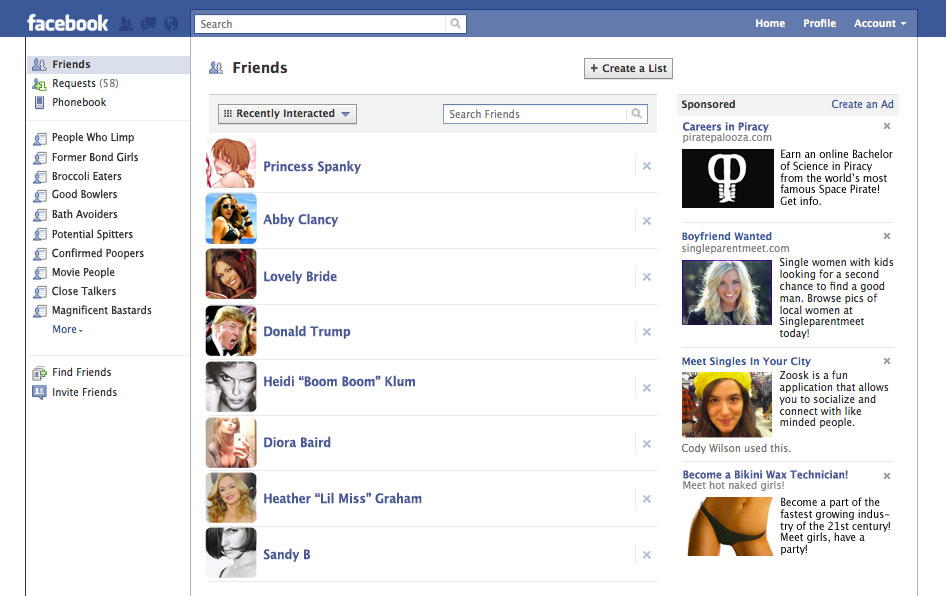
In an age where the friends you have are the friends you never really knew, how can we help one another?:

Donald Trump & Princess Spanky are my homies!

What can we do?
How do we help one another?
Speaking personally, I get depressed.
Like seriously. wretchedly depressed looking at my feed.
But, not even just my feed, posting to my professional page:
  • When viewership goes down.
  • When the number of clicks plummets
  • When the number of people I may or may not know anonymously click on an article I have written and don't leave a comment, they become a single tick mark on the social media machine that tells me nothing about the beautiful, wonderful, individual souls that pass through my digital hall for a brief span of this precious life.
What can I do?
What can they do? 
What can we do?

When Instagram is the dining experience as opposed to the DINING EXPERIENCE being the dining experience:


Visual media and sensory information is becoming the dominant.

I feel compelled to chronologue every excursion, every event, every single fucking thing.
And why?

Because how do I know if I lived a life?
How do I know if what I did mattered?
How many people care about me?
Do you?
Does anyone?
How do you know?

Twitter tells you.
Facebook tells you.
Instagram tells you.


Unless you are completely switched off, which is possible, possibly even preferable these days, there is an objective tick counter that tells you how many people like whatever you are posting.

There is a way to find and support almost anybody anywhere at anytime.

But, this is our digital world.
And it is a reflection of our real world.

My very best friend Bevin, says that there must be a spiritual side to the digital landscape.
And I, for one, support her in that idea.
The digital sphere is what we have made it.
It doesn't have to be.

Because there are any number of ways that the digital sphere has been supportive and wonderful.
Her spiritual jam sessions where Bevin asks thought-provoking questions are just one.
As a political platform, it is unquestionably valid.
The democracy of the internet is unquestioned.
Everyone has access to the same internet so long as they have a connection.
(there are socio-economic concerns there that are not the subject of this article, e.g. access to poor/disenfranchised areas being less prevalent than our 5G enabled megatropolis of the United States)

Point being: WHAT CAN WE DO TO HELP ONE ANOTHER.

For me?

Letter writing.
Studying the art of letter writing.
In an age where everything is public, where everything is vocal, and loud, and noisy in our digital space, we need a chance to be quiet.
A chance for kindness and dialogue and helping one another.

Why?
Because we perform. ALL THE TIME.
The feed is like the town square. It is a place where people shout to be heard, discuss prices, dinners, bargains, news, stories, experiences, in loud voices with other people possibly watching and listening too.
We need places and experiences to not do that.
Writing letters is one.

They are a physical, tangible way to show how much you care.
The require time and crafting to be made manifest.
But, they need not be purely physical.
Writing digital messages in a bottle and sending them off is wonderfully cathartic for me.
Apologies, love letters, congratulations, and calls for help to friends past, present, and future creates a digital landscape that I find spiritually and socially satisfying.
I wish that I could just have the Messenger without the Facebook feed sometimes.

Finding one's tribe in a digital landscape is what I think it is all about.
Exposing oneself to different ideas is the ideal, but creating/paving the way for thoughtful, powerful experiences digitally is how I know best to help one another.
SO I write letters.

  • I write thank you letters to people for helping me out of bad situations
  • I write apology letters to people that I have wronged or felt that I have
  • I write celebratory letters to people that seem in need of uplifting or joy
  • I write letters for me so that I know somebody does.
I don't send all of them.
Most haven't because they take time and they take craft.
But, they are there. 

I guess the biggest thing that I take away from it all is thoughtfulness.
In a sea of information, I don't feel like a drop in the sea, or a part of the ocean. 
No.
I feel like a drowning man in the middle of a tempest without so much as a plank.


Every day is a hard fight to breathe and post something that is meaningful.
Not just to me.
oh no.
But, to everyone.
And that is where the feeling comes from.

So maybe the better term is deliberate.
I aim to move towards a deliberate digital presence, a deliberate spiritual practice that can influence not only mine, but others as well.

This letter is one of the first to be made public.
It is to my dear friend, Bevin and to any and all who read it.
I hope you find it worthwhile.
I hope it helps and expands the conversation.

Too often, I find social media to be the last place where anybody wants to engage in political debates.
Mostly because the ability to offend through a purely textual medium is easy.
It doesn't allow for positive rhetoric or affirmations of the quality of the ideas.
Bevin manages to do it in her Facebook feed.
She can and should be thanked.
Thanks Bevin for all your hard work and bringing people together.
It really means the world.
It can be hard to engage because you never know if what you're saying has any meaning.
I hate ascribing meaning to Facebook's "like" button. 
So, for me, personally, I'd like to burn that bad boy.

But, that being said, it brings me to my final suggestion.
How we might best help one another:
Show the love.
I know everyone is doing it all of the time.
And that is part of the problem of social media: Too much lovers, not enough time to love.
I have too many friends to individually like and comment on everything they post.
Same is true for me.
Facebook cherry picks what I see.
Already we have some people who are not seen in feeds nearly as much.
Content that gets passed over. 
It can be very scary.
And very daunting.
The silent few who don't get noticed.
  1. Please notice them.
  2. Help them where you can.
  3. Message them.
  4. Write a couple letters to people that you remember after years of not talking.
And finally:
Think about the kind of digital life you would like to have. 
If you would like for it to happen, try doing it for someone else.
And ask.
Always ask for it to be returned. 
Maybe not right away, but soon.
You deserve it.
We all do deserve that much. 

Sincerly,
Your Friendly Neighborhood Artist.

Wednesday, July 13, 2016

How Earnest Hemingway Taught me to Live (And other tall tales)

Today, we discuss this guy:

(Ernest!)

Hemingway.
It's Hemingway.
How do you write like Hemingway?
And by that I mean it literally.
I don't have answers in this post.
This is me banging my head up against a wall.

See, Hemingway lived.
No questions asked.
My friend, who is a literal Spartan (every sense--yes, 300) idolizes this man.
And for good reason.
He fought in a world war as an ambulance medic.
Was at the storming of Normandy.
He chronologued the other as a journalist.
Was at the liberation of Paris.
Married and divorced four times.
Turned all the women into literature.
Wrote reams of material as a novelist, journalist, & short story writer.
Got injured in TWO SUCCESSIVE PLANE CRASHES IN THE AFRICA.
Got the Nobel Prize in Literature for his efforts.
As well as the Pulitzer.

This guy.
He is a legend.
And that is just the tip of the iceberg.
For a full reading of his biography, check out here.
For a close reading of his pseudo-biography, just read his books.

So how did he do it?
I have been trying to live like Hemingway.
Maybe not literally, but figuratively.
Consistently, the professional writers that I meet are lonely people.
Nanowrimo for writers is like Pokemon Go for depressives.
It just gets people out of the door to do what they love.

The problem with writing:

Is that it is enjoyable.
People who write or are creative genuinely enjoy it.
But, it is work.
But, most of the work is invisible or private.
Meaning, writers work

  • inside their heads, 
  • or in their notebooks
  • or in their computers
  • or on the Goggle machine
Nobody gets to see it until they publish.
AND once it is published:
  • most of the books/audience is outside the realm of their experience.
Some nameless, faceless person downloads it off Amazon and reads it off their digital reader. Sure, the writer's salary is inflated, but the direct connection is with the book and not with the author.
The author doesn't get to see the well worn pages.
The author doesn't get to see someone cry and cradle their book late at night (I'm looking at you JK)
The author doesn't get to meet each and every single person.
(though they may be friends/family/acquaintances at conferences, and that is lovely. Sometimes the audience base becomes an extended family and that I think is beautiful and right and good)

At least in the performing arts, we get to meet our audience directly and immediately.
Our finished product is done for an audience that is physically there.
They pay before walking in the door and are present.
We can go up to them after and greet them.
Sure, it can be lonely, but those parties and meet and greets and student talk backs are great.

But, for anyone who doesn't perform...well...no wonder writers work at Starbucks and coffee shops.
They want to feel connected.
It can be incredibly isolating.
So Nanowrimo gets them out the door. 

But, what then?
So now, writers are writing out of doors. 
What else do they do?
To be honest, many of the professional writers I have met so far, that is about it.
They write.
For many it is a livelihood that takes up 10-14 hours of their day.

That leaves little enough time for 
  1. exercise
  2. family
  3. cooking
  4. cleaning
  5. adventure
  6. life
Most travel, but it is to conferences where they promote and sell their books.
They meet other authors in the area.
They work and collaborate together. 
On writing.
All of this sounds fantastic, but what about life?
What about adventure?
What about Hemingway's wars and the dames and the adventures (hunting in Africa)?
They are conspicuously absent. 
And that is not to say everyone has to hunt down wild game in Africa to be happy or as great a writer as Hemingway.
But, I am finding adventure to be incredibly enlivening in my life.
Every day I try to go somewhere new, try a food or restaurant I've never been, see new sights, go on adventures.
It takes up an exhausting amount of my day.
And when I come home at the end of it, I go to bed early and wake up late (10pm-8am).
Why?
Because I'm tuckered out (as Mum would say).

So where/how do I do it all?
How can I have adventure and make art and live with friends/family and eat my cake?
The answer according to Hemingway is pretty bleak:
Writing, at its best, is a lonely life. Organizations for writers palliate the writer's loneliness but I doubt if they improve his writing. He grows in public stature as he sheds his loneliness and often his work deteriorates. For he does his work alone and if he is a good enough writer he must face eternity, or the lack of it, each day.
That was at his Nobel Prize acceptance speech.
Which, he couldn't attend.
He was still recovering from a plane crash (or two).
According to Hemingway, loneliness is the key to great art.
Staring into the abyss is what I call it.
Facing eternity is what Hemingway calls it.
"She does her work alone and good writers become worse ones as they shed their loneliness." (to paraphrase Hemingway...words I never thought I would say)
With all due respect to Hemingway, I think that that is bullshit.
There has got to be a way to balance the adventurous life with art and companions.
Even if you have to drag your comrades around the world while writing/dictating to a tape recorder (if those still exist) there has got to be a way.
I am committed to living by my own personal legend and that is my criteria for a successful life:

  1. Adventure
  2. Art/arting
  3. Company along the road
If you have any thoughts or suggestions on how to do that besides "just doing it" (I'm working on that part), please leave your thoughts and comments here.
I love and adore each and every one of you.
I hope you're happy.

Saturday, June 18, 2016

Best First Day & Hogtied by Children (What is Busking?)

Today, let us talk about busking:


What is busking?
According to Merriam Webster:
A person who entertains in a public space for "donations" [quotations added for ironical effect]
A bit too clinical, but it gets the point across.
I prefer this...

According to Dictionary.com:
  1. To make money by singing, dancing, acting, etc in public places in the hopes of "donations"
  2. To sell articles/obscene ballads, perform music, or improvise in a theatre queue in the hopes of "donations"
  3.  Buscare (Italian): to procure, get, gain; Buscar (Spanish): to look for, to seek
  4.  To "cruise as a pirate"
So we perform in the hopes of donations.
According to this definition, we possibly started in theatre queues while people were waiting for their tickets or for the house to open.
Performers would entertain and hope for patronage.
My personal favorite is to cruise as a pirate. This may be the origin of working on cruise lines, entertaining as a profession on ships.

The biggest things these definitions have in common:

  1. In Public 
  2.  Performance
  3. Hope
  4. "Donations"
But what is busking really?
I didn't really know until I performed.
Try it!

Public

So what do we mean by public?
Well...public.
It can be literally anywhere.


I have seen performers in almost any setting.
Now, for it to be legal, certain restrictions should be observed.
For example, one of my friends invited me to come with him to New York, spend a day with him on the subway, asking for donations while we perform scenes from contemporary plays for the waiting audience.
This sounded like a lot of fun...

(Excuse me! Ladies and Gentlemen! May I have your attention? Please!) 

Until I rode a subway and realized that that was inappropriate as fuck.
People on subways just want to get home. Or to work.
They are unphased by panhandlers and solicitors.
And what is more, it is illegal to do on public transit.


Now, that being said, you can do it in places of public transit and meeting, like this train station and net a tidy sum if you are particular about what you perform.

Performance

What type of performance should busking be?
If you believe the dictionaries, it almost always comes down to music.
But it could be...

Whatever this guy is doing. Zyle? Can you help me out?


Weight sharing


A quartet (with an mother-flipping accordion!)


Circus


Unicycling


Traditional dance


Point being. 
It can be anything.
Anything that you desire your street performance to be.
Busking is flexible enough to cover pretty much all of it.

Hope

I leave this one to people far better equipped than I.

"Donations"

I dislike this word.
Mostly because donations
The act of giving to a charity, especially a sum of money
It equates performance with charity
PERFORMANCE IS NOT CHARITY.
Therefore, why would you donate to one?
PERFORMANCE IS A JOB. IT IS A CAREER.
Plenty of people make wildly successful careers off their performance and their art.


Amanda Palmer survives on people giving to her on a monthly basis.
Check out her Patreon here.


Or Beyonce?
Quick price search of her tickets is wow!
$114-2700
at the time of this article.
Do you consider that a donation to the Beyonce charity?
Some people would argue hers is a religious experience, so the case could be made, but I do not consider it charity.
Beyonce has worked and hustled hard and found overwhelming success.
So no. Not charity.
And not donations.

Patronage

Patronage is 
support given by a patron
What is a patron?
someone who gives support to an institution, individual, or artist.
It doesn't have to be in arts.
The sciences have patrons all of the time.
They often thank them for their kind donations.
And that is fine.
Some people don't have the dislike of the word that I do.
But, I prefer patronage.
The financial support of persons who appreciate what artists do and wish to see them succeed at this crazy little thing called art.

That is the lifeblood of busking.
Patronage.
This is what lets people make careers out of it.
And it all starts with the hat.


Or guitar box.
Those also seem to be super common.


Point being, there is some way to receive patronage.
And the art is what is given back.
And often a thank you.
There is often something intangible about art. 
It is ephemeral, hard to pin down, difficult to figure out.

It is easiest when something tangible exchanges hands. 
A CD, a painting, a sculpture, a sketch.
When these pass to people, they are able to give immediately.
Oh, the CD is five quid? Sure, I'll take two, give one away as a gift.
It becomes a simple, monetary transaction.
I give you goods, you give me money.

But, busking and performance is harder because it is performative.
No goods exchange hands.
So it becomes a little bit scary when your busker looks like this:


See! There is the chalice! Go drop in the dollar bill so he can pay rent this month.
And there is no goods that can exchange hands at the end of the performance (like a CD)
Yeah...
So it becomes just a little bit thornier.

Point being, it is a scary prospect to stop and watch a busker perform.
It can be scarier to donate because it is such a new and wondrous thing.
  • This person is asking for money simply for performing?
  • She isn't donating to a good cause?
  • She isn't starving?
  • She isn't telling me about how her mom is in the hospital and if only she could get on the bus?
  • What is this remarkable event?
Performance.
We're poor as dirt, but we have dignity.


Well...some of us do.
Point being, I promised I would bring it up and I will.
There is this video.

Playing a Stradivarius. 
In DC Metro.

The Argument

  1. He is one of the preeminent musicians of our generation
  2. performing six Bach pieces over 45 minutes
  3. The equivalent of what people could expect to pay hundreds in a concert hall
  4. He performed for FREE 
  5. Only 7 people stopped to listen
  6. 2 donations of a dollar
THE UNCULTURED SWINE.

I refute this.
Amanda Palmer in her Art of Asking says look at the relationship differently, and from a busking scenario you have to.
Joshua Bell, with all due respect, has illustrated in one act, what I learned from a single performance of busking.
I imagine he learned it too.

What I learned from busking.

You have to earn your audience.

So I am from a classical acting background. 
Which is a bit of an institution. 
The audience, like cattle, are corraled into a seated posture, facing the stage. The lights are dimmed and they are forced to stare at the only illuminated part of the stage. The actors are presented. And we beg the audience not to use cell phones as it may distract from the art. It is a little...prepared. A little...full of rigor...rigor-ful? 
Looks like this:


Now, this is not every theatre, but for the sake of time, let us say that it is.
Classic performance models will almost always adhere to this rigid structure.

Now, busking is a public performance model.
So crowds can come at you from almost any angle.
This can be purely physical (it rarely is)


More likely it will include an emotional aspect (look how happy everyone is on their way to work)


It can even be openly hostile (GET A REAL JOB!)


These can be extreme examples.
But, if you are willing to take a little eyebrow raises, a few heckles, a few shouts you can really command an audience.
Either through silence (mime) or through presence (dance) or through good old fashioned soundscape (barker).
If you have a routine or something remarkable, something people are willing to watch or find genuinely joyful you can turn the tide of the physical/emotional landscape to one of wonder and/or compassion.


If you are telling a story, people may even route for you.


That sounds nice.
But, more commonly you will have to deal with this:


The backs of heads.
Because...

Your relationship is only temporary

As good as you may be, as good as the performance is, you are performing in a public place.
That means that people will come and see you perform.
They will enjoy it for however long they have time.
And then they leave.

This is one of the harder ones to deal with.
The rejection.
Except it isn't. 
Because people do not have time to stay does not mean that they don't have time for you.
And it does not mean that you have to pull them back in.
It isn't a commentary on your performance or your self-worth if people leave.
That is just the nature of the beast.

When you have an audience, keep the audience

Meaning, unless you have a remarkable act, in between the sets is where it gets dangerous for audience attendance. 
Particularly for my performance, which we will get to in just a moment.
See, people's time and money is valuable.
It should be treated as such and
I believe performers do honor that value.
However, when you are setting up, moving between acts, or otherwise crunched for time:
Audience attention wanes.
And it wanes fast. 
So after the dancers would end their fabulous performance and the sound system was getting broken down and I was setting up to go on, people would leave.
That big, healthy audience we had built would disperse. 
I didn't take it personally, but suddenly I realized I would be playing to this:


This scared me.
To no end. 
Because, I have only ever had audiences come see me.
I have never had to drudge up an audience.
New skill set!
This is where Joshua Bell and myself fall flat on our faces:
We have never had to create our own audience. Therefore, we have none of those skills in our artistic toolbox at the ready.

What I did on my first day busking

I did what anybody in my position would do.
I started barking.
I think I did a literal "Hear ye, hear ye" I kind of blacked out for a minute there.
I asked everyone to applaud for the wonderful dancers and then wait a moment while I steeled myself for a presentation of what I called
FIRST DAY.
Why did I call it that?
Because it was my first day.
And I was terrified.
I knew of only one other scenario that was like that.
School.

Doesn't matter what school you go to.
Doesn't matter what age.
First days are awkward.
They are about making friends and making them fast.
So you are willing to do anything to try anything.
So that is what I did. And I decided to perform it.

Give yourself permission to play

Really I needed that more than anything.
I needed time and space to play.
Essentially, permission to fuck up.
Which I did. A lot of.
I entered the playing space and there was a single child sitting in the front row.
I waved.
He waved.
He smiled.
I smiled.
I waved.
He waved.
He smiled.
I smiled.
We did this for a full minute.
Eventually I moved a box that was six sizes bigger than me, and invited him into the playing space.
Him and one or two other children.
They all hopped onto the box.
I had no idea my plan to make friends would go so well!

And then they turned to me.
They were confused.
Nobody had ever done this before.
I had them in the playing space.
But, we weren't friends yet.
Because we weren't playing.

I initiated some mime, but they weren't having it, they thought it was weird.
I asked what they wanted to do.

  • They said sit down.
  • Go back to their seats.
  • Grow up.
This broke my heart.
So I encouraged them to do it.
And as each one left, I gave out a scream like the mortally wounded.
My friends were leaving!
They were amused. Amused and terrified.
They decided to help me down off of my box.
I proved too afraid.
Then, the one most anxious to grow up, the most disillusioned with my performance told me I needed to get over my obsession with this box. 
He literally pried me off of it and stuck me to a wall.
So I was stuck to a wall as he was king of the box.

The others didn't dare to challenge his authority. 
He chased me away from the box when I tried to approach, screaming like a feral tiger as I cowered against the wall.
They tried pulling me away from the wall and after that, I was stuck to the wall.
The King rolled up his sleeves and shouted I shouldn't be so attached to things.

Eventually they tied me to a telephone pole. Literally with my tie.
And then I was rescued by a girl passing by, who brought me back to the box.
And the whole thing repeated over.

That is when I learned

If you can capture the imagination of the children, you've got an audience.

They were a wonderfully attentive audience.
Clever, insightful, ready to keep playing, keep performing.
They were a lot of fun.
It broke my heart to call an end to it all.
To say we had to move on to the next act.
I think they were a little crestfallen too.
There was no big climax.
Nothing to tell us we were done.
I felt like a huge letdown.
But, we had played.
We had had fun.
We were friends.

So that was my first day.
And my first piece. 
Called First Day.
It wasn't a raucous success.
But, it wasn't a failure either.

And the moment that stuck with me was after.
A girl came up to me and asked when I was performing next.
She said she had watched her brother have so much fun and wanted to see me perform again so she could get a turn.
I had a fan.

If you perform truthfully and well, you've got a recurring audience.

And that touched me more than words can say.

For the best book on busking, asking, and the art of, check out Amanda Palmer's
Available wherever they sell books and stuff.


Thursday, June 9, 2016

Are we Human (Or Are we Dancers? Can't we be both?)

Today, let us discuss dance.

Classically, I have associated dance with...well classical dance:


Or maybe this


But, on May 28, I was privileged enough to see Artlab J's gala event at the Detroit Institue of the Arts.


It was an amazing evening filled with dance and wonder and surprises.
One of the biggest was the education programs coming out to dance.
See, I have this bias.
I think dancers look like this:


Young, virile, people who are able to control every aspect of their body.
And that is definitely SOME dancers.

The educational program dealt with non-traditional or learning dancers.
So there were dancers that looked like this:


Kids. They were effectively children. But, they were dancing!
Dare I say dancers?

Perhaps the most moving piece of the night was the elderly women's education program.
Dancers that looked like this:


It was amazingly difficult to find an image for dancers of this age group.

Not surprising, but deeply frustrating.
For you see, that is what was so incredible about this age group in particular.
The women, aged 30-70+ were dancing!
Dancing together exploring themes like growing old, their bodies changing, embracing their ability to still move even as they wore down over the course of their lives and the performance.

I would say it was the most moving piece of the night.
And in that moment I realized one of our biggest problems with the art.
One of the most pervasive quotes I have run across with regards to acting:
"It takes twenty years to become an actor [/artist]"
-Stanislavki/Meisner/Everyone

I have been debating what exactly this means.
I'm still unsure.
But, I know it has created an expectation in me that actors are not young.
I know that.
And dancers mean ballet, which means they cannot be old.
SO art happens in this weird middle place in life where you are old enough to have skill and technique and young enough to still make the best art.

These women and this particular dance completely shattered that expectation.
Because what they were doing was undoubtedly art.
It may not have been the most physically deft dance.
It may not have been the most polished piece of the night.
But, it was profound all the same because it was difficult, because they were struggling with something, grappling with ideas bigger than themselves, and in territory that was absolutely relevant to their and our experience right then right there.
It was incredible.

And it sent me off down this reverie

Questions for Art (I mean that literally)

  • Are young children artists even though they don't know better?
  • Is art only a craft, meaning a created event?
  • How old/trained must you be in order to create that art?
  • If it is true and children are artists and we grow out of it, can we grow back into it?
  • When is art art?
  • How do we determine what/when is art?