Showing posts with label Happiness. Show all posts

Wednesday, August 31, 2016

Picking out a Spot in Heaven (What Really Happens when we Die)

Today we discuss what happens when we die (good morning by the way),

PHYSICS!

So there are a number of things that I hold very dearly with regards to this topic.
One is this online comic:


Happle Tea. 

  • God?
  • Hm?
  • Where do people go when they die?
  • The same place people go.
  • Heaven?
  • The ground.


It's sad, but it's true.
But, there is also something deeply beautiful about the idea.
There are no concerns like in the Greek mythology of different places where people end up, let alone the animals:

Civil planning was a nightmare
Instead, we all get the same treatment.
No cosmic judgment.
No good or bad or the other.
Just the ground.
With everyone else.

Hamlet actually says it best:

HAMLET
Dost thou think Alexander looked o' this fashion i'
the earth?
HORATIO
E'en so.
HAMLET
And smelt so? pah!
Puts down the skull
HORATIO
E'en so, my lord.
HAMLET
To what base uses we may return, Horatio! Why may
not imagination trace the noble dust of Alexander,
till he find it stopping a bung-hole?
HORATIO
'Twere to consider too curiously, to consider so.
HAMLET
No, faith, not a jot; but to follow him thither with
modesty enough, and likelihood to lead it: as
thus: Alexander died, Alexander was buried,
Alexander returneth into dust; the dust is earth; of
earth we make loam; and why of that loam, whereto he
was converted, might they not stop a beer-barrel?
Imperious Caesar, dead and turn'd to clay,
Might stop a hole to keep the wind away:
O, that that earth, which kept the world in awe,
Should patch a wall to expel the winter flaw!

Alexander, the world's greatest conqueror would one day act as a stopper for beer. 
We should all hope for so much.

METAPHYSICS!

To relate on a more metaphysical level:
Zhuangzi (one of the greatest Daoist thinkers) had this dream that most everyone is familiar with:


"Once upon a time, I, Chuang Chou, dreamt I was a butterfly, fluttering hither and thither, to all intents and purposes a butterfly. I was conscious only of my happiness as a butterfly, unaware that I was Chou. Soon I awaked, and there I was, veritably myself again. Now I do not know whether I was then a man dreaming I was a butterfly, or whether I am now a butterfly, dreaming I am a man. Between a man and a butterfly there is necessarily a distinction. The transition is called the transformation of material things." 

  •  A man has a dream that he was a butterfly
  • In the dream he was unaware of being anything but a butterfly
  • Awakes again as the man
  • Is no longer sure he is the butterfly dreaming or the man who dreamt
In no medium have I seen this more accurately portrayed than Roy in Rick & Morty.


Meet Roy.
Roy is a game.
A game that people play.
Where they wake up as a child from a horrid nightmare where they lived with otherworldly beings.
We are reassured by our mothers back to bed.
And we live a life.
And when we die it's GAME OVER. 
And then we wake up.

And that is Roy's life.
To us, to Roy it is complete and real and whole and valuable.
But, from a larger perspective, it is just a game.
That disturbs me more than anything.
What if the nightmares from our childhood were the reality we are trying to escape?
What if when we die, we wake up?
Are we really butterflies?
Are we monsters?
Something inbetween?

Wednesday, August 10, 2016

Those we Love? (Making Molehills out of Who Picks up the Check)

Today we discuss one of Bevin's spirit jam questions:

What is our responsibility to those we love?

I'll just insert this here and go back to it:

Initial response:

NONE.

My initial answer is nothing.
But, that sounds too harsh.
We have no responsibility to those that we love?
That doesn't sound right.

But, there must be a truth in the gut reaction, right?
So, taking it as a partial truth.
"We have no responsibility to those that we love."
Why?

Because we are our own persons.
We are responsible for making ourselves happy.
That is true of us all.
Therefore, we have no responsibility or obligation to those that we love because it is up to each of us to make us happy.

Okay.
What else?

Considered response:

SOME.

There is some responsibility to the ones we love.
But, what is it?
How do we determine what it is/might be in any given situation?
Partial truth:
"We have some responsibilities to those that we love. "
So what might that be?
I think it is an understood relationship.
Something that is crafted and that we can all agree with.
Meaning, those who engage in sex and expect to have a baby have a responsibility to each other.
They expect and, I think, are responsible to one another and to the child to take care of one another, to support one another.
Now, what shape/details does that entail?
I do not know, they could be anything that is agreed to or understood.
The point is that there is a relationship that is entered and agreed upon.
"We are going to be parents. Therefore, we must enter into a paternal/maternal//paternal/paternal//maternal/maternal//(whatever non-heteronormativity you can insert) responsibility.

Final thought:

FRIENDS

Watching the video, I think it is one of the best ideas for responsibility to those we love:
"Treat them how you would your best friend."
What a beautiful idea.
If everyone treated those they loved as if they were their best friends? What a world in which we would live.
The idea of EQUALITY: out the window!
The idea is one of FAIRNESS!
I want to contribute to this date/holiday, but only make a fifth of your earning potential.
It is a lavish, extravagant holiday.
I cannot pay for half the holiday.
Can I pay for a fifth?
Fair.
That is what I would expect of friends and of partners who work well together.
No one is obligated to pay for everything.
But, it is our responsibility to do our fair share.
Right?

Doing it the other way round.
I could feasibly pay for this entire holiday, but to have the other person not even so much as offer to help out?
Or have them offer to help and then deny them the ability to do it?
None of that seems fair or friendly.
It is important to allow people the opportunity to contribute where they can and to accept help whenever possible.

So that would be my best answer.
"Our responsibility to those that we love is the same as that to our best friends."
We enter into a relationship, a partnership, a teammate situation where we each contribute fairly to one another because that is what we have agreed upon, recognizing that it is to ourselves that we must turn to if we are unhappy with a situation, but we can always ask for help.

Here is a picture of foxes to illustrate the point:
Happy Little Fox Family

Tuesday, August 2, 2016

My Friend Bevin is a Digital Yogi! (How Can we Best Help Each Other?)

Today we discuss our digital self:


This is seriously one of my favorite things. Ever.
We are conscious of ourselves; social media is the market’s response to a generation that only wanted to perform. So the market said, “Here, perform EVERYTHING. To each other. All the time. For no reason.” And we do. It is audience and performer melded into one. It’s prison. It’s horrific. What do we want to do more at the end of the day than to sit down and watch our lives as a satisfied audience member.
Everyone is a performer in this day and age. Social media demands that we be. Demands that performers are no longer just performers in their work, but in everything they do:
  • where/how they eat, 
  • how they dress, 
  • what they wear, 
  • where they go, 
  • who/what they see, 
  • who/what sees them. 

Look at Lin Manuel Miranda and his legions of Twitter followers to feel inspired and uplifted, only to realize that you don't have that many friends.
To realize that nobody cares what you have to say outside of your social sphere.

My generation, and by that I mean I, was taught to think I was special, to think that my opinion mattered.
That I would one day be like Lin Manuel Miranda.
"I have a privileged life, and I got lucky, and I'm unhappy. "
 Truer words were never spoken by a white, cisgender male.
So what do we do?
You’ll notice the audience doesn’t answer.

In the tradition of Bevin Bell-Hall’s spirit jams on social media, let us ask questions and hope for response (because that is the truth, we never know if we will have a response/impact or not; every day is a leap of faith. I know, I asked Bevin):

In an age where more emphasis is placed on social media and the visual information, how can we best help each other? 


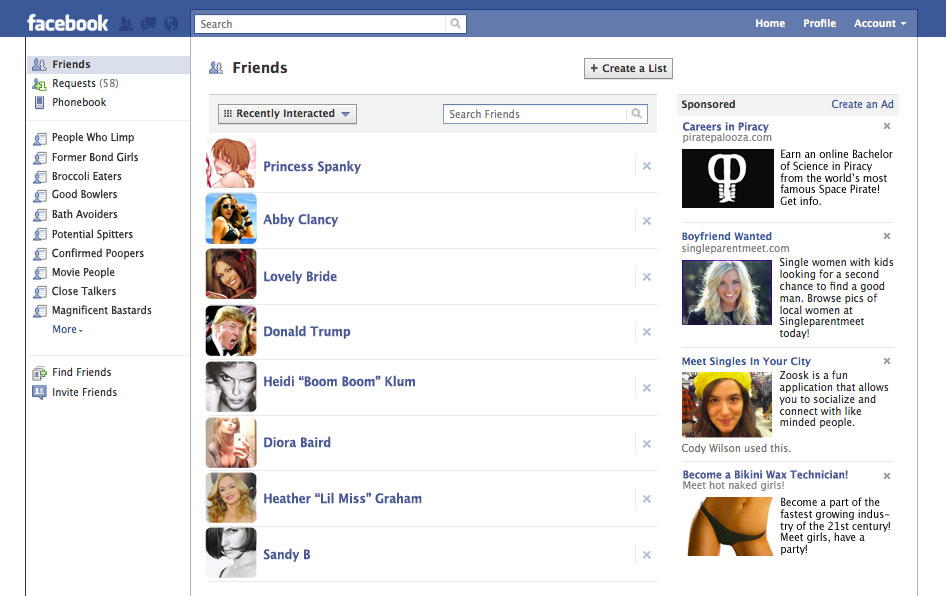
In an age where the friends you have are the friends you never really knew, how can we help one another?:

Donald Trump & Princess Spanky are my homies!

What can we do?
How do we help one another?
Speaking personally, I get depressed.
Like seriously. wretchedly depressed looking at my feed.
But, not even just my feed, posting to my professional page:
  • When viewership goes down.
  • When the number of clicks plummets
  • When the number of people I may or may not know anonymously click on an article I have written and don't leave a comment, they become a single tick mark on the social media machine that tells me nothing about the beautiful, wonderful, individual souls that pass through my digital hall for a brief span of this precious life.
What can I do?
What can they do? 
What can we do?

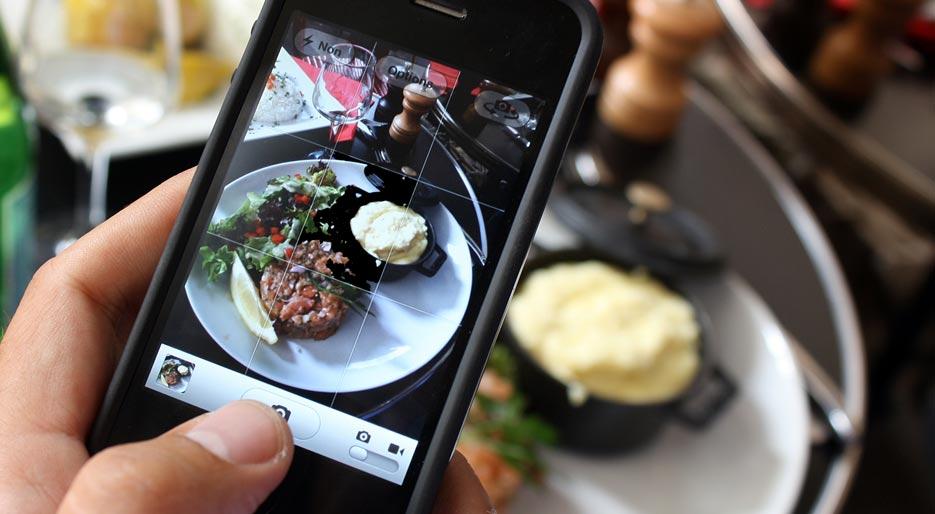
When Instagram is the dining experience as opposed to the DINING EXPERIENCE being the dining experience:


Visual media and sensory information is becoming the dominant.

I feel compelled to chronologue every excursion, every event, every single fucking thing.
And why?

Because how do I know if I lived a life?
How do I know if what I did mattered?
How many people care about me?
Do you?
Does anyone?
How do you know?

Twitter tells you.
Facebook tells you.
Instagram tells you.


Unless you are completely switched off, which is possible, possibly even preferable these days, there is an objective tick counter that tells you how many people like whatever you are posting.

There is a way to find and support almost anybody anywhere at anytime.

But, this is our digital world.
And it is a reflection of our real world.

My very best friend Bevin, says that there must be a spiritual side to the digital landscape.
And I, for one, support her in that idea.
The digital sphere is what we have made it.
It doesn't have to be.

Because there are any number of ways that the digital sphere has been supportive and wonderful.
Her spiritual jam sessions where Bevin asks thought-provoking questions are just one.
As a political platform, it is unquestionably valid.
The democracy of the internet is unquestioned.
Everyone has access to the same internet so long as they have a connection.
(there are socio-economic concerns there that are not the subject of this article, e.g. access to poor/disenfranchised areas being less prevalent than our 5G enabled megatropolis of the United States)

Point being: WHAT CAN WE DO TO HELP ONE ANOTHER.

For me?

Letter writing.
Studying the art of letter writing.
In an age where everything is public, where everything is vocal, and loud, and noisy in our digital space, we need a chance to be quiet.
A chance for kindness and dialogue and helping one another.

Why?
Because we perform. ALL THE TIME.
The feed is like the town square. It is a place where people shout to be heard, discuss prices, dinners, bargains, news, stories, experiences, in loud voices with other people possibly watching and listening too.
We need places and experiences to not do that.
Writing letters is one.

They are a physical, tangible way to show how much you care.
The require time and crafting to be made manifest.
But, they need not be purely physical.
Writing digital messages in a bottle and sending them off is wonderfully cathartic for me.
Apologies, love letters, congratulations, and calls for help to friends past, present, and future creates a digital landscape that I find spiritually and socially satisfying.
I wish that I could just have the Messenger without the Facebook feed sometimes.

Finding one's tribe in a digital landscape is what I think it is all about.
Exposing oneself to different ideas is the ideal, but creating/paving the way for thoughtful, powerful experiences digitally is how I know best to help one another.
SO I write letters.

  • I write thank you letters to people for helping me out of bad situations
  • I write apology letters to people that I have wronged or felt that I have
  • I write celebratory letters to people that seem in need of uplifting or joy
  • I write letters for me so that I know somebody does.
I don't send all of them.
Most haven't because they take time and they take craft.
But, they are there. 

I guess the biggest thing that I take away from it all is thoughtfulness.
In a sea of information, I don't feel like a drop in the sea, or a part of the ocean. 
No.
I feel like a drowning man in the middle of a tempest without so much as a plank.


Every day is a hard fight to breathe and post something that is meaningful.
Not just to me.
oh no.
But, to everyone.
And that is where the feeling comes from.

So maybe the better term is deliberate.
I aim to move towards a deliberate digital presence, a deliberate spiritual practice that can influence not only mine, but others as well.

This letter is one of the first to be made public.
It is to my dear friend, Bevin and to any and all who read it.
I hope you find it worthwhile.
I hope it helps and expands the conversation.

Too often, I find social media to be the last place where anybody wants to engage in political debates.
Mostly because the ability to offend through a purely textual medium is easy.
It doesn't allow for positive rhetoric or affirmations of the quality of the ideas.
Bevin manages to do it in her Facebook feed.
She can and should be thanked.
Thanks Bevin for all your hard work and bringing people together.
It really means the world.
It can be hard to engage because you never know if what you're saying has any meaning.
I hate ascribing meaning to Facebook's "like" button. 
So, for me, personally, I'd like to burn that bad boy.

But, that being said, it brings me to my final suggestion.
How we might best help one another:
Show the love.
I know everyone is doing it all of the time.
And that is part of the problem of social media: Too much lovers, not enough time to love.
I have too many friends to individually like and comment on everything they post.
Same is true for me.
Facebook cherry picks what I see.
Already we have some people who are not seen in feeds nearly as much.
Content that gets passed over. 
It can be very scary.
And very daunting.
The silent few who don't get noticed.
  1. Please notice them.
  2. Help them where you can.
  3. Message them.
  4. Write a couple letters to people that you remember after years of not talking.
And finally:
Think about the kind of digital life you would like to have. 
If you would like for it to happen, try doing it for someone else.
And ask.
Always ask for it to be returned. 
Maybe not right away, but soon.
You deserve it.
We all do deserve that much. 

Sincerly,
Your Friendly Neighborhood Artist.

Monday, May 30, 2016

What is the Work You Can't Not Do? (Finding what you love and doing it till you die)

Today, we discuss what the hell I've been up to for the last few weeks!
PATREON!
That is Patreon.
For a brief primer:

  • Patreon is a crowd-sourcing site for artists.
  • It doesn't matter what you make, all types are supported.
  • People provide single or ongoing donations for either campaigns or artists that they love and support.

I dig this.
I dig this so much, so hardcore that I made one.
MY PATREON!

I made a thing mum and dad!

So that is what I have been doing the last few weeks:
Preparing and getting ready for my launch and then making sure that I keep up with the deadlines I set for myself.

And it has been hard
How hard?
SO.
Why?

Well, it is a lot that I have set for myself.
And a big adjustment.
To go from producing maybe one maybe two things per month or year to producing constantly all of the time.

Why did I do this?
Because it makes me happy.
I have found that clear, definable goals and accomplishing them make me happy.
Clear progress to an achievable thing that is hard and impressive makes me happy.

The problem?
Deadlines.
I don't have any.

When you make art professionally or for an audience or yourself or whatever (subject of another post) you have no deadlines.
Not unless you have a publisher or a patron breathing down your neck.
Which isn't an antagonistic relationship by the way, it is just a relationship.
Think about how many editors/publishers/collaborators/readers are thanked in the credits/dedication page of every book/piece.
There has to be a reason!
It is because it can be a genuinely healthy relationship when handled well.

Big Problem:
I cannot make my own deadlines.
It is true, I set deadlines for myself and the art just does not happen.
I stare at my computer screen for hours watching sooo much Facebook scroll past.
And oop...it's New Year's...again...
So I produce.
I write this blog.
I do things to keep on keeping on.

But, it can be hard.
Because too often it can feel like shouting into the Void.
It can be demoralizing.
To shout and not even hear an echo.
When your number of viewers declines.
When your subscriptions fall.
When you aren't growing in a clear, linear, geometric progression.

BUT THAT IS LIFE!
So you keep going.
You keep growing.
You keep making.

But, art cannot happen in a vacuum.
Not for me.
And so I need that sense of deadlines.
Of having a relationship.
Accountability.

Amanda Palmer in her brilliant book: The Art of Asking
She states:
“When you’re an artist, nobody ever tells you or hits you with the magic wand of legitimacy. You have to hit your own head with your own handmade wand. And you feel stupid doing it.
There’s no “correct path” to becoming a real artist. You might think you’ll gain legitimacy by going to art school, getting published, getting signed to a record label. But it’s all bullshit, and it’s all in your head. You’re an artist when you say you are. And you’re a good artist when you make somebody else experience or feel something deep or unexpected.”
~Amanda Palmer, in The Art of Asking, pg. 43

I am an artist when I say I am.
Brilliant!
But, when do I say I am?
When I feel like one.
When do I feel most like an artist?

For me, most of the time, it has to do with audience.
Specifically deadlines.
Someone very special once said:
"The fear of an opening night just lights a fire under the actors' collective ass." 
 She was referring to their fear of an audience.
Their fear of accountability.
Of being found out.
Of being under scrutiny from the Fraud Police (another Amanda Palmer term) and being found wanting.
Of not being artists.
Of not being actors.

So what do they do?
They make some art.
And they make it up quick.

I miss that sense of art.
Of being a part of a larger collective, an institution with deadlines and things.
It is very important to my artistry to know how and when to produce things.
And to make them well.

So what is the secret to doing that for oneself?
As the eminent Sanjay from Slings & Arrows says:
"It's all...a trick!"

It's like a spell.
You say the words or set up circumstances and then it becomes real.
So I need deadlines, but not from me?
Who sets them up if not for me?

The paradox was killing me artistically.
And then it clicked.
All deadlines are arbitrary.
I decide how and when to do everything in my life.
Nobody told me to go to college (well, yes they id, but I agreed to go)
Nobody told me to go to grad school.
Nobody told me to start theatre companies.
How did I do it.
By saying screw it and telling other people to tell me what to do.

SO:
Finally I said screw it, I'll set up something I can't shirk.
Something I don't want to shirk.
Something public and awesome.
So I did Patreon.
It is still waaaay too new to know if it is working for real.
This may all just be beginner's luck.
But, it feels wonderful to commit to something.
To throw myself into it wholeheartedly.

Bamboo farmers work for three years on the shoots before there is any sign of growth.
One day it shoots up twenty feet.
They had no idea while they were working all those years, but one day it just pays off.
But, that doesn't happen if you abandon the field.
Or don't till the earth.

So this is me tilling.
Here is a wonderful TED talk titled Find the Work you Love:


He set himself up for success by surrounding himself by people who were committed to the same work that he loved.
He woke up every day and committed himself over and over to it.
And one day...it shot up like bamboo.
And he found himself in the world where he always wanted to be.

So...that is what I have been doing the last few weeks.

Friday, May 20, 2016

Manifest Coolness From Nerd to Shining Dweeb (Wouldn't it be Cool If...)

Today, let us discuss coolness.

Let me start by saying I have never been cool.
I have never thought of myself as cool or have any idea how to be cool.
The mere fact I use the word cool should highlight my credentials.

But, I have been studying cool people for years.
And I have come down to a couple of criteria for identifying cool people

  • They always seem to be happy
  • They always seem to do what they want
  • They always seem to somehow succeed at those things
Those basic criteria are generally what I consider to be cool/coolness.

So how do we go about becoming cool?
Well, it is tricky. 
My new belief is we are all innately cool.
But, are we the coolest?
Are we as cool as we want to be?

My contention is an emphatic YES

WE ARE AS COOL AS WE WANT TO BE.
So what does that mean?
WE ARE IN CONTROL OF HOW COOL OUR LIVES CAN BE.
I usually distill this down to a simple adage that I repeat often:
"We get the life we craft."

SO what are we crafting?
I look around and I see bills piling up, a seasonal job, not enough time in the day, and too much Netflix binges.
That isn't terribly cool.
Not like the cool kids that I know/see who go skydiving or travel the world.
That makes me frustrated.
Why do they get to do it and not me?
What makes them so freaking cool?

And therein lies the truth of it.
They aren't cooler than me.
They aren't more special than me.
They are just doing it.

Looking at the list again:

  • They always seem to be happy
  • They always seem to do what they want
  • They always seem to somehow succeed at those things

So why are they happy?
Well they do what they want.
They always seem to succeed (for expansion on why this may be so, check out How to Write a Better Life)

Now, I am not suggesting that these cool people aren't living lives filled with tragedy and suffering just like the rest of us
(My main contention is that they are the rest of us)
But the point is that when you are living a legend, when you are living not just a cool life, but the coolest life, you get to wake up every day.
You don't drag yourself to a 9 to 5, you run to it.
And why?
Because your life becomes a training montage!
You're excited and free to go and do whatever you want.

Why the word "COOL"?
Because it works for me.
It sings to me.
I have no idea why or how, but it does.
So I run with it.

When I wake up and I think, "Wouldn't it be cool if..." I take that as a big flipping sign and run with it.
So after years I am finally:

  • Writing story (novels/shorts)
  • Writing poetry
  • Taking film photographs
  • Taking dance classes
  • Running workshops
  • Travelling the world
  • Teaching
  • Cooking
All of the things that I thought, "Wouldn't it be cool if" but never thought at which I would be good.
That stops now. 
I want to be the coolest me.
And that's pretty cool.

Monday, January 11, 2016

The Secret to Happiness (It was the TED talk's Title not Mine)

Today, let us talk about Robert Waldinger.
This guy:


Why is he important?
If you watched the Ted talk you already know he is the fourth director of an ongoing study that studies 742 individual men over the course of 75 years.
This is the longest study of its kind.
What is the nature of the study?
Happiness.

What makes people happy?

They discovered:

  • relationships
  • the quality of those relationships
"The good life is built with good relationships"
That is the conclusions of their research so far (IT IS STILL ONGOING!)
That overall, the subjects of their study, which, let us be frank, are pretty biased (Harvard men), report that the better their personal relationships, the better quality of life they experience.

Relationships are the single most important determining factor in a healthy and productive life.

When asking millenials what they value, 80% reported financial success, getting rich.
50% reported getting famous.

So what the scientists have discovered is that healthy relationships are the most important factor for determining happiness.
And based on their control group (disenfranchised Boston youth of the 1930s), your outward circumstances/opportunities are not the most important factor.
Having and maintaining those relationships is the most important thing.

Why do I care about this topic?
Mostly because it reinforces my position:
Community in theatre/art is the most important thing to help it grow and develop.

But, it is also really close to home.
And I mean that almost literally.
I recently moved out to a new city across the country from friends, family, and the whole community I love and depend on for sanity.
I have made big moves before with varying degrees of success.

However, one night, I was lying awake wondering about my anxiety when I realized that I have always lived with people
Friends, family, loved ones.

  • family home
  • college dormitories
  • 10 Altin (apartment house with three artists)
  • Trumbull House (apartment house with three artists)
  • Hancock St (apartment across from university, student neighbors)
  • 5th Ave S (apartment with partner)
One of these things is not like the others.
Suddenly, I was across the country, isolated, with only a single person or two to rely on for society.
I will not lie, I was miserable.

I could barely get out of bed (still have trouble, but at least I do)
I didn't eat.
I didn't exercise.
I produced nothing for weeks.
I pretended to be a struggling artist.
Instead I was just struggling to find or do anything.
I applied everywhere except the art community.
Auditions came and went. 
I waited for the spring.

I was unhappy.
In the worst possible sense.
I was angry and embittered towards everyone and completely inconsolable.

And then, I remembered why I moved out to Seattle.
The community.
A place for friends to fall back and find a place to recoup after the hardships inherent in our artistic life.
I was living that hardship.
I needed that place.
I needed to either make it or find it.

So I started messaging people.
I have gotten very adept at the Facebook Messenger app.
Creating groups of friends, now labelled "10 Altin" and "Trumbull House" helps me feel connected to those places.
Those spaces.
It tells me that those mythic places aren't gone, the people are now separated, but they still exist because it is our relationship to one another that created those spaces.
Digital mediums are able to replicate the feelings.
Though it does not replace them.

So I work actively to reconnecct with the people and places where my artistry flourished.
That was a very important first step.
But, the actual, physical living arrangement was also important.
So I started talking with local artists.
Seattle has some of the best art walks I have ever seen.
We went to one with our friend Mark and found out about Georgetown, a local artist area.
Went to Georgetown and met Tenaya.


Who no world of a lie lives in an artist space.
Now, I had started looking into them that week.
An artist space tends to be a community area, similar to a dormitory.
You live with other artists, in an apartment building in subsidized housing, with large community areas to display/showcase your work.

There are several in the Seattle area and one opening up in Detroit.
We are applying to the ones in Seattle and are moving to the one in Detroit.
Young Fenix House.
I am very excited and if everything goes through, we will be among artists contributing to theatre for social change in the heart of Detroit producing year round.
Because when I was a young lad and my teachers asked me what I wanted out of this life, I just wanted to produce art.
Live comfortably and make things.
That was really the beginning and end of my ambitions.
I want recognition for my artistry.
I was recognized for it in undergrad by being cast.
I was recognized for it by being invited to attend graduate school.
And now I am being recognized for it by being invited into one of the art spaces that I have always dreamed of being a part of.

I could not be more excited.
The road is hard.
It does not get easy.
Your life is a story, if it is easy you are in stasis and that means the boom is coming.
So enjoy a little mayhem, a little chaos.
And work towards your dreams.
You may not get them right away or in the way you expected.
But, if you keep an open mind and a strong community, you will be happy to weather the storm and find exciting adventures on the other side.