Showing posts with label Design. Show all posts

Tuesday, July 5, 2016

Postmodern Magic for a Skeptical Atheist (How Grant Morrison taught me Design)

Today let us discuss "magic".
Or rather this:

Meet Grant Morrison.
He is a wizard.
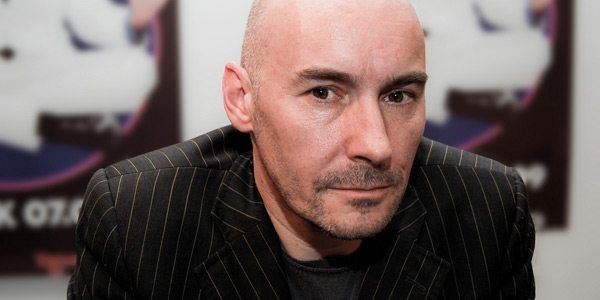
(Self-proclaimed).

In this talk about counter culture and sigil magic, Grant Morrison discusses how to become a practicing magician.
What does that mean?

The Abduction

Grant Morrison was abducted by aliens at Kathmandu.
And why?
Because Grant Morrison went to Kathmandu to be abducted by aliens.
He describes them as
Formless, morphing, blobs of shifting chrome that think.
And in this encounter (after taking him to Alpha Centauri) they describe to him how the universe works. And they say:
Tell the world what is going on.
So that is what Grant Morrison does.

What the aliens said.

The "same bullshit":

  • The universe we live in is set to grow "larvae" (hint, we are the larvae)
  • Beyond space and time are our actual selves (a higher dimensional existence)
  • Each of us is a section through time
  • Our body is a process: from when we were born to when we die
  • We look like a giant centipede (starting at birth and moving through time until we die)

The Hand

If you pass your hand through a layer of water and call it time, you see four distinct circles that are part of a larger whole. That is what we are: discrete intersection through time that are part of a larger process. 

 How Is This Magic?

Well, the aliens apparently exist in a sea of pure information outside of spacetime and create their own reality.
They are able to influence it.
How?
According to Grant Morrison with words.

How to Magic:

  1. Write down a desire (making sure it is physically possible inside of our material universe)
  2. Take out the vowels
  3. Take out the repeated consonants
  4. Reduce it down to an image

That is it. 
Why/how does it work?

To go into how it works, we need to appreciate a little history of magic and how it became the occult.

This talk is not only about the occult &sigil magic.
Grant Morrison is also discussing counter culture.

Counter culture has been around since the French Revolution when the youth culture would wear costumes to mock the outfits of the wealthy.


What we have here is an original case of hipsters.
This idea of counter culture proved important during the French Revolution
This garment is called the sans culottes:


Literally: without breeches.
Because the peasant class could not afford to wear breeches, which were not a working class uniform.
The Sans-Culottes were also a political movement, a radical militarization of the peasantry that overthrew the French aristocracy leading to the beheading of the royal family.
Fabric, due to its design, leading to political action, leading to war.


So now we have this idea of counter culture and its importance/influence. 
What about magic?
Magic used to be pretty common place.
In Egypt:

In Greece:


In Rome:


So what happened?
According to Grant Morrison it had something to do with the Industrial Era.
This caught my attention.
He explains a little bit in detail, but think about that. 

Think of how to create a sigil:
reducing a desire down to just a few lines to create a symbol to convey meaning to change the world (meaning the minds of those who view it.)
Keeping that in mind we get: 

 McDonald's
 Nike
adidas.

The modern, contemporary, culture is wholly consumed with images, with sigils, with symbols that convey meaning and change or influence the culture accordingly.
And in that moment I started rethinking what we mean when we say magic.

The Legend of McDonald's

Have you ever heard the trivia about the McDonald's logo?
It was chosen to be harmless, caring, inviting, and nourishing. 
Keep that in mind as we go.

Now, if you follow any logo, it simplifies through time, similar to the rules for sigil magic until we get: 

This: 


And this is the part that freaks me out.
The "M" is meant to symbolize a mother's breasts.
And I didn't get it for years until I realized that I was looking up at them.
So from my perspective as audience, I am looking up at a pair of breasts, something that I haven't done since I was a child.
Therefore, when I look at the logo, unconscious association is meant to pair with that experience to convey: harmless, caring, inviting, and nourishing.
Just like a mother's breasts.

Grant Morrison contends it works because we exist in a sea of information that exists outside of spacetime that we can only experience through mind-altering drugs.
I don't know about all of that.

But!
There seems to be something there when you realize that all of our corporate overlords follow these rules.
Arguably, they are just good rules for design:


This is a wonderful TED talk about design.

So the laws of design are similar/the same as practicing magic.
Why?
Because of a revolutionary idea.
Design is a form of magic.
And all that magic is is a form of design.

Friday, March 25, 2016

Easter (The Play not the Pagan Holiday)

Slipstream Theatre Initiative closes out the holiday season with the appropriately titled play Easter adapted by the company from August Strindberg's original.

The play opens with...let me start again.

The Summary

The play is, as advertised on Slipstream's website:
A family unit is publicly ruined and awaits the "Giant"
The "Giant" being a direct allusion to one of the characters and possibly metaphorical to the guilt/sin that wracks the entire family.  It opens on a family in the middle of a scandal, with Elis's (Ryan Ernst) father imprisoned for siphoning funds from his investors. Elis and his fiancee Kristine (Luna Alexander) are trying to survive the upheaval of this small town when they are visited by Elis's faithful student Benjamin (Miles Bond). Benjamin befriends their insane sister, Eleonora (Lauren Alo). Through their budding romance, it is revealed that Eleonora has inadvertently stolen a flower from the florist, which induces another scandal on top of the one already bubbling. Sin stacks on top of sin and more goes wrong before it is ultimately set right in a late, third act, deus ex machina ending.

The Adaptation

August Strindberg was a Swedish playwright at the turn of the century.  Celebrated as perhaps their greatest author, Strindberg wrote prolifically over 60 plays and 30 books.  His most famous international work is perhaps Miss Julie, done at the height of his career, it was among the most influential works of the naturalist movement.  Naturalism was developed by writers such as August Strindberg and Henrik Ibsen (Norwegian playwright) and is believed to have been perfected in the play Miss Julie as a single event happening in nearly real time with almost no cuts in time or place or characters. The most effective image to describe it would be: imagine a domestic drama happening within a house and then take away one of the walls (hence the expression: fourth wall).

Easter is an earlier work than Miss Julie, but just as influential. It was polemical even in its day. The line: Judge not, lest ye be judged springs to mind upon viewing of Easter and among the most common lines in the play is:
"As you sow, so shall you reap."
That idea is pervasive in Strindberg's work and is most clearly displayed in his play Easter.

This adaptation has few anachronisms that spring to mind outside of the formal dialogue that the characters use. I mention it only because one of the characters, Benjamin (played by Miles Bond), also remarks on the peculiar nature of the speech patterns.  However, Benjamin is free from such verbal restrictions and brings a wonderfully vibrant, contemporary sound to the dialogue that refreshes the audience whenever it would to be too much.

The Lobby

As with all of Slipstream's productions, the show starts as soon as you walk in the door. Their use of space has consistently been dynamic, often using multiple spaces or the lobby as a part of the theatrical experience, setting the tone of the play with improvisation or performance-based house speeches. This time there was no such thing. It was surprisingly muted with chairs lining the lobby and a single book lying open where audience was encouraged to sign it like a guest registry at a church or funeral home.

The Design

Once inside the playing space, we were greeted by the lovely artwork of Joshua Daniel Palmer who painted the backdrops that lined the windows that were backlit to give the impression of stained glass to great effect. The back wall of the space is painted concrete; the mismatching colors work surprisingly well, the crude design choice creates a provincial atmosphere that verisimilitude could not. The audience is split down the middle by the stage, which appears to be in the shape of a giant cross. The effect is startling. The overwhelming religious iconography in the space definitely gave the impression of an almost religious event (and all the guilt that that implies).

The Actors

Elis played by Ryan Ernst is a remarkably charming little bastard, complaining about every one else's foibles and ignorant of his own with just a hint of pinache. His wife Kristine played by Luna Alexander plays this performance remarkably close to the chest, but says more in a sigh or the taking off of a jacket than most of the expository lines in the play.  Mrs. Heyst played by the incomparable Jan Cartwright is delightfully overbearing in her role; attacking her family and friends with shocking vitriol and wit (and we love her for it). Eleonora played by Lauren Alo is disturbing as fuck; one part savior, one part madwoman, and three parts messiah; the moment she hit the stage I was no longer sure what play I was in.  Benjamin played by Miles Bond performs a sincere and lovestruck school boy to great acclaim, delivering a healthy dose of contemporary colloquialisms to an adaptation that can feel otherwise clunky in its dialogue. Lindkvist played by the dynamo David Schoen as the "Giant come down from the Mountain" is frightening and somehow heart-warming all at once.

The Staging/Direction

I do not wish to belabor this too much, but the most glaring problem with the play was easily the staging.  The stage in the shape of a giant cross proved to be both boon and bane. Boon in that it was a remarkably constructed icon of religious symbolism. Bane in that the actors had all of three directions to go: left, right, or forward. At no point was this more apparent than in Act III with the introduction of Lindkvist (David Schoen) walks back and forth between Elis and his seat on the couch against the back wall. This happened by my count no less than six times and I started counting after the fact. It was miserable to watch as there was no variety whatever. It limited the number of playing spaces to on the stage and a small room behind the audience's seating (for the young lovers in one scene). 

Conclusion

I will say this, I am unsure about the play's relevance in contemporary theatre. It isn't the epitome of Strindberg's naturalism, nor indicative of his later work, which led to surrealist works like Dream Play, which influenced later writers like Eugene O'Neill and Sean O'Casey.  It doesn't have the sort of themes that resonate deeply in today's zeitgeist the way Ibsen's A Doll's House still does. It is a middling play in the middle of Strindberg's career. When leaving, I heard a number of people remark on how "nice" the play was and "pleasant", which is unusual for a polemical work. Normally they tend towards a call to arms. But, maybe that is the point. Maybe, unlike Ibsen's Doll's House, Ghosts, or An Enemy of the People, Strindberg's Easter is more about the community rallying together in times of upheaval. Maybe society isn't something to be overthrown, but lived with and nurtured. Kind of like the insane girl they kept locked away for years in her room and let her out once an appropriately aged boy discovered her by accident. You know...charming.

 For tickets click here!

Monday, January 25, 2016

An Actor Walks Out Onstage (Slips and Dies)

Today let us discuss the stage.
Here are a couple of (what I find amusing) anecdotes of set and performers and the trouble they get into when put in the same room.


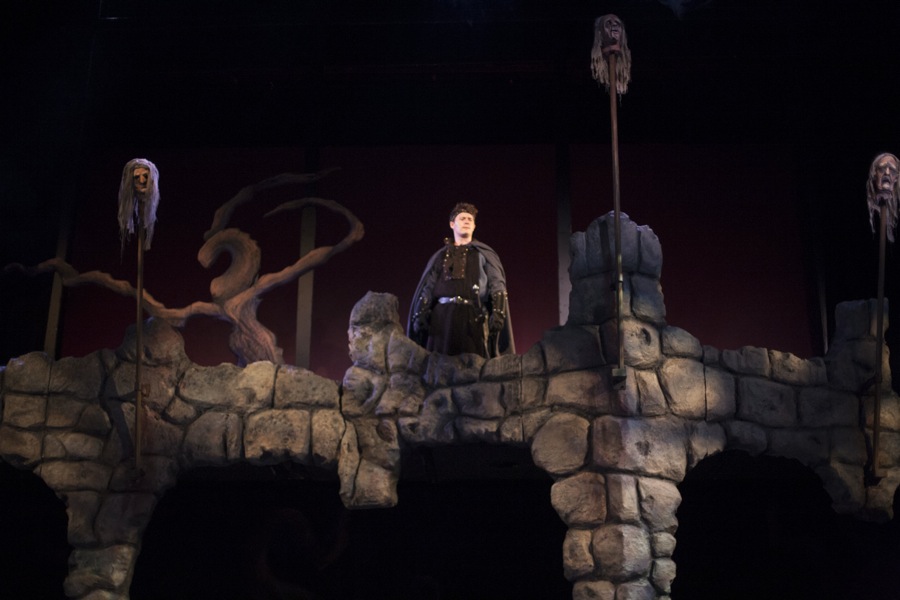
Macbeth (or the set that tried to get me)

People often speak of the "cursed" Scottish Play (so much so they dare not call it by its given name)
In all likelihood, Macbeth was performed in rep after a particular tragedy (death/sickness in the cast), because it is such a short play requiring very few actors (half the cast is ill? Put on Macbeth!)
So Macbeth probably gained a sinister reputation due to the face that people fell ill before it was performed.

That being said, Macbeth tried to kill me.
And by that I mean the set.
The set was...interesting...

(DON'T JUMP!)
Yes, that is a picture of the set.
For those who didn't see it there was an upper platform and a relatively bare stage on the ground.
The upper platform was connected by stairs of shall we say varying height?


No that is not a picture from our set.
And that isn't what is looked like.


This actually gives a better idea of how the stairs felt.
There were no railings.
They were winding and occasionally very steep.
Running up and down was actually a dangerous activity.
As Macbeth I had to do it.

I will say it was very terrifying during tech/dress rehearsal.
Because it was the first time working on this set, but also in costume with floor length robes, fur, and ribbons trailing.
I thought I was going to die.

But, by repeating my blocking over and over, I was able to become comfortable and engage with the set as if it were my own (poorly constructed) house.

Oh, there was also a metal grate in the middle of the wooden floor.
I bring it up because I had to lift it without gloves.
The grating bit right into my fingers, slicing them like grapes.
I still have the emotional scars.
When I brought this up, I was told the problem was taken care of.
It hurt a lot for already being fixed.

Gross Indecency and the Tables of Doom

So take a look at the set.
Now back at me.
Now, back at the set.
Now, back at me (I'm in the back).

That stage is raked towards the audience.
We are standing on a 30 degree (?) incline.
So all of us are on our heels the whole time.

I saw Alec (the gentleman advancing) slip a number of times as he made that cross simply because it is a weird frigging angle to walk on.
Bevin (judge in the very back) stood like that for almost two hours...in heels.

Those tables are set at angles to one another.
One upstage.
One downstage.
During intermission they are switched.

One night that didn't happen.
To begin the play I have a fast cross upstage.
But, as I crossed upstage, I bumped my hip into a table edge.
It hurt.
A lot.
I wondered about it while I stood in the background for fives minutes.
And then, I realized, everything was backwards.
THE TABLES WERE ALREADY SWITCHED!

All the blocking had to be turned around!
It was an exciting fives minutes.
Because at the end of those five minutes, the actors moved the tables back.
During the show.
So what it must have looked like was the defendant (Oscar Wilde) and his attorney decided to move their god damn table.
Because reasons.
Funniest thing that happened during that show.

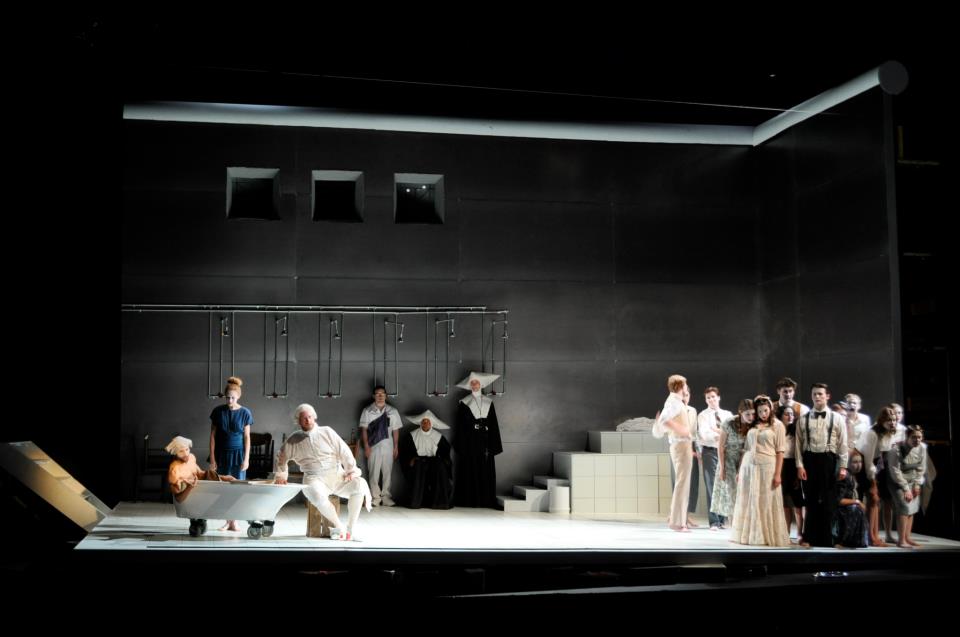
Marat/Sade and the Heels I Dreaded.

Welcome to Marat/Sade.
This set was raked 15 degrees to the side.
So now we have a stage trying to kick us off.
I am in the back.
The one in the nun outfit.
I was in heels and a floor length robe (dress).

Where in Gross Indecency, I relied on my leaning back to counter the rake of the stage:
I was in heels.
All my weight wanted to travel forward.
I felt like I was going to fall off every single night.
The patients were barefoot.
I thought I would stomp them to death.
So I decided to be very gentle with them.

The tub had wheels and could be maneuvered around the stage.
Which was terrifying, but I want to be very fair.
Those locks were monstrous.
When the actor was locked in place he was going NOWHERE.
Now, that being said, he had to be locked in.
Some nights that step was missed.
He only rolled a little before engaging it himself.

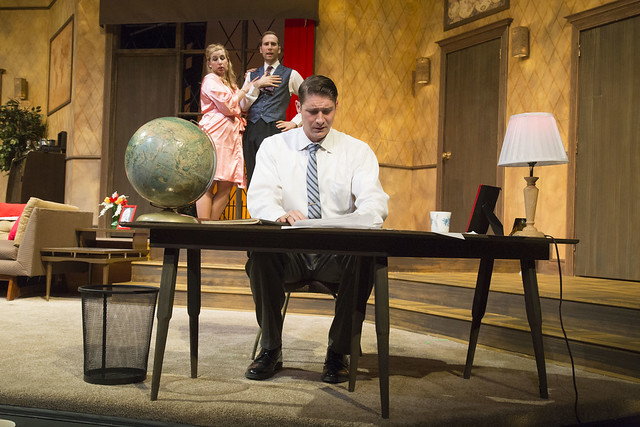
Boeing Boeing takes Flight


This was a beautiful set to play on.
Boeing is a door farce.
It requires precise timing with distance and door choreography (dooreography)
When we got onstage for the first time in tech, it took a couple of runs to get the groove.
Then, props were added and costumes.

It was a nightmare.
For me.
I played the butler.
See me? In the back?
I had to shift everything.
Sometimes mid show.
I transformed that whole space regularly.
Every show.
All alone.
I was a beast.

But, it took some doing.
I was tired by the end of it.
But, it was one of the most rewarding experiences because the set was difficult to manage.
Not because it was poorly designed, but there was so much available to do.
It was a bar and an office and a kitchen and...a home.

What surprised me most was how much it changed from tech to opening.
The littlest touch like the lamp shades and the map on the wall and the flowers on the table transformed a sparse design to a fully realized home.
The set became a character in the farce and played with us.
Sometimes it went perfectly smoothly and sometimes it was very naughty.
(One night one of those doors refused to close and I had to slam it...for comedic effect).

I will say this though.
I played the butler.
The script called for six doors:

  1. The entrance
  2. The guest room
  3. The master bedroom
  4. The bathroom
  5. The kitchen
  6. A non-specific location
The non-specific location was changed to be an outdoor terrace.
Which was beautiful
But, when I said I was retiring for the night and going to bed and packing my things, I realized: 
IT WAS MY BEDROOM!
The designer and director had designed away my bedroom.
I brought it up and I never got a satisfactory answer.
Eventually it was agreed that I would sleep in the kitchen.

Finally, we end with my favorite set/theatre space:


Empty Theatres

To this day there is nothing I find more calming than an empty theatre.
No set.
No audience.
No director.
No actors.
Just me.
And the stage.

It is a meditative practice that I find deeply calming.
I think about all of the sets and performances and performers that have crossed the boards.
Ghosts in the wings I have heard said before.

Theatre is an ephemeral creation.
Unlike other artistic mediums (save other performance art) we make something that doesn't last anywhere save in memory.
I like to remember as much as I can while in a theatre and imagine other shows.
This is my favorite place and time.
I don't know how many share this pastime of mine (standing in empty theatres), but if you haven't as a performer, try it sometime.
It is deeply moving.


I am not sure if you can conclude anything from my anecdotal situations.
But, a lot goes into performance.
Set is crucial because it is the hard limit.
You cannot play over there if there is a wall in the way.
Set tends to be the hard boundary and I am grateful for it.
But, it is important to treat it as part of the performance and finding ways to integrate it can be tricky for performers as well as designers.

Sunday, January 10, 2016

Musings In 30 Americans (But, not really involving them at all)

Today, let us talk about 30 Americans.
I was in Detroit around the new year and managed to catch the exhibition of 30 Americans at the Detroit Institute of Arts.
Now, this was a beautiful gallery filled with haunting imagery by a buttload of really talented artists.
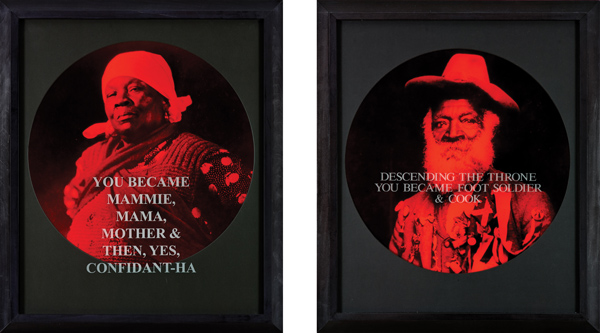
Things like this waited around the corner:

Yeah...
There wasn't much talking.
In fact, I want people to appreciate some of my favorite pieces just on their own merit.


Deeply wonderful and beautiful works of art.
Social change.
Lots of buzzwords.

Now, while wandering the gallery, I noticed something peculiar.
All of the patrons in any given room seemed to be Caucasian.
All of the security guards were black.
It was that quick.
I turned around and realized everyone looking at the art was white.
Everyone facing away from the art was black.

It was that fast and that jarring to me.
Because I am sure it isn't wholly true.
Not everyone who visited the museum and 30 Americans were white, but it seemed like a microcosm for just a split second and threw up a couple of questions.
Who was the art for?
Normally, I hate the discussion of demographics.
It sets my teeth on edge.
But, smarter artists than me market their art for a particular audience and find success with it over and over again.
Young Adult fiction writers do well not to write gritty murder erotica to "experiment with the form"
SO who was this art for?

Then, I started wondering if art serves a purpose.
Does it promote something? And if so, then what?
Are we meant to learn? If so, what is the lesson?
And who is learning something?
What are they learning?
Because these images are directly from the heart of a dialogue that is raging in this country.
What is the message?
What is art for?

And then, the spell was broken.
A middle aged, black woman complained of a lost ring.
She said it was precious to her, very valuable, belonged to her grandmother, part of a set, and lost in these rooms.
Suddenly everyone was looking.
And I mean everyone.
Kids were on the floor, men were asking her where to search, women were comforting her.
Suddenly, the whole relationship of the building was inverted.

The art was now just obstacles to be moved around.
No one faced the art for a full five minutes.
The ground was more fascinating.
Under our shoes was more interesting.
It was one of the strangest moments of my life because the museum was no longer quiet and reverent, but filled with bubbling voices and rapid movement.
I have finally seen a child on the floor, army crawling underneath the benches of a museum.
It was sweet.

The questions shifted to some older ones:
When is it art?
When is art valuable?
There is some objective level of art at a certain point, once it has been sold at auction, art has intrinsic, monetary value.
But, this art, that was worth millions of dollars all told could not compare to the interest held by a hundred year old engagement ring.
Life is a barrel of weird.