Showing posts with label Story. Show all posts

Wednesday, September 28, 2016

The Seed to the Craft of Art is The Art of Going Insane (And Other Acting Tips)

Today we discuss madness.


Nope, not that.


Yep.


Yep. That.
There, that is better.
Or worse.
I can never tell.
And that is really the subject of this post.

"There are no sane characters. "
-Miles Boucher
What do I mean by that?
WHAT I SAID!
(hint: that was for dramatic effect)

But, seriously, there are no sane characters.
Rather:
There are no reasonable people in drama.
Don't believe me?
Look at Oedipus:

Cast Study: OEDIPUS

That right there is a King of Thebes...

Oedipus meets his father Laius on the side of the road and what happens?

  1. Oedipus's father Laius tries to murder Oedipus
  2. Oedipus murders his father
  3. Oedipus marries his mother and becomes king of Thebes
  4. His mother has four of Oedipus's children
  5. Thebes suffers plague
  6. Oedipus curses himself (unknowingly)
  7. Oedipus banishes his brother Creon and the prophet Tireisias
  8. His mother Jocasta finds out he is her son and hangs herself
  9. Oedipus gouges out his own eyes AND is banished
Why?
Why does this happen?
Because Oedipus's father Laius is told by a prophet that someday his son will murder him.
So what does he do?
  • Laius sends his son away to die on the mountainside.


I would call that an unreasonable response.
Just the all of it.
Because really what it came down to was the fact that a blind hermaphrodite tells a king that someday his newborn son will kill him and that is all it takes for him to order his son to die.
Everything that follows stems from that moment.
Arguably Oedipus is a complete innocent.
But, the Greeks really don't seem to care about secular morality.

Okay. 
That is an extreme case.
But, that was the Greeks.
They worshiped dirt. 
That couldn't happen in a reasonable society.
Like the Elizabethans in England?

Case Study: HAMLET

This may seem like easy picking.
Hamlet and Horatio certainly talk about death and madness a lot.

Hamlet: Does this seem healthy to you?
Horatio: No.
Gravedigger: No.
Hamlet: I was talking to the skull.
Ophelia does literally go insane:

The King is like get this crazed bitch out of here!
Hamlet certainly feigns madness in the play scene where he woos the spurned Ophelia discussing lying between her legs and then does it!


And then of course, Hamlet speaks to a ghostly vision that no one else can see save Hamlet and the audience....scholars still debate that one.

Seriously, look at that shadow. That is my Father!
So some would say the play is filled with madness.
I would argue that they are right.
Yet again the:
  1. Hamlet spurning Ophelia
  2. Hamlet murdering Polonius
  3. Claudius's banishment of Hamlet
  4. Claudius's orders to execute Hamlet
  5. Laertes's rebellion
  6. Ophelia's insanity
  7. Ophelia's apparent suicide
  8. Hamlet's return and subsequent jumping into Ophelia's grave and fighting Laertes in it
  9. Their duel
  10. The accidental poisoning of the Queen
  11. The accidental poisoning of Laertes
  12. The deliberate poisoning of Hamlet
  13. The deliberate poisoning and the subsequent stabbing of Claudius 
All of this, all of this, all of this stems from:
  • Hamlet believing the Ghost who said:
    • I am thy Father's Spirit AND
    • Your Uncle killed me
That is it.
That is all it took to convince Hamlet that it was all his Uncle and everything that followed stems from it.
Who does that?!
Crazy people do that. 

But, those were from the Renaissance.
They did more drugs than the Flower Children.
They drank ale instead of water.
Shakespeare probably smoked cannabis.
Of course their characters were crazy.
We couldn't have that today...
(it's a leading line of thought, but still)

Case Study: HOW I MET YOUR MOTHER (or any sitcom...Scrubs/Friends/New Girl/Cheers)

*SPOILERS*
Meet Ted:

Aww early Ted is the best Ted!
Ted is a psychopath.


Crazy eyes! Crazy eyes!
Ted meets a girl named Robin:

Her name is literally Smulders...
The entire first season is about them getting together.
Second season is about them falling apart.
Third season is about them working on being together (Friends w/Benefits)
Fourth season they break up; Ted gets desperate.
Fifth season is art.
Everything after is just a sorry excuse.
And then Ted finally meets up to his promise and meets the Mother of his kids:

Sup!
And it was good.
Until she dies.

WHY?!
So sad.
And in the end, we find out that all of this is just an excuse to chase Robin.
AGAIN!
He literally asks his kids if it would be okay to date Robin after the death of his wife.


Now, here is the sanity:
It is very healthy to talk to your kids about dating again.
They are a part of the relationship and can and probably should be consulted.

But, Ted literally tells them everything about his sexual history, his conquests, his travails, his foibles.
They know Ted & Robin have the unhealthiest relationship.


That is not the action of a sane and healthy individual.
Ted is the most obtuse individual when it comes to self-awareness and self-control.

And here is the thing...
It's what we love about him.
NOT ALL THE TIME!


Oh shut up!
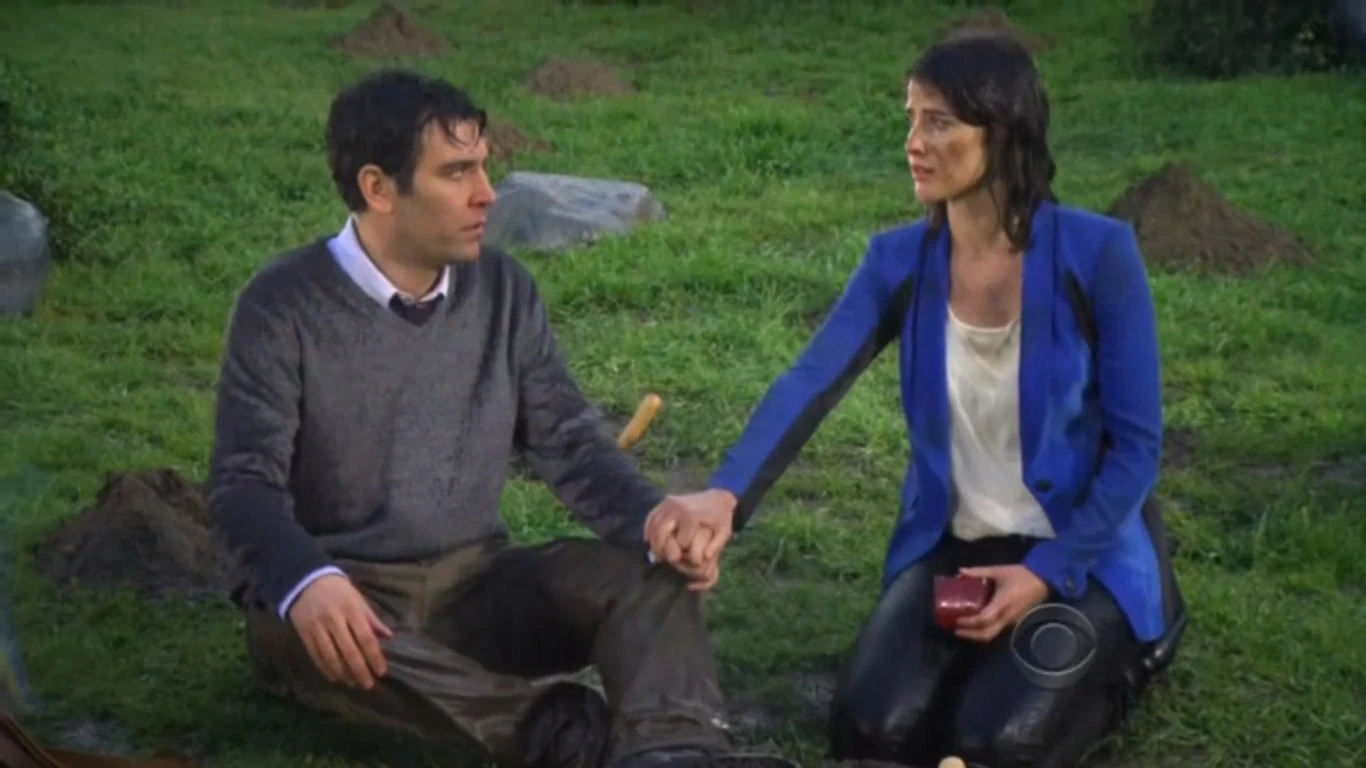

She is engaged bro!
To name a few.
But, there are so many precious, beautiful moments that we love.

His apparent disassociated moments with his students:


The fact that Ted made it rain for Robin:


The fact that he would have stolen an entire blue orchestra:


These are still the acts of a crazy person.
But, we can and do find them endearing.
There are reasons explored actually within the series, but are not the subect of this article:


The point is:
All drama is filled with crazy and that is what we love.

Case Study: YOUR FAVORITE STORY

Think of your favorite story.
Okay?
You have a story?
You got it in your head?
Know all the back story?
The ups? The downs? The surprises?
Good.

Now, really examine those characters.
Examine their behavior.
Examine their responses.
Are they responding reasonably?
Dare I say sanely?
I'd argue probably not.

Now, here is the thing.
EVERYONE WANTS TO BE SANE.
So far as I have been able to gather.
However, I would contend:

Art is Insane

End stop.
Art is Insane.
It is what we love about art.
People do things we would never do.

  • Ted Mosby loves in spite of love kicking his ass.
  • Hamlet goes off the word of a spectre and his whole family ends up murdered and his kingdom overthrown.
  • Oedipus ends up blind, childless, and cursed.

We like watching these stories.
We like watching characters get kicked and getting back up again
And why?
Because it is crazy to do so!
So why is the first critical response I hear always, always, always:
  • It was so real!
  • That is exactly how I would respond!
Really?
Really?!
Would you really?
Would you really kill your father, mother, nieces, nephews, and children?
If so, I may want to have you committed.

Now, to be fair, it may say something about the human condition.
Namely: we are all insane.
But, that is the subject of another post.
Here is my point:

Artists are trying to make their characters sane

It is the biggest tragedy to art I see right now.
People are trying to make their characters 'real'. 
And that means by toning down their responses.
That means that instead of tearing up the contract, characters are politely saying, "No, thank you."
Instead of throwing pies in each other's faces, we see them tersely eat dinner for a half hour scene.
This is not an overall trend.
In fact, many modern comedies embrace the insane quite well: 
  • Death at a Funeral
  • Hot Fuzz
  • Shaun of the Dead
  • At World's End
  • Ted
  • Rush Hour
  • Tommy Boy
To name but a few. 
But, if you are stuck, if you can't quite figure out why a scene isn't working, consider that maybe you or your partner or the situation isn't quite crazy enough.

Questions to Consider

  • Who is right in this situation?
  • Who is wrong in this situation?
  • Can I make them wrong?
    • How?
  • Am I acting unreasonably?
    • Can I act more unreasonably?
    • How?
  • What would an insane response be?
    • Why am I not doing that?
      • Is the reason: to be liked?
      • Is it because I would "never" do that?
        • What is wrong with doing it?
  • What is the most I can get away with?
  • What are the consequences for my current action?
    • Is it imprisonment?
      • Why not?
    • Is it lower than imprisonment?
      • Why?
I'm not saying everyone needs to go to prison or murder someone.
That would be formulaic.
But, the number of comedies that have a prison sequence is as high as the wedding:
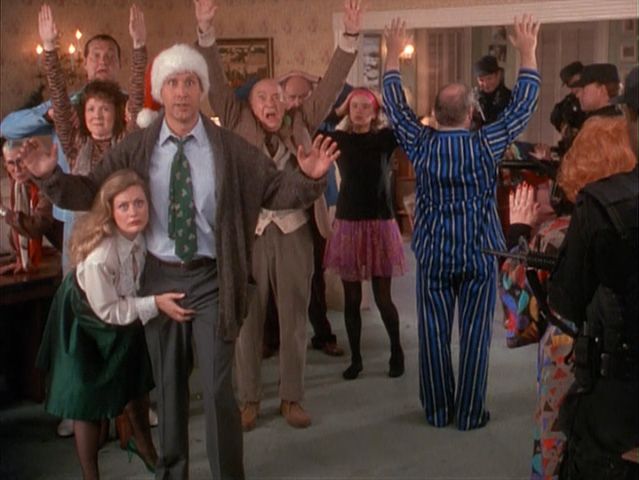
National Lampoon's Christmas Vacation

Bridesmaids

So if you aren't risking something in the scene.
If you aren't gambling on going to prison in your play or screenplay or novel at some point.
Then, I don't think you are writing drama.
Because your characters aren't insane.
And that really makes all the difference.

Sunday, September 4, 2016

Sleep No More Changed Theatre (And You can too)

Today we discuss a spirit jam:
"How do you see 'the theatre of the future'"
The idea of a "theatre of the future" is a tricky one.
What would it look like?
Would it have cooler designs?
Better interfaces?


More impressive/realistic projections?


Be terminally consumed with comfort?


In order to engage with this idea, I would contend we need to think less about a "theatre of the future"
Because I believe theatre is of the now. This. The present this.
There can be no future for theatre; it is dying even as it lives, much like all of us.
So there is no future theatre to which we can speak.
Instead, I would suggest that we discuss "the future of theatre."
That can be guessed at, hinted at in our present time.

With that in mind:
I believe the future of theatre is moving further away from the idea of comfort, emulating cinema and their palaces of comfort.
We cannot compete

Cinema

Cinema has supplanted theatre as a means of entertainment:

  • The seats are luxuriously comfortable
  • The ticket is always a fair price point (usually under $10)
  • The food is convenient and allowed into the theatre proper
Theatre has very little of that these days.
  • The seats are usually fold out or worse.
  • They are often cramped being a hundred years old.
  • The tickets sky rocket to $25-250.
  • Food and drink are highly discouraged.
In almost every respect theatre loses to the cinema when it comes to convenience, price point, and quite honestly, quality of content.

However, not all is lost, not all is bleak.
Theatre has some remarkable experiences going for it. 

Theatre is becoming what the critics call "immersive" and that I believe is the future of theatre.

Immersion

To define immersion:
Merriam Webster defines "immersion" as:
the act of immersing or the state of being immersed, as:

  • baptism by complete submersion of the person in water
  • absorbing/complete involvement
  • instruction based on extensive exposure to surroundings or conditions that are native or pertinent to the object of study

The idea is that it can be

  1. a physical act of immersing the senses in something
  2. a mental act of engagement with their surroundings
  3. a learning process through the first two definitions in order to learn something that otherwise they wouldn't be able
This can be applied to the type of theatre that is growing more and more popular.
I will use Sleep No More as a case study.

Sleep No More

Sleep No More is a dance piece that takes place inside of a six floor hotel.
First floor is tickets, coats, merchandise, pick up, and drop off. 
Second floor is a flow blown bar and jazz lounge.
Floors three through six are the play.
What play?
Macbeth and Hitchcock's films (Rebecca and Vertigo) in a kind of weird synthesis that (in my humble opinion) doesn't really make much sense, but lends to the creepy hotel vibe.

Why is Sleep No More so successful?
I maintain because the audience engagement is so fierce right from the start.


When you enter the second floor, through a dizzying labyrinth of ill-lit corridors, you find the jazz lounge.
And it is breath taking.
Filled with a complete bar, you can find your seat, order food, live up the high life in wonderful turn of the century fashion. 
It is a dizzying spectacle right from the get go.
Entertainment plays all night, the bar never closes, and the food is fair.
You could literally spend the whole night enjoying a jazz experience with friendly faces, a live band, a bar, and catered restaurant.
And some people do.
And that is okay.


Then, there are the other floors.
They are filled with unbelievable artistry and attention to detail.
This is the apothecary, filled with drying/dried herbs and flowers.
Dead things are preserved in jars along the walls...snake skeletons and things like that.
And this is just one room over many many floors.
You can spend literally the entire night exploring rooms filled with stuff you can lift and touch and play with.
And some people do.
And that is okay.


Then, there is the performance, which is so difficult to describe in words.
Everyone is granted a mask before entering the playing space.
Each mask provides a sense of anonymity.
They encourage exploration and interaction, but are very cognizant of safety.
The actors physically stop audience members from getting too close or interfering with the action of the drama.
You could literally follow one person, one character through the entire hotel up and down four flights and into countless changes/scenarios, into secret areas/wings.
And some people do.
And that is okay.

The reason that I think Sleep No More and shows like it are the future of theatre is because they immerse their audience wholly in the experience.
  • They encourage free exploration.
  • They create a dynamic, free-flowing atmosphere where audience can seamlessly go from one stage to another in an instant. 
I remember crawling down after the second repetition too tired to stand and in sore need of a piss, wandering into the rest room as a guy with a drink was coming out.
He appraised me, and with a shrug of his shoulders that said, "Once more?" he downed his drink, put his mask back on and headed for the portal I had just vacated. 
There was a sense of camaraderie with that audience that I have almost never felt with another before or since.
And I think it came from that sense of play.
There was a freedom to the experience; the creators had designed a beautiful playground in which we could lose ourselves in almost any of it.

Now, I say seamless. 
There were clear holes in the work:
  • A drawer full of lost rings that were all the same size bands of brass
  • Plastic plants that were meant to be exotic fixtures
  • Sterilized patches of art
I didn't begrudge the experience for the gaps in the design like so many other productions that I see.
Because in other productions those things are glaring.
It is clear and immediate what is wrong with the whole.
In Sleep No More, I had to literally search for those types of things. 
And why?
Because the rest of it was so compelling, so nuanced, so interesting.

So that is the trend that I am noticing in contemporary theatre that I wish to be built upon and be the foundation of future endeavors: 
The future of theatre will be built on the experiences that are only possible in the immediate present with bodies sharing space and breath within a singular theatrical design.
And you can see the trend developing with theatre companies like:
Slipstream Theatre Initiative:


 Or Nerve: 


Where immersion, where experience is the name of the game.
Where audiences are not told what to feel or how to interact, instead they are given ever more carte blanche to write or even change the experience because they are willing participants in the action. 
It is daring, new, exciting, and dare I say, slightly medieval.
The practice of throwing rotten vegetables is an age old way for the audience to show appreciation for the action they are experiencing and to interrupt it, if they so desire.
So maybe the future of theatre lies in its origins.
But, that is another tale.

Thursday, July 28, 2016

The Art of War is all about Storytelling (Laying Plans)

Today we discuss Sun Tzu's The Art of War. 


I've been meaning to post this for a year now and darn it, I'm going to do it.

I maintain that The Art of War is one of the greatest storytelling textbooks of all time.
I will attempt to illustrate how throughout this series by drawing on how it relates to the author of the piece, the characters, and the plot.

It begins:
The art of war is of vital importance to the State. It is a matter of life and death, a road either to safety or ruin. Hence, it is a subject of inquiry which can on no account be neglected. 
It actually begins:
Sun Tzu said:  The art of war is of vital importance to the State. It is a matter of life and death, a road either to safety or ruin. Hence, it is a subject of inquiry which can on no account be neglected. 
But, that sounds creepy and just a little formal.
It's like saying Miles Boucher says...

Point being, Sun Tzu says that the art of war is of vital importance and can on no account be neglected.
Why?
He illuminates (later on) that war is the last tool of diplomacy.
Meaning if diplomacy has failed us, war is the only recourse.
But, the converse is also true: diplomacy should never fail, there should always be the option to be diplomatic.
Therefore, the greatest of nations/utopias would be those without the need for war.

However, life is rarely so benevolent.
Things happen.
Bad rulers rise.
And diplomacy does fail.
To what must we turn in times of turmoil?
Simply war.
Since it is the last resort, it must be studied in ever greater detail (according to Sun Tzu).
Why?

Because diplomacy has failed.
If it had succeeded there would be no need of war.
Therefore, diplomacy will not save you in the future.
Your nation's skill in war must be the saving factor from annihilation.
Therefore, study.
And attend.

The Art of War:

Sun Tzu gifts us five "heads" to determine who wins the field:
Conditions when obtaining the field:

  1.  The Moral Law
  2. Heaven
  3. Earth
  4. The Commander
  5. Method and Discipline
He then defines each: 

The Moral Law unites the people under their ruler and means that they will lay down their lives for her, believing them to be in the right. 

By Heaven, he means night and day, cold and heat, time and seasons.

Earth comprises distances, great and small, danger and security, open ground and narrow passes, the chances of life and death.

The Commander stands for virtue, wisdom, sincerity, benevolence. 

Method and discipline are to be understood as the marshaling of the army into its proper subdivisions, graduation of ranks to officers, maintenance of roads, supplies, and funds. 

Once these are outlined he goes on to say:
These five heads should be familiar to every general. She who knows them shall be victorious, she who knows them not will fail. 
So now, we have our conditions for victory and failure. 
Familiarity with the five heads.

He even provides a useful list of questions to ask when entering a battlefield:
  1. Which of the two sovereigns is imbued with the Moral Law?
  2. Which of the two generals has the most ability?
  3. With whom lie the advantages derived from Heaven and Earth?
  4. On which side is the discipline most rigorously enforced?
  5. Which army is stronger?
  6. On which side are the officers and men more highly trained?
  7. In which army is there the greater constancy both in reward and punishment?
By these, Sun Tzu is able to forecast who shall win any encounter.

A Case Study: The Bat


The Batman is one of my go to protagonists.
Why?
Because he fights like a damn diplomat.
Meaning, he uses everything at his disposal in order to have an edge.
And why?
Because on any given Tuesday he might run up against this: 
That my friends is our god. 
Slash Superman.
Same difference.
Point being he is on a murderous rampage and what are you going to do?
If you're Batman, you are going to win.
And how? 
Well you can bet your last dollar that he has read the Art of War. 
Because Batman comes with the full accompaniment:
  1. Batman has the Moral Law. He seeks Justice, not Revenge (The Killing Joke).
  2. Batman has the single greatest mind on planet earth. He is without doubt the general with the most ability 
  3. Advantages would lie with almost any other adversary that Batman faces. Superman definitely has the power of Heaven and Earth. However, Batman lays plans to his advantage: Gotham is his playground and he makes sure to always have the upper hand (The Court of Owls where he identifies the type of stone that constructs their secret base and uses it to create an explosive to escape in the waterways)
  4. Batman is the most disciplined. (The Batman Files illustrate his daily training regimen, which is fierce)
  5. Which army is the strongest? Probably the other guy. Damn you Supes. But, through carefully laid plans, Batman again becomes the strongest by weakening his foe (In Batman: Hush, Batman says that you never go to Metropolis (home of Superman) without preparing for him and pulls out a ring made of kryptonite (Superman's greatest weakness, able to kill him in some stories))
  6. Batman is more highly trained (Batman Files again)
  7. Batman is a good guy, meaning that he rewards and doles out punishment on a pretty consistent basis. You don't see him slamming Robin into a wall for acting like a hero on a daily basis (Batman: Hush)
In every single category Batman, by laying plans and reaping the advantages of his calculations is able to overcome any adversary, no matter the difficulty.
That is why I always bet on the Batman.
And judging from this list: Sun Tzu would too. 

Sun Tzu goes on to say: 
All warfare is based on deception.
  • When able to attack, we must seem unable
  • When using our forces, we must seem inactive
  • When we are near, we must make the enemy believe we are far away
  • When far away, we must make her believe we are near
  • Hold out baits to entice the enemy. Feign disorder and crush her
  • If she is secure at all points, be prepared for her. If she is in superior strength, evade her
  • If your opponent is of choleric temper, seek to irritate her. Pretend to be weak, that she may grow arrogant
  • If she is taking her ease, give her no rest. If her forces are united, separate them
  • Attack her where she is unprepared, appear where you are not expected

Another Case Study: Bilbo in J.R.R. Tolkien's The Hobbit

How to use this advice as an author?
Consider your protagonist an enemy. 
Just do it.
It can even be someone you like.
Like Bilbo.


Screw it.
Make Bilbo a badass girl.


Yeah.
Someone you can love.
Now, who is Bilbo?
She is:
  • Affluent
  • Homeowner
  • Busybody
  • Fussy
In a word: SECURE.
So what do you do with someone just bursting with potential?
Well, as an author, you have to do awful things to them.

So Bilbo is affluent? Take away her money and make her a traveler.
Bilbo is a homeowner? Take away her home.
Bilbo likes her creature comforts like a hanky? Take away the hanky, give her the hardship of the road.

And that is just the bare essentials.
The comfort level stuff.
Bilbo is attacked by spiders, goblins, orcs, giant bears, elves, dark things in the night, etc.

How did Tolkien manage to make such a compelling story?
By attacking Bilbo at every turn. 
By managing her expectations.

Bilbo & Co. are lost in Mirkwood.
So, they send Bilbo into the least comfortable place imaginable: 

Up a tree.
What is she up there to do?
See the edge of Mirkwood.
Except she doesn't:
"It was no good. Gaze as much as she might, she could see no end to the trees and the leaves in any direction. Her heart, that had been lightened by the sight of the sun and the feel of the wind, sank back into her toes: there was no food to go back to down below.
Bilbo is at her lowest point.
She is stuck up in a tree.
No food anywhere.
And no end in sight.
But, that is the key: "in sight. "
Tolkien confides in the reader: 
Actually, as I have told you, they were not far off the edge of the forest; and if Bilbo had had the sense to see it, the tree that she had climbed, though it was tall in itself, was standing near the bottom of a wide valley, so that from its top the trees seemed to swell up all round like the edges of a great bowl, and she could not expect to see how far the forest lasted. Still she did not see this, and she climbed down full of despair. She got to the bottom again at last, scratched, hot, and miserable, and she could not see anything in the gloom below when she got there. Her report soon made the others as miserable as she was. 
 Boom.
Tolkien is managing our expectations as well as our protagonist's.
For Bilbo will reach the edge of the forest of Mirkwood.
How do you know?
You were promised a Lonely Mountain and a Dragon.
Until those two story items are on the page, the story isn't over.
It is like watching a trailer for a film.
Until you see everything in that trailer, you know the characters will keep on going.

Now, we have been assured that they are very near the edge of the forest.
But, the characters are in the midst of despair.
Tolkien could have written ANYTHING.
Bilbo could have seen a giant sign that said EDGE OF MIRKWOOD and that would have been that.
Instead, Tolkien deceived poor Bilbo & Co.
By making Mirkwood seemingly endless, he was able to provoke Bilbo & Co. into seeking help from the elves (bad idea) and into a nest of spiders (really bad idea).

Sun Tzu says at the end of his first chapter:
Now the general who wins a battle makes many calculations in his temple ere the battle is fought. The general who loses a battle makes few calculations beforehand. Thus do many calculations lead to victory, and few calculations to defeat: how much more no calculation at all! 
Batman always wins because he is well calculated.
Bilbo just manages to win by taking in enough calculations.
Writers don't write because they make no calculations at all and so lose out on all their wonderful story.
I hope that this quick foray encourages people to try writing and telling stories like they are waging war.
Try it!

Friday, July 22, 2016

Why Food Wars! is the Best of Us (The Greatest Story Ever Told)

Today we discuss this:

SHOKUGEKI NO SOMA

Otherwise known as: 

FOOD WARS!

Wherein Yukihira


wants to be the very best, like no one ever was. 


Yep, he's one of those.
Thing is, he is good1
But, unlike almost EVERY OTHER POST, this is not about the characters.
Which, Shokugeki has in abundance: 


Instead, let us discuss the JOY that is Food Wars!
And I mean that literally.

See, back in the day, someone very dear to me watched cooking shows constantly. 
Iron Chef & Iron Chef America & Gordan Ramsay. 


I didn't really understand what their obsession was with the genre. 
Until I sat down and started watching with them.
It was incredible!

See, even though they are competing against one another, they are still rooting for one another. 
Everyone is making delicious food.
So they aren't trying to do a pirouette or pummel their opponent into submission.
Instead, they are creating a sensory experience to be enjoyed by, not only their judges, but by their opponents as well.
That is a pretty big shift in the competition world.

So Food Wars! is essentially the anime version of Iron Chef.
However, there are a few exceptions.
For one there is plot, meaning a story. 
So the characters, usually Yukihira are thrown into wild, often melodramatic/cartoonish situations.
E.g. a real estate shark is moving in on their turf, she threatens to close down the place.
Yukihira responds with a wager. 
They'll leave the spot tenantless so they don't even need to buy it off them if she doesn't eat every last scrap of his meal.
Having spoiled all of his choice meat already, the real estate shark accepts the wager.
Let's see what happens next.

(Explicit: The show also contains plot: urban dictionary-the revelation of the naked human form for gratuitous or fan-based service, synonyms: fanservice, ecchi)


She loses the bet.
In the BEST way.
As do her muscled security guards. 
There is a beautiful equality to it.
Keep in mind, these are the mortal enemies of protagonist's little diner. 
Everyone despises one another.
But, they all come together over a wager and quite literally share a meal to determine the victor.
And the result? 
Good guys win, bad guys lose, but everyone and I mean EVERYONE had a good time.

It is the best of us. 
It is the most brilliant idea ever.
The resulting conflict is always competitive.
The solutions always stem from a fusion of tradition and innovation.

This is hands down:
better than Aaron Sorkin.
better than Joss Whedon.
It is pure joy, wrapped inside a compelling story, and a cooking show all at once.

I don't know what else I can say about it, but watch it.
Oh.
And:
Bon appetit.

Tuesday, June 28, 2016

On Storms (And Other Art Necessities)

Today let us talk about storms.
Life is full of them.
So too must art be.

What is a storm?


Nope.

Yesssssss.

So what are they?
According to their rote definition:
a violent disturbance of the atmosphere with strong winds, rain, thunder, lightning, or snow
Source 
(Look Ma! I cited!)
Another
(It's British! So it has more clout!)

Define Clout

Anywho, now that we have had fun, let us get back to the aweful (original).

Storms.
This rather clinical definition does not encompass the majesty of the word nearly so well as its synonyms:

  • Tempest
  • Whirlwind
  • Gale
  • Squall
Shakespeare calls one of his latest works The Tempest and for fine reason.
There is something magical and romantic about a tempest.

Sarah Ruhl addresses storms in her 100 Essays I don't have Time to Write.
In it, she describes them beautifully.

A storm comes sweeping through the natural world.
It upsets the balance of everything.
It disrupts stasis.
People go running, things get tied down, animals aren't let out.
They are terrifying things and those are the storms we are aware of.

There are flashfloods and freak weather as well.
There are even documentaries about it:

You know it.
It was really popular not too long ago.
I think because of its attractive host:


Point being, there was a time when we understood storms.
I think it was when people lived primarily out of doors. 
Think about the drama and the art of every great movement in the theatre.

The Greeks

Their Theatre

Looks like this.

The Play

Medea


In Medea, we have a scorned woman, mother of two of Jason's children, a warrior in her own right, who is left for a political marriage. 
In response is the argument of the play. 
The conclusion is that she murders her children and Jason is left to despair. 
  • She gets a fair trial
  • Judged guilty by a jury of her peers.
  • Sentenced to death
  • Has a stirring plea on the gallows
  • Tragic death
Don't remember that in Medea?
Because it doesn't happen.
Medea is saved by one of the gods and rides away ON A CHARIOT MADE OF DRAGONS.


That seems weird and not in keeping the legal justice system.

Who cares?
It's rad!
But, people make fun of deus ex machina like this.

It may be for as simple a reason as:
We are so used to a logical progression in our art.
A to B, then C logically follows.
The Greeks had no such qualms.

The Deus ex Machina or "god in the machine" stems from the Greek.
The Greeks used to lower deity characters down using a pulley system, hence the expression.
Now, it is synonymous with a plot device to fix an otherwise impossible situation.
It is a disruption of logic.
A storm, if you will.

The Elizabethans

Their Theatre

The Play

The Tempest.

No.
That would be too easy.
Let's see...
Romeo & Juliet.


In this little debacle,

  • star-crossed lovers from warring factions marry and bed one another. 
  • Romeo murders Juliet's cousin Tybalt after an enforced peace and is banished. 
  • Juliet takes a draught of (never named in the play) and falls into a death-like coma. 
  • The Friar (purveyor of nameless medicine) sends a letter off to Romeo to assure him of things.
  • Romeo doesn't receive the letter and instead rushes off to bury himself with Juliet.


It all turns on a letter.
The letter is the storm.
In almost every production of R&J, the letter will be given to Balthasar, a relatively small role, but a Montague, who will then be played by a woman who is hopelessly in love with Romeo. And that is why the letter is waylaid.
Why?
Because it means saving on casting another actor in the role of Friar John?
No.
Because it makes sense.
And we love for things to make sense.
A to B, then C.
Balthasar loves Romeo, therefore, she doesn't give him the letter and he kills himself.
Like dominoes.

Naturalistic Theatre

Their Theatre


The Play

A Doll's House. 


In it, the protagonist Nora is infantilized by her husband, Torvald, to the point of ludicrousness. 
  • Turns out, prior to the events of the play, she took out a loan in her husband's name with her father's surety, but forged their names, committing a crime to save her husband's life. 
  • Krogstad, the man who loaned her the money, presses this advantage to ensure that he keeps his position at the bank. Nora, puts off telling her husband. Kristine, her oldest friend and long lost love of Krogstad, offers herself as a peace offering to him, asking for his hand in marriage. 
  • In the end, Torvald receives the blackmail letter and the other letter that says Krogstad has reconsidered. 
It is like deus ex machina, except the tragedy ensues. 
  • Nora leaves Torvald because she now recognizes that she must. In fact, she spends a two page monologue explaining why this is the best choice for her.

A to B, then C.
She could have just left. 
That would have been a storm.

Often, the Naturalists (Ibsen, Strindberg) are credited with creating what is known as the well-made play. 
A well-made play is exactly that, logical.
It follows the 
A to B, then C structure.
It is a relatively new invention (only a hundred years or so), but we, in American theatre have rigorously adhered to it since.
So much so, that I believe it to be crippling our growth as an art form.

Just look at some of these 


I get it.
There are parallels.
Symmetry.

Almost any contemporary play will be done isolated within a rigid structure.
I mean this literally e.g. a house. 
I mean this structurally e.g. the climactic structure 
Almost any play will take place in of doors or in a single location near in of doors (a backyard)

Gone are the gods.
Gone are the storms.
Gone are the myths.

Now, this is not to imply that there are no plays without these things.
No contemporary examples.
One of my favorite modern shows is Deadwood.

In "Amalgamation and Capital" the characters are negotiating a thorny bit of dealing.
This contract will literally set the town up for peace and prosperity.
Everything is going aright.


When suddenly a wild horse appears and kills the sheriff's only son.


Because of it the deal doesn't get negotiated.
Heated words are exchanged. 
The town grieves.
Things happen.

It is a truly horrific moment and one of the best in cinema.
But, why is it?
I maintain because it is a brilliant storm.

Nobody could have predicted that that would happen.
None of the characters.
Not the audience.
It was a freak, natural accident.
A horse, one of the wildest, most beautiful creatures maimed a child through fear and the act of running.

What a great storm.

So how do we make art like that?
I'm unsure.
My instinct is to say let it happen spontaneously.
But, if it happened spontaneously, then we would have more storms in art.

Trust your gut. 
Go with it.
And in lieu of a gut instinct, try going out of doors more.
Meet a summer storm more.
Get lost more.
Find yourself in a blizzard more.