Tuesday, June 23, 2015

Ode to Opening Nights (A Lament)

Let us talk a little bit about how haste makes waste.
One of the biggest problems I have with theatre is the opening night.
It is a nightmare.
We:

  1. announce it the year prior, choosing performance dates, 
  2. tell people to put it into their calendar and buy tickets
  3. plan vacations around it. 

All before:

  1. finding out our creative team or cast, 
  2. before our first rehearsal, 
  3. before the beginnings of artististry.

Why do we do that?

There is a definite motivating factor: give people enough time, make them aware enough and we will have an audience for that all important opening night.
I have done the struggle, it is hard, believe me.
However, from the creative side, for me, it is a nightmare.
Why would we give an audience  an entire year to prepare for opening night and the performers and creative team only a few weeks at most?

I am forced to conclude economic reasons.
Now kids, this is what we want to avoid.

A show has to be opened and closed in the shortest, most expedient amount of time imaginable.
Why?
Well because of rights reasons; we pay to perform the majority of shows that we do ergo a longer run or changing of the dates is impossible whether due to finances, copyright law, or the agencies that handle the scripts. They have to be notified of the performance dates six weeks prior to the first rehearsal. You have to know when you are going to perform before you can even look at the script that you want to order....Already we have a problem. But we'll come back to it:
Because of rehearsal spaces; we so often rent the theatre spaces we are to perform in, which tend to be large stages or warehouses to accommodate say...an audience? Ergo they cost a lot of green. So they are prohibitively expensive. So we rent rehearsal halls.
Now we have rehearsal hall expenses to worry about.
All of this is before we even get to creative team expenses.
Now the actors want gas money?!

Fathom this:
The design team is paid by design.
That is it.
All of the time they put into crafting their work doesn't get paid (much like actors) however, their work is due prior to the first rehearsal.
Before they have met anyone that will actually be performing in or around their work, they are expected to create it.
Why?
So we have time to build it over the course of the rehearsal process.
Well, the more time they spend on a design, the less they get paid.
And I have had designers say this TO MY FACE.
If I were to spend time in rehearsal, watching the actors, adjusting my design, I wouldn't be paid for it. Sure, it would be better, but that is stealing time away from my next design job, another opportunity for me to make MONEY.
We are so far gone if that is the mentality of theatre.
We do not have time to work on the artistic project we are currently working on.
We are forever looking towards the next project and the next.
No one feels secure artistically or financially.

This is my nightmare.
This is a description of my worst fears on how to work and it is the reality that some in the theatre live every day.
Now, this is not to say others do not find this process enlivening, enjoyable, or rewarding.
In fact, many do. I am simply not among them. I do not artistically thrive under those conditions.
But, I also know I am not alone.

So I want to make my own rules.
My advisors all throughout school said:
Miles, you may need to open your own theatre because you don't like working with anyone.
A little harsh, and just a little true.
But it isn't that I don't like working with anyone.
I don't like working with anyone in this way.

Is there a hope, a dream in any of this?
I think so, but bear with me, it is early days. A diamond in the rough.
Now, this may be the subject of another post, but I will plug my dream here and hope if it speaks to you, send me a message and we will talk about making it happen.
Ideally, we pay everyone on the creative team.
I don't know with what...the government's money? Because I don't have any.
We make a farm.
We eat, commune, and grow things together so nobody goes hungry.
We build houses for people to stay in.
The audience shows up and stays with us, in our homes, in tents outside, in their cars, wherever.
They help tend the farm.
They share in the making of a thing.
We rehearse for as long as we need.
We perform every night.
We perform in repertory.
Opening nights can then become surprising things.
Hey, you thought you were coming to see this play, but actually we are ready to perform this! Would you like to see it?
The audience and the performers become more familial and we share in the work to make theatre happen.

This is definitely the subject of a much longer post, but that is my dream.
It is rough, a little unpolished, but it is mine:
A theatre devoted to its practitioners and its audience.
Where people can come see theatre every night and not know what they will see, but trust it will be good because we are the ones making it.
Where no one is hungry or worried about where they need to go next.
An artistic home where everyone can and hopefully will return.
A rotating repertory in a single location that audience and most importantly artists are familiar.
We rehearse on the same stage as we perform and with the design elements in rehearsal.
We add to the repertory and perform classics and new works.
That is what I would like to make.
I'd like opening nights to no longer be the most important deciding factor in theatre.

Sunday, June 21, 2015

Motivation-ability (Or: Why it took me years to get off the couch and start making art)

Today, we are going to talk about a little thing called motivation.
Or hell.
At least it feels like hell.

But what is motivation?
Of what stuff is it made?
Can I have some please?

Looking at past experience I have concluded:
All the people who are doing stuff have motivation.
I do not.
How do I know this?
I am not doing stuff.
Ergo, I must not have motivation.

A number of creatives I know have this selfsame problem:
Lack of motivation.
We call it by many names:
Laziness, lack of skill, lack of connections, lack of...you see what I am getting at yet?

We all lack something.
We must; we are human.
At least I pretend to be.
But we mourn what it is we do not have: an agent, a book deal, a Broadway gig, ad nauseum.
Why do we do this?
Because it can be very painful to realize one's limitations.
But why are they limits?

Do we not possess this mythical stuff of which others are made?
Decathalon runners have it. Shakespeare had it. Isaac Newton had it.
You beautiful bastard.
What makes them so special?
In truth. Not very much.

Motivation is a myth.
One we all buy into.
We say terribly weighted adages like: "Get MOTIVATED!"
In really high-pitched voices early in the morning when everyone should still be asleep.
Why do we say this?
Why do we treat motivation like a commodity?

Because that is how we have been trained to perceive it.
The thing that unites all the gifted in our society is that they were doing something else, they 'got' motivated, and then did something else.
My contention is the joy is in the doing.
We simply haven't found something to be joyful about.

I did yoga for years.
Practiced little, cared less.
I thought it was me, and technically it was.
When suddenly I had a stark realization: I. Hate. YOGA.
Fuck you, kindly.
Simply loathe it.
And it has nothing to do with me, it has nothing to do with my teachers, but it has everything to do with Yoga.
(static, unmoving postures, that you simply hold and breathe, oh and meditate, still the mind, but don't think about anything as your joints scream in protest and gasp, gasp like a fish out of water, and namaste)

Why did I do that?
Why did I pursue something that for years made me unhappy?
Because people told me I just had to get into it, get motivated, practice daily.

The reverse is true:
If you love something, you can practice daily.
Now, this is not a get out of jail free card.
You still need to practice.
But look at your daily practice.
Are you reliably exercising?
Are you practicing your craft?
If no, why not?

I hated movement for years, couldn't stand the terminology used, the exercise regimen (mostly yoga, but also Pilates: for those who don't know Pilates was a German man interred in a Nazi PoW camp who came up with a series of exercises to do in his prison cell and with hospital equipment...and I wondered why I didn't like it).
So I had to find my own practice.
I have been studying Jerzy Grotowski's work for a little over a year now.
I have never exercised/practiced my technique as reliably.
Looking at movement as an expression of internal stimuli, overcoming mental bias, and most importantly: as research has really allowed me to flourish.
But I didn't need to get motivated, I enjoy the work, I aspire to it, I revel in my accomplishments.

So screw getting motivated.
Find something that you genuinely want to do and do that.
Nobody can force you to do anything you don't wish to do:
Horse, water, drink, adage.
I hate the gym mentality, I hate the gym atmosphere, you could not pay me to step inside a gym.
Now, I practice my movement outside on the grass.
I get spectators.
I work in such a way that augments my creativity and my acting and doesn't hinder it:
e.g. sitting/standing, squatting on a workbench.

As a final note, this is not to say that my way is the only way to practice; I focused a great deal on physical movement because that is what I have found the most joy in recently.
But finding your own effective route to practicing is the most important secret to defying the motivation myth.

Friday, June 19, 2015

Paralysis in Rehearsal (or at the typewriter, workbench, gym, kitchen, bedroom, you get the idea)

You are [insert craft of choice] and you find yourself drawing a blank.
The scene begins, you walk out on stage look at your scene partner and flat, emotionless Shakespeare vomits out of you.
You sit in front of your book-maker of choice and stare at an empty page. The blank page stares back.  Time passes.
Repeat ad nauseum.

Why does this happen?
How does this happen?
Is there anything we can do about it?

All mental blocks are physical.
This is my new mantra.
That and: 
All physical blocks are mental, but that may be the subject of another post.

So what does that mean?
The body and mind are not disconnected; they are not disparate; they are not unified.
They are, in point of fact, one.

So what do we do with that?
Well, to put it simply: any time you are now stuck on a mental problem, try changing what you are doing.
I mean this literally.
Change.
Stand if you are sitting, sit if you are standing, run if you are walking, crouch if there is nowhere to sit, cartwheel, dance, do anything except what you are doing.
Because that is how we get stuck.
That is how the blank page never gets filled.
You stare at a blank page.
Won't this be productive? An hour passes. Shit.

Do something!
Even if it is the act of typing nonsense gibberish at least you are turning it from a blank page into something you can work with.
This I have found is the single greatest trick to my work as an artist.
Do something.
At least then it is craftable, changeable, malleable, dare I say, alive?

One of the most remarkable improvisational workshops I have ever taken was where the master watched the scene carefully.
Let it go until it, in his parlance, 'died'.
I was so thrown, but he explained:
"Comedy/improv, is like an organism. It lives, it breathes, it grows, and sometimes it dies on the vine. It is my job to help you sense when that happens and how to avoid it."
Brilliant.
Art as organism.
Art as life.

The real trick that I find as a director/actor is turning off the Censor.
You may know him by his other name: Satan.
No, I don't mean literally.
But, there is a voice that is systemic in artists, I have found, that constantly whispers creepy (Satanic) shit like: "That's not good enough" "You'll never be that good" "You're not on Broadway"
Really useless crap.
But we LISTEN!
I tell actors in my rehearsal hall every day that what they did, which was silly and ridiculous and stupid was perfect for the scene.
But they shy away from 'that sort of acting'.
Why do we do that?
Because it is silly and ridiculous and stupid.
Our whole life has been about avoiding that sort of behavior in order to blend in and survive.
We need to be a bit more daring.

I'm not just talking about artists anymore.
This is everyone:
Be honest, be truthful, be silly, be courageous. 
It is worthy of art.
It is truthful.
It will help.
And if it does not....
Try something else.

Thursday, June 18, 2015

RA: Recovering Artist (It is like AA, but we don't have chips)

Sorry, I know I haven't published in a while, but I promise there is a good reason!
FEAR.
Who said that?
Me!
Who are you?
The voices inside your head.
Can't worry about them, I have to write this article for all my adoring fans.
What adoring fans?
I must have some readership, even if it is friends, family, my immediate community.
So what? Who are they? Do they really matter?
...........
Aaaaaaand Scene.

This was a dramatic reading from inside my head, but it illustrates the point very quickly.
We are our own worst enemy.
I know what you are saying, because I say it: What good is this to me? Everybody says that!

Hold onto your seats folks....you ready? I don't think you are......
Everybody feels afraid.
No really, look around your home, or Starbucks, or dorm, wherever you are reading right now.
Everybody worries their art isn't enough.
That they are not enough.
It is why we lash out, why there is so much pain and frustration in artistic circles and domestic circles.
We are all just screaming for attention and most importantly: love.
"What a radical notion!" he said to the emptiness of interweb space.

But it is true.
We are creative beings.
We are storytellers by nature.
So what stops us from telling stories?
What makes us think our artistic endeavors are not enough?

I have been dwelling on this for weeks.
It is one of the big reasons why I haven't published a damn thing.
And it all comes back to fear.
So I decided to do something about it.
I decided to do my own art.

And that is when I became a practicing artist.
Oh you, me, the bloke on the street corner: all artists.
I believe that in my bones and no one can take that away from me.
But practicing your art, whatever it may be is the most important thing.
So I grabbed this book: The Artist's Way
"A spiritual path to higher creativity" and I started working on what I now call my artist's recovery program.
Now, let me be clear...I hate this book.
I despise it.
And the authoress.
I'm talking to you Jane!
You and your dumb face.
It is, to put it bluntly, (and I apologize for my English) not my cup of tea.
There! I said it!

People often make art into a spiritual experience with colors and energy and...I don't know what the hell they are talking about.
Give me concrete examples that I can process phenomenologically and I am your boy!
No one makes it more "spiritual", and when I say "spiritual" I mean that guy that asks, "Are you a 'spiritual' person", than this lady!
God, which she refers to throughout, is the ultimate creative force in the universe and if we open ourselves up to it, we can become conduits for the divine creative energy.
There. I did it. I gagged. But I did it.

So why am I plugging it?
I am not.
But I will say the lady understands artist block.
I have not written a single thing for my own benefit in over ten years.
TEN. YEARS.
Practicing daily, I started writing again, I am sketching, singing, looking into acro-swordplay-archery-lessons for the first time in a decade!

Now, I do not know how copywright [sic] works so I will give you the toned down version:
Write every day.
Fill your artistic vessel every day and produce something artistic every day.
That is the book in a nutshell.
Plus a whole lot of deity talk.

Every day we face the naysayers and the critics.
And we are worse than all of them because we have been taught to be.
My father taught me that rough drafts are the most important thing in the world.
Which made me terrified of rough drafts.
I graduated with a master's degree in fine arts and I have not written a rough draft since elementary school. Where they were REQUIRED!
Why did I do that?
My dad demanded that I give him a rough draft before I even started working on a project.
Why did he do that?
Because he is an engineer. And a damned good one.
In his craft, he requires blue prints because they are less expensive than models.
I am an artist, I require mess and chaos, my dad requires order and cohesion.
So for years I have been an artist too afraid to write a rough draft.

Still am.
But I write them anyway.
Why do I do that?
Because it feels good today.

Life is full of suffering, most of it our own making.
Trust that we all have problems, fears, but know that it is tempered by love.
Leap. Trust that your work is good enough and it will be.
Practice every day.
Who knows?
You might become an artist yet.

Monday, April 6, 2015

My Ideal Audience

In my previous post I mentioned a few experiences I've had as an audience member.
Here are a few more:

Cymbeline at the Stratford festival in Canada.
What a wonderful show.
Shakespeare pulls out every stop and creates one of the most lush and ridiculous shows I have ever seen.
Here's the SparkNotes:
We sit through the opening of the show: Posthumous flees from the kingdom (I'm guessing England), afraid for his life (because the queen is evil like Snow White level evil) to a friend whose castle is in France somewhere. Posthumous is engaged to Imogen, the daughter of Cymbeline, who swears to be faithful, but Posthumous is goaded into a bet (because he is not clever) by the wily Iachimo played by this creepy mother-lover:
Who says, I bet I can sleep with your girlfriend because women are all sluts! Posthumous challenges him to a duel, but then figures, nah, I trust my girl, you've got a bet!
Anyway, Imogen is pure and chaste, Iachimo is pure evil and they have a scene where he woos her in place of Posthumous because reasons! It's Shakespeare!
So, it is getting all Richard III and I mean he cannot keep his hands off this lady and everyone is ready for her to slap him or screw him and then this plays:
Yeah.
If you're like me the irony is so powerful you can't help but wonder if it is intentional.
Is  it part of the soundscape? Is it a misplaced cue? What is it?
Oh no.
It is a cellphone.
And I mean in a sea of 500 witnesses it is playing...loudly.
So Imogen gets through to the end of her line and Iachimo just waits, staring at her.
It keeps playing.
He looks down at the ground...stewing.
It keeps playing.
He turns out to the crowd and stares.
It keeps playing.

Now I don't blame the person because at that point about 500 onlookers are all scouring the seats looking for this cellphone ready to murder.
It finally, miraculously ends and Iachimo dusts himself off, looks at Imogen, and keeps acting.
Boom.

Now I will say I was mortified for all involved, but I've been granted a new perspective.
Everyone took their time with it.
The cellphone went off and the actor playing Iachimo (see above) felt that what was happening was so important, the audience shouldn't miss it.
He stopped the action to allow the person to deal with their business and when it didn't happen quickly he showed very clearly he expected it to stop.
When it didn't, he waited for it to finish, showed he didn't want it to happen again, and continued.

This is a fabulous moment of communication.
Everyone wanted to be a part of the action and the actors took their time and let everything sink in.
They considered what they were doing serious enough and the audience's attention important enough to let an awkward moment happen for literally the length of a song and then continue where they left off.
I found it masterful storytelling:
"Don't worry, we'll get back to it once this is finally over."
And we totally did!

But what surprised me most was the audience: there was no booing, no talking, no whispering, no snickering during the whole exchange.
I think we were fascinated with Iachimo to see what he would do and how he would handle it.
I believe (because I've seen it happen too often) that if the actors had continued as if there were no cellphone, we, the audience, would have spent the time listening to the song, resenting the person whose phone went off, and missed the whole scene.
Instead the performers acknowledged us as part of the theatrical event.
"I know you're there, I can hear you in the room, I'm busy trying to have sex with this very attractive woman and you're distracting me. Could you not?"
Our attention, both as performers and audience were unified in that moment.

Now ideally nothing "interferes" with the event, but this is live theatre, something always goes wrong!
I am not calling for everyone to turn their phones on in the theatre, though that could be entertaining.
I'm tired of opening announcements being: stop talking, listen to me, be quiet, don't move, don't fidget, eyes front, phones off, oh and applaud at the end.
We, as actors, wonder why an audience is "dead", I think it is because we "kill" them often and early in middle/high school.


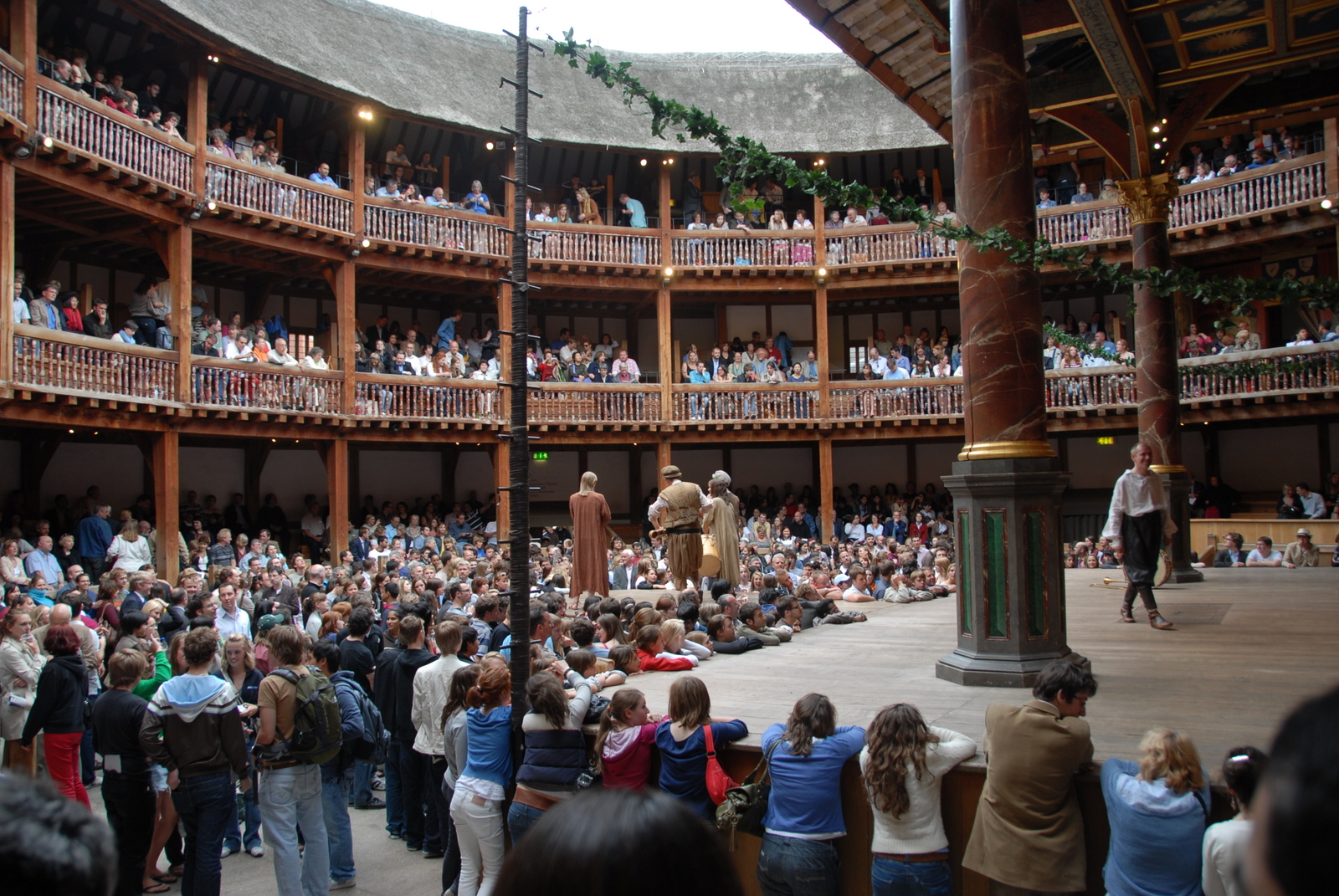
I suppose my ideal audience would look a lot like a globe theatre audience or a perpetual student matinee (sans teachers).
Why student matinees?
Kids laugh and joke during a show, they get the penis references, they want to shout at the characters to stop being idiots.
I think that is good and right and proper.
I have never connected as deeply with a show as when standing in front of a sea of students they cry out "Don't do it!" before drinking the poison.
You know they can't stand to see you or your character or whatever leave the stage or the world of the piece.
That is a very moving moment everyone can share because you both know you have to drink the poison!
Appreciating the complexity of that is what an audience and actor is about. I think.

The reason I say no teachers is because they create a hierarchy, which I dislike in an audience or community.
I think there can be a beneficial hierarchy and it can be important for society to thrive, but in an audience, everyone's experience is equal.
But all too often, teachers, faculty, sometimes other students feel they have the right to shoosh one another or infringe on another's experience.

This is where I run into the most trouble: whose experience is more valid, the individual's or the group's? I don't think there is an easy answer.
Because every person has the right to an experience, whatever that means.
But what does that mean when it is a communal experience?
Some of this is touched on in my previous post, but let us treat is as a thought experiment:
Someone vocalizes a little too loudly for another person's experience. So without knowing, someone having a deeply moving experience has 'impacted' another's experience.  Whose is more valid? Whose need is greater? I don't know.

I am reminded not of my own experience in Greece, but a colleague who went to an American production of Ajax at a Greek conference.
The audience ripped it apart during the entire show, talking about what was good and bad while it happened, laughing at the awkward moments, applauding the students' work.
At the end of the show, they shot to their feet and gave a standing ovation.
My friend was flabbergasted, but she did have this theory, "They left nothing for afterward, the entire audience knew what they felt and expressed it during the whole run that by the time the cast bowed the only thing left to do was to applaud them for their work, regardless of how they [the audience] felt about it."
This. I love this.

What if, instead of silently experiencing the show we create a dynamic for talking, for laughing, for exploring it with one another as it happens.
That way we can create a communal event that everyone can enjoy while it happens and if someone doesn't understand or isn't enjoying it, we can engage with them, explain to them, feel more at ease in the theatre and therefore more electric.
Because the audiences I love best are the ones I can connect with, the ones who let me know if I'm good or bad.
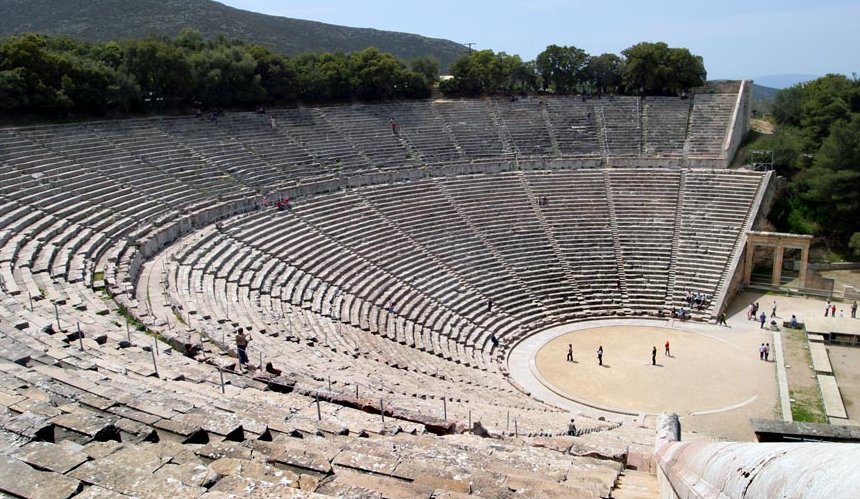
I think the theatre could go back to a playing space and hopefully look more like the Globe, the amphitheatre, or this:

People say the theatre is dying, but playing, acting is such a human quality that I cannot believe it for a second.
If we could create the kind of dynamic with the audience that sports has with its fans, then I think  would be the right direction.

I want to give people permission to curse, swear, scream, laugh, cry, take photos, videos, shout at/with me, and maybe, just maybe share something special.

Sunday, April 5, 2015

Why am I such a Bad Audience Member? (9:30)

I witnessed the funniest Oscar Wilde play EVER and couldn't laugh.

I should preface this by saying I have never found Oscar Wilde amusing onstage.
I have loved his plays since high school, the wit, the satire, but never a staged performance...ever.

Now, back to the show:
We were at the theatre, we showed up, got student rush, 15 euro for front row seats.
I walk all the way to the front of the theatre in my Captain America t-shirt and Chucks, sat in my seat, and looked up to see this:

I was literally breathless.

We have Oscar Wilde, an Irish playwright, writing about the English, performed by the Irish in front of the Irish and exactly three Americans.
The play opens, two women walk out fanning themselves, stand next to a chaise and slump as if to say, "Woe is me."

The audience roared.
Without a single word being uttered, we got it, the hypocrisy, the satire, the irony:
These people are so god damn wealthy they can't possibly have issues; they simply have to make their own.
I fell completely and utterly with this man:

Yeah, that's right, I said it.
For the first act, I whooped and hollered, laughing with everyone, some of the verbal quips so brutal they elicit an actual, "Jesus Christ!" from me.
The lights go down, the actors exit, we bask in the enormity of what we are a part of.
And then the house manager asks us politely to step outside.
We were being too loud; he understood we were enjoying the show, but we were being so boisterous it was interfering with the rest of the audience and actors.
Now let it be said, this man handled it with grace and aplomb, but I was livid.

For the second act (which was fabulous by the way) we were unable to laugh.
We figured we could, but now it was "How loud is too loud? What is appropriate?"

I will never forget how remarkable a show it was, nor how badly I wanted to laugh.
Now I won't say we were blameless.
I talk during shows and my friend has a laugh that wouldn't be surprising on a buxom Viking strumpet in the throes of passion.
Loud, certainly. But enjoying the show? Without a doubt.

So what is the point of an audience member?
What is our function in the artistic event?

I used to think it was to passively receive a story, process it, and dissect it later.
But performing in front of an audience consistently for years now, I don't think that is enough.
The audience is a central part of live performance.
What are we there for if not to share in the joys, triumphs, and failures of not only the characters, but the actors as well: I saw you drop that line! It's okay. We can laugh about it.

I think now that the audience is there to share with the performers in the theatrical event.
It is a collaborative effort that both work towards in order to mutually enjoy.
Performers have to be proficient so that the audience can willingly believe.

On the same trip, we saw Antony & Cleopatra at the Globe.
Antony had a fever the previous day and had missed a show.
We stood in the pouring rain for three hours until his Act V speech.
He forgot his lines.
He called, "Line"
And the audience was breathless.
Every single person in the audience (to my mind) was shouting with their whole selves "You can do it".
This was an actor at the top of his game struggling with a bit of memory at the end of one of the hardest roles ever.
We were there for him.

The reason that I bring all this up is an open letter written in the Metro Times to the jerk who sat behind him.
I found it to be quite horrible.
If only because it was wildly one sided and allowed for no other experience.
The hatred and contempt for these audience members from a fellow audience member is palpable:
I’ll tell you what’s awkward you [sic]: A trio of art-hating pseudo-hipster malcontents going to an opera, putting their feet up on the seats, and talking at a high volume throughout the entire performance.
 My dear trust fund hipster container of men’s effluent, you are the one who drives people away from this city. It isn‘t the crime. It isn’t the lack of opportunity. It isn’t the segregation. It is you.
Now, I would never deny the writer's experience of the event or how they feel.
It was strong and clearly quite personal.
However, these ideas may be shared by other members of the audience, even by the cast.

That is what disturbs me:

I am left wondering who tells us how to act?
Whose to say their experience isn't valid, that that isn't a valid way in which to engage with art?

I move for a more collaborative theatre.
One where audience and performer commune for a time in the theatrical experience together.
Where sharing occurs in both directions:
The performers, their performance and skill, the audience, their joy and appreciation.

This post is becoming a bear.
I think I'll continue this post later...

Saturday, April 4, 2015

Learning & Creativity: How Babies Rule the World (3:13)


Creativity is the most valuable resource we have available.
It is the foundation upon which both the arts and sciences are established.
There is no situation in the world where the phrase, "Oh, what a predictable solution!" is considered praise.
And yet, institutions, I would say categorically kill creativity in youth.
Sir Ken Robinson makes one of the most compelling appeals to redeveloping the school model in order to capitalize rather than economize our growing workforce in an ever-changing world:

If you don't have time to watch the entire TED talk (which is brilliant) here are some key points:
  • Creativity (defined) is the ability to come up with new ideas that have value
  • Creativity is impossible without the ability to fail or to make mistakes
  • Failure and mistakes are precisely the thing schools stigmatize every day
  • Creativity is not learned, but natural, and can be schooled out of children
Don't believe me?
Here is a chart of the Scientific Method:
I've made it color coded for convenience and to be less scary.
It is a flow chart, essentially you come up with an idea, draw on past experience, test it, figure out of it is working, and if it is, draw conclusions, and finally share that with others.
Now this chart daunts middle/high schoolers of all ages.
AND YET! AAAAAAND YET!
Babies do this.
That's right.
Fucking babies:
Babies perform research.
They have rich, detailed ideas about how the world works, and when it doesn't fit into their mold, they engage with it, expecting further discoveries.
Creativity and research go hand in hand since we are infants.
To squash one will kill the other.
It is so innately human to be curious about the world, to feel awe in the face of wondrous objects, and to search for truth and replicate it.
And yet we deny children and teenagers the ability to search for their own unique perspective on the world: schools cut funding to sports and arts programs, colleges are reduced or combined, and parents and teachers tell children that their hobbies are not careers.
This is the single greatest calamity to happen to the education of our youth, a remnant of the Industrial Era where our education system is lodged, where children are run with factory bells to train them (can you say: Pavlovian conditioning?), where maths, sciences, and finally the humanities are given importance, rather than equal or individual study.

Keith Johnstone, an improviser and theatre teacher, says this in his seminal work Improv:
I once had a close rapport with a teenager who seemed 'mad' when she was with other people, but relativly normal when she was with me. I treated her rather as I would a Mask--that is to say, I was gentle, and I didn't try to impose my reality on her.
I'm remembering her now because of an interaction she had with a very gentle,  motherly schoolteacher. We were in a beautiful garden (where the teenager had just seen God) and the teacher picked a flower and said: 'Look at the pretty flower, Betty.'

Betty, filled with spiritual radiance, said, 'All the flowers are beautiful.'
'Ah,' said the teacher, blocking her, 'but this flower is especially beautiful.'Betty rolled on the ground screaming. Nobody seemed to notice that she was screaming, 'Can't you see? Can't you see!'
In the gentlest possible way, this teacher had been very violent. She was insisting on categorising, and selecting. Actually it is crazy to insist that one flower is especially beautiful in a whole garden of flowers, but the teacher is allowed to do this, and it is not perceived by sane people as violent. Grown-ups are expected to distort the perceptions of the child in this way. Since then I've noticed sch behavior constantly, but it took the mad girl to open my eyes to it.
I say let us be gentle with one another, let us not insist or push our own realities on one another.
In so doing, I hope that we can understand one another and learn from one another.
No one can teach you to be creative, no one can teach you to be an artist, no one can teach you to be a scientist; you already are one.
And no one can take that from you.