Wednesday, September 28, 2016

The Seed to the Craft of Art is The Art of Going Insane (And Other Acting Tips)

Today we discuss madness.


Nope, not that.


Yep.


Yep. That.
There, that is better.
Or worse.
I can never tell.
And that is really the subject of this post.

"There are no sane characters. "
-Miles Boucher
What do I mean by that?
WHAT I SAID!
(hint: that was for dramatic effect)

But, seriously, there are no sane characters.
Rather:
There are no reasonable people in drama.
Don't believe me?
Look at Oedipus:

Cast Study: OEDIPUS

That right there is a King of Thebes...

Oedipus meets his father Laius on the side of the road and what happens?

  1. Oedipus's father Laius tries to murder Oedipus
  2. Oedipus murders his father
  3. Oedipus marries his mother and becomes king of Thebes
  4. His mother has four of Oedipus's children
  5. Thebes suffers plague
  6. Oedipus curses himself (unknowingly)
  7. Oedipus banishes his brother Creon and the prophet Tireisias
  8. His mother Jocasta finds out he is her son and hangs herself
  9. Oedipus gouges out his own eyes AND is banished
Why?
Why does this happen?
Because Oedipus's father Laius is told by a prophet that someday his son will murder him.
So what does he do?
  • Laius sends his son away to die on the mountainside.


I would call that an unreasonable response.
Just the all of it.
Because really what it came down to was the fact that a blind hermaphrodite tells a king that someday his newborn son will kill him and that is all it takes for him to order his son to die.
Everything that follows stems from that moment.
Arguably Oedipus is a complete innocent.
But, the Greeks really don't seem to care about secular morality.

Okay. 
That is an extreme case.
But, that was the Greeks.
They worshiped dirt. 
That couldn't happen in a reasonable society.
Like the Elizabethans in England?

Case Study: HAMLET

This may seem like easy picking.
Hamlet and Horatio certainly talk about death and madness a lot.

Hamlet: Does this seem healthy to you?
Horatio: No.
Gravedigger: No.
Hamlet: I was talking to the skull.
Ophelia does literally go insane:

The King is like get this crazed bitch out of here!
Hamlet certainly feigns madness in the play scene where he woos the spurned Ophelia discussing lying between her legs and then does it!


And then of course, Hamlet speaks to a ghostly vision that no one else can see save Hamlet and the audience....scholars still debate that one.

Seriously, look at that shadow. That is my Father!
So some would say the play is filled with madness.
I would argue that they are right.
Yet again the:
  1. Hamlet spurning Ophelia
  2. Hamlet murdering Polonius
  3. Claudius's banishment of Hamlet
  4. Claudius's orders to execute Hamlet
  5. Laertes's rebellion
  6. Ophelia's insanity
  7. Ophelia's apparent suicide
  8. Hamlet's return and subsequent jumping into Ophelia's grave and fighting Laertes in it
  9. Their duel
  10. The accidental poisoning of the Queen
  11. The accidental poisoning of Laertes
  12. The deliberate poisoning of Hamlet
  13. The deliberate poisoning and the subsequent stabbing of Claudius 
All of this, all of this, all of this stems from:
  • Hamlet believing the Ghost who said:
    • I am thy Father's Spirit AND
    • Your Uncle killed me
That is it.
That is all it took to convince Hamlet that it was all his Uncle and everything that followed stems from it.
Who does that?!
Crazy people do that. 

But, those were from the Renaissance.
They did more drugs than the Flower Children.
They drank ale instead of water.
Shakespeare probably smoked cannabis.
Of course their characters were crazy.
We couldn't have that today...
(it's a leading line of thought, but still)

Case Study: HOW I MET YOUR MOTHER (or any sitcom...Scrubs/Friends/New Girl/Cheers)

*SPOILERS*
Meet Ted:

Aww early Ted is the best Ted!
Ted is a psychopath.


Crazy eyes! Crazy eyes!
Ted meets a girl named Robin:

Her name is literally Smulders...
The entire first season is about them getting together.
Second season is about them falling apart.
Third season is about them working on being together (Friends w/Benefits)
Fourth season they break up; Ted gets desperate.
Fifth season is art.
Everything after is just a sorry excuse.
And then Ted finally meets up to his promise and meets the Mother of his kids:

Sup!
And it was good.
Until she dies.

WHY?!
So sad.
And in the end, we find out that all of this is just an excuse to chase Robin.
AGAIN!
He literally asks his kids if it would be okay to date Robin after the death of his wife.


Now, here is the sanity:
It is very healthy to talk to your kids about dating again.
They are a part of the relationship and can and probably should be consulted.

But, Ted literally tells them everything about his sexual history, his conquests, his travails, his foibles.
They know Ted & Robin have the unhealthiest relationship.


That is not the action of a sane and healthy individual.
Ted is the most obtuse individual when it comes to self-awareness and self-control.

And here is the thing...
It's what we love about him.
NOT ALL THE TIME!


Oh shut up!
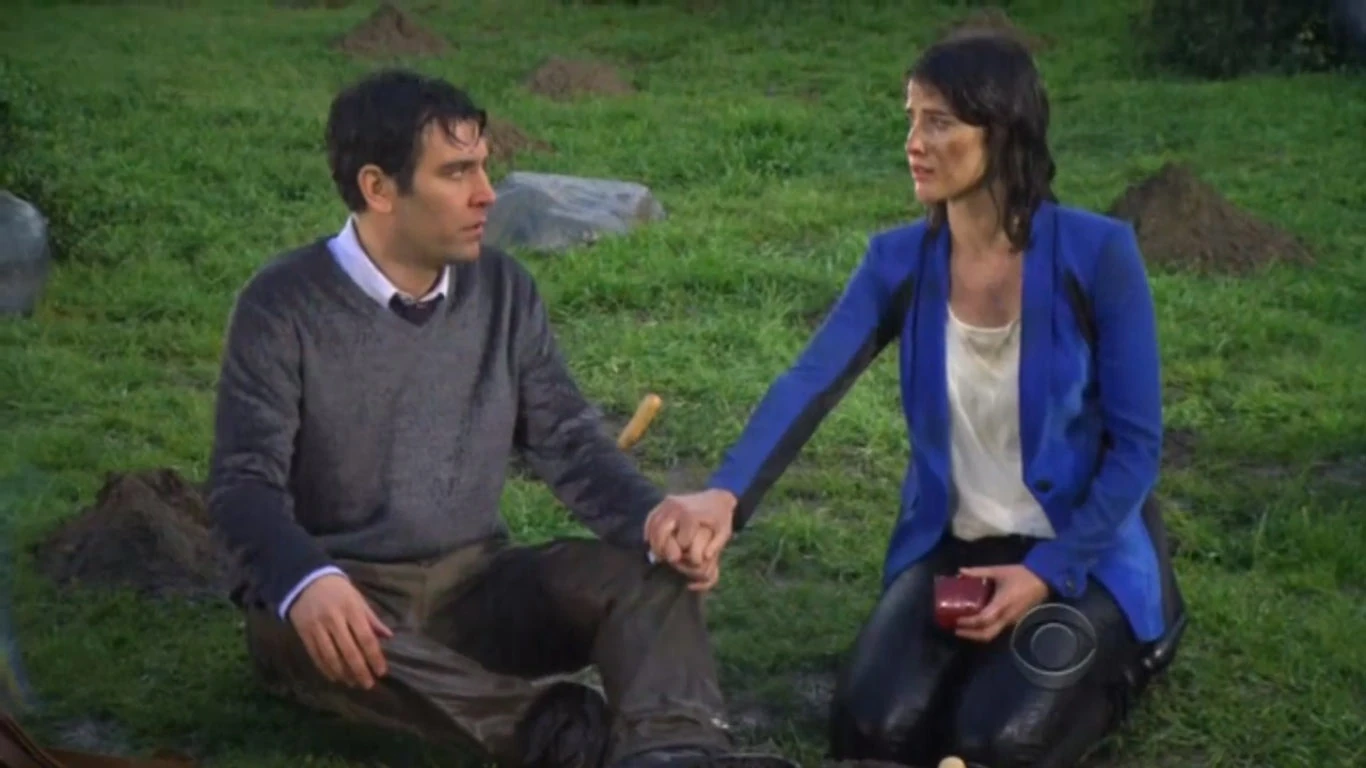

She is engaged bro!
To name a few.
But, there are so many precious, beautiful moments that we love.

His apparent disassociated moments with his students:


The fact that Ted made it rain for Robin:


The fact that he would have stolen an entire blue orchestra:


These are still the acts of a crazy person.
But, we can and do find them endearing.
There are reasons explored actually within the series, but are not the subect of this article:


The point is:
All drama is filled with crazy and that is what we love.

Case Study: YOUR FAVORITE STORY

Think of your favorite story.
Okay?
You have a story?
You got it in your head?
Know all the back story?
The ups? The downs? The surprises?
Good.

Now, really examine those characters.
Examine their behavior.
Examine their responses.
Are they responding reasonably?
Dare I say sanely?
I'd argue probably not.

Now, here is the thing.
EVERYONE WANTS TO BE SANE.
So far as I have been able to gather.
However, I would contend:

Art is Insane

End stop.
Art is Insane.
It is what we love about art.
People do things we would never do.

  • Ted Mosby loves in spite of love kicking his ass.
  • Hamlet goes off the word of a spectre and his whole family ends up murdered and his kingdom overthrown.
  • Oedipus ends up blind, childless, and cursed.

We like watching these stories.
We like watching characters get kicked and getting back up again
And why?
Because it is crazy to do so!
So why is the first critical response I hear always, always, always:
  • It was so real!
  • That is exactly how I would respond!
Really?
Really?!
Would you really?
Would you really kill your father, mother, nieces, nephews, and children?
If so, I may want to have you committed.

Now, to be fair, it may say something about the human condition.
Namely: we are all insane.
But, that is the subject of another post.
Here is my point:

Artists are trying to make their characters sane

It is the biggest tragedy to art I see right now.
People are trying to make their characters 'real'. 
And that means by toning down their responses.
That means that instead of tearing up the contract, characters are politely saying, "No, thank you."
Instead of throwing pies in each other's faces, we see them tersely eat dinner for a half hour scene.
This is not an overall trend.
In fact, many modern comedies embrace the insane quite well: 
  • Death at a Funeral
  • Hot Fuzz
  • Shaun of the Dead
  • At World's End
  • Ted
  • Rush Hour
  • Tommy Boy
To name but a few. 
But, if you are stuck, if you can't quite figure out why a scene isn't working, consider that maybe you or your partner or the situation isn't quite crazy enough.

Questions to Consider

  • Who is right in this situation?
  • Who is wrong in this situation?
  • Can I make them wrong?
    • How?
  • Am I acting unreasonably?
    • Can I act more unreasonably?
    • How?
  • What would an insane response be?
    • Why am I not doing that?
      • Is the reason: to be liked?
      • Is it because I would "never" do that?
        • What is wrong with doing it?
  • What is the most I can get away with?
  • What are the consequences for my current action?
    • Is it imprisonment?
      • Why not?
    • Is it lower than imprisonment?
      • Why?
I'm not saying everyone needs to go to prison or murder someone.
That would be formulaic.
But, the number of comedies that have a prison sequence is as high as the wedding:
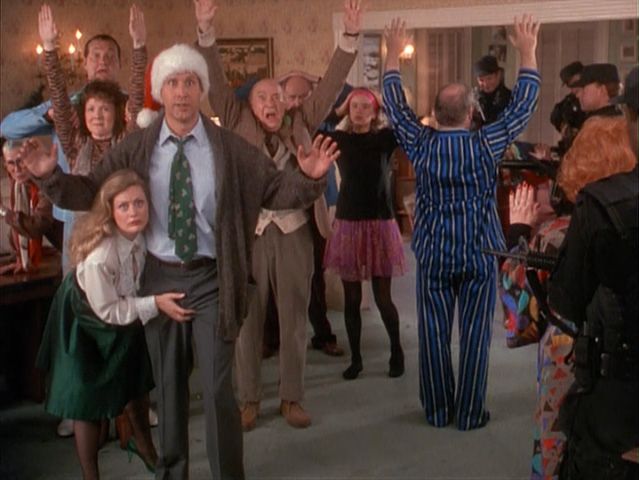
National Lampoon's Christmas Vacation

Bridesmaids

So if you aren't risking something in the scene.
If you aren't gambling on going to prison in your play or screenplay or novel at some point.
Then, I don't think you are writing drama.
Because your characters aren't insane.
And that really makes all the difference.

Monday, September 5, 2016

Why Advertising is Killing my Soul (How Wells Fargo dropped the Ball and so did You)

Today we discuss Wells Fargo:

Or more specifically this:

Can you feel where I may not like this?
The lack of respect for artists is deplorable.
"A ballerina yesterday.
An engineer today."
"An actor yesterday.
A botanist today."
I don't know that I have to explain ads to any generation at this point.
They have been a popular form of consumer culture since they were invented.
But, why don't we go down that rabbit hole?

Merriam Webster defines an advertisement as: 

  • something that is shown or presented to the public to help sell a product or make an announcement
  • a person or thing that shows how good or effective something is
  • the act or process of advertising

Now, advertisements have been around since...awhile.
We are familiar with the often ridiculous ads from the 50s, 60s, & 70s.
Things like a baby wrapped in cellophane to help sell cellophane (pictured above)
Or a doctor recommending a certain type of cigarette:

Because he is a dentist
 Or the infamous "If your husband ever finds out..." ad:


Where a woman is held over the knee of her husband because...she isn't store testing for fresher coffee.
Chase & Sanborn ladies and gents.
But, for sheer longevity:


Lecture on Egypt from the New York Historical Society in 1864.
A lecture by Professor Henry J Anderson, LL.D.
It tells you the time, the place.
All the information you need know.
Also!
To be followed by the Unrolling of the Mummy.
TICKETS are 50 CENTS

For those who don't know, often mummies were unrolled when they were discovered.
Everyone got a turn unwrapping a little bit of it.
What a remarkably unwholesome affair.
But, it only cost 50 cents to get in.
Which, if we access the inflation calculator (which only goes back to 1913) we get:

$12.15
It would have cost less than a movie to attend and unwrap an historical monarch of Egypt.
Talk about cultural sensitivity.

Point Being:
Advertisements have been around.
We know good ones and bad ones.
They have become a huge part of our culture.
They have permeated almost every single medium.

So we know what we are getting with each new batch.
So now, let us take a look at the Wells Fargo ad one more time:


"An actor yesterday.
A botanist today."
What could they possibly be selling?
Are they selling botany? Engineering?
Specifically? No.
Wells Fargo is selling a career. A dream. Somewhere to go.
They are selling the future.
How do you attain that future?
By investing in them and their education programs today.
So we have the three act structure:

Act I: The arts are yesterday

The arts lie in the past in this ad. Dancing, acting, other forms, are for the past. The implication being that they are hobbies, the stuff of children, of youth. 

Act II: The education starts today

You need what we are selling. Education. Why? Because you were an artist. You have no skill set. You need to be trained. And why do you need to be trained? 

Act III: The future is coming

Their byline is literally:
"Let's get them ready for tomorrow."
Why would you need to get them ready? Because these children are ill-prepared.
Why are they ill-prepared? Because they don't know nothing.
Why don't they know nothing? Because they were artists.

Logically, I follow the ad campaign.
It seems to flow. 
You start out as a child, naive, innocent.
They have to prepare you for the daunting future.
So you buy an education in order to live the dream and overcome adversity.
It's a lovely campaign.

Big problem:

They disparage an entire community of professionals by linking artistry and the craft thereof with youthful innocence and ineptitude. 
Above is my link to one of my first articles: 

In it I maintain that: 
  • Learning
  • Creativity
  • Science
  • Research
These are not things that are taught, these are natural processes that we learn or have ingrained within us from a very young age.
Not from professors or learned persons, but from our own observations about things.

But, the purpose of an ad campaign is to create a need where there may not be one. 
So, we as youths are convinced we are ignorant and therefore require more training, more understanding. 
Doesn't that just sound like parents, friends, and teachers: 
"Oh you don't know enough yet. You should go to school/university/graduate school in order to get more training!"

This is the worst lie, particularly for artists.
Because we already are artists.
We already have the power to create from a very young age.
Anybody can put crayon to paper.
Most do at some point.
Or stick to dirt.
Or build in the sand.
Or out of garbage.
We are naturally creative people.
So why don't we?
Why don't we create?
Because we believe the lie that we are not 'ready'.
That we do not have 'marketable skills'.

None of that is true.
As artists we create
That is the most marketable thing in the world
Employers want people who:

  • can learn quickly
  • are highly adaptable
  • work well alone or in groups
  • can memorize things verbatim
  • can create a pleasant atmosphere in which to work
  • are friendly, open, inviting personalities
  • can speak in front of a group
  • communicate clearly and effectively
  • create opportunities rather than problems
Every single one of these describes an artist or a creative.
All of us are capable of being fantastic employees. 
Now, this is not to suggest that an artist could easily step into a specialized school or advanced career like engineering or law or doctoring.
These are noble professions that require years of study.
So too does artistry.
All of them require years of craft.
Each of them can and should be respected as said craft.
  • Doctor
  • Lawyer
  • Artist
I would dare to put them on a level playing field.
Because this ad goes deeper than just Wells Fargo.
Despite the fact that they recanted after an outpouring of reader comments showed their distaste.
Wells Fargo responded that they wished to be inclusive to all careers with their advertisement and they fell short. 
But, why did they fall short?

I contend because nobody at the institution recognized artistry as a professional career path.
And that scares me more than anything.
The fact that we have built a culture that celebrates the careers in Science, Technology, Engineering, and Mathematics over and above artistry to the point where we are no longer recognized as career professionals scares me.
We need to right this.
How?
  • By working as a community.
  • By embracing our artist friends.
  • By paying for art.
  • By teaching art as a career 
  • By encouraging community involvement with the artist
  • By never accepting, nor offering an opportunity as a "resume builder"
  • By never under-bidding ourselves
  • By creating work relevant to the community
  • By taking commissions
  • By cultivating a sense of patronage

This list is not exhaustive.
In fact, if others have more ideas, please share them.
If this is ever going to change, we need help.
Help as artists.
Help as a community.
Because the apologies aren't enough anymore.
We need action to follow.
I don't expect MIT to suddenly become an artist's haven, but we need something when I hear fellow artists say: 
"Well, we aren't firemen."
A fellow artist said that to me and it broke my heart.
We can do better.

Sunday, September 4, 2016

Sleep No More Changed Theatre (And You can too)

Today we discuss a spirit jam:
"How do you see 'the theatre of the future'"
The idea of a "theatre of the future" is a tricky one.
What would it look like?
Would it have cooler designs?
Better interfaces?


More impressive/realistic projections?


Be terminally consumed with comfort?


In order to engage with this idea, I would contend we need to think less about a "theatre of the future"
Because I believe theatre is of the now. This. The present this.
There can be no future for theatre; it is dying even as it lives, much like all of us.
So there is no future theatre to which we can speak.
Instead, I would suggest that we discuss "the future of theatre."
That can be guessed at, hinted at in our present time.

With that in mind:
I believe the future of theatre is moving further away from the idea of comfort, emulating cinema and their palaces of comfort.
We cannot compete

Cinema

Cinema has supplanted theatre as a means of entertainment:

  • The seats are luxuriously comfortable
  • The ticket is always a fair price point (usually under $10)
  • The food is convenient and allowed into the theatre proper
Theatre has very little of that these days.
  • The seats are usually fold out or worse.
  • They are often cramped being a hundred years old.
  • The tickets sky rocket to $25-250.
  • Food and drink are highly discouraged.
In almost every respect theatre loses to the cinema when it comes to convenience, price point, and quite honestly, quality of content.

However, not all is lost, not all is bleak.
Theatre has some remarkable experiences going for it. 

Theatre is becoming what the critics call "immersive" and that I believe is the future of theatre.

Immersion

To define immersion:
Merriam Webster defines "immersion" as:
the act of immersing or the state of being immersed, as:

  • baptism by complete submersion of the person in water
  • absorbing/complete involvement
  • instruction based on extensive exposure to surroundings or conditions that are native or pertinent to the object of study

The idea is that it can be

  1. a physical act of immersing the senses in something
  2. a mental act of engagement with their surroundings
  3. a learning process through the first two definitions in order to learn something that otherwise they wouldn't be able
This can be applied to the type of theatre that is growing more and more popular.
I will use Sleep No More as a case study.

Sleep No More

Sleep No More is a dance piece that takes place inside of a six floor hotel.
First floor is tickets, coats, merchandise, pick up, and drop off. 
Second floor is a flow blown bar and jazz lounge.
Floors three through six are the play.
What play?
Macbeth and Hitchcock's films (Rebecca and Vertigo) in a kind of weird synthesis that (in my humble opinion) doesn't really make much sense, but lends to the creepy hotel vibe.

Why is Sleep No More so successful?
I maintain because the audience engagement is so fierce right from the start.


When you enter the second floor, through a dizzying labyrinth of ill-lit corridors, you find the jazz lounge.
And it is breath taking.
Filled with a complete bar, you can find your seat, order food, live up the high life in wonderful turn of the century fashion. 
It is a dizzying spectacle right from the get go.
Entertainment plays all night, the bar never closes, and the food is fair.
You could literally spend the whole night enjoying a jazz experience with friendly faces, a live band, a bar, and catered restaurant.
And some people do.
And that is okay.


Then, there are the other floors.
They are filled with unbelievable artistry and attention to detail.
This is the apothecary, filled with drying/dried herbs and flowers.
Dead things are preserved in jars along the walls...snake skeletons and things like that.
And this is just one room over many many floors.
You can spend literally the entire night exploring rooms filled with stuff you can lift and touch and play with.
And some people do.
And that is okay.


Then, there is the performance, which is so difficult to describe in words.
Everyone is granted a mask before entering the playing space.
Each mask provides a sense of anonymity.
They encourage exploration and interaction, but are very cognizant of safety.
The actors physically stop audience members from getting too close or interfering with the action of the drama.
You could literally follow one person, one character through the entire hotel up and down four flights and into countless changes/scenarios, into secret areas/wings.
And some people do.
And that is okay.

The reason that I think Sleep No More and shows like it are the future of theatre is because they immerse their audience wholly in the experience.
  • They encourage free exploration.
  • They create a dynamic, free-flowing atmosphere where audience can seamlessly go from one stage to another in an instant. 
I remember crawling down after the second repetition too tired to stand and in sore need of a piss, wandering into the rest room as a guy with a drink was coming out.
He appraised me, and with a shrug of his shoulders that said, "Once more?" he downed his drink, put his mask back on and headed for the portal I had just vacated. 
There was a sense of camaraderie with that audience that I have almost never felt with another before or since.
And I think it came from that sense of play.
There was a freedom to the experience; the creators had designed a beautiful playground in which we could lose ourselves in almost any of it.

Now, I say seamless. 
There were clear holes in the work:
  • A drawer full of lost rings that were all the same size bands of brass
  • Plastic plants that were meant to be exotic fixtures
  • Sterilized patches of art
I didn't begrudge the experience for the gaps in the design like so many other productions that I see.
Because in other productions those things are glaring.
It is clear and immediate what is wrong with the whole.
In Sleep No More, I had to literally search for those types of things. 
And why?
Because the rest of it was so compelling, so nuanced, so interesting.

So that is the trend that I am noticing in contemporary theatre that I wish to be built upon and be the foundation of future endeavors: 
The future of theatre will be built on the experiences that are only possible in the immediate present with bodies sharing space and breath within a singular theatrical design.
And you can see the trend developing with theatre companies like:
Slipstream Theatre Initiative:


 Or Nerve: 


Where immersion, where experience is the name of the game.
Where audiences are not told what to feel or how to interact, instead they are given ever more carte blanche to write or even change the experience because they are willing participants in the action. 
It is daring, new, exciting, and dare I say, slightly medieval.
The practice of throwing rotten vegetables is an age old way for the audience to show appreciation for the action they are experiencing and to interrupt it, if they so desire.
So maybe the future of theatre lies in its origins.
But, that is another tale.

Wednesday, August 31, 2016

Picking out a Spot in Heaven (What Really Happens when we Die)

Today we discuss what happens when we die (good morning by the way),

PHYSICS!

So there are a number of things that I hold very dearly with regards to this topic.
One is this online comic:


Happle Tea. 

  • God?
  • Hm?
  • Where do people go when they die?
  • The same place people go.
  • Heaven?
  • The ground.


It's sad, but it's true.
But, there is also something deeply beautiful about the idea.
There are no concerns like in the Greek mythology of different places where people end up, let alone the animals:

Civil planning was a nightmare
Instead, we all get the same treatment.
No cosmic judgment.
No good or bad or the other.
Just the ground.
With everyone else.

Hamlet actually says it best:

HAMLET
Dost thou think Alexander looked o' this fashion i'
the earth?
HORATIO
E'en so.
HAMLET
And smelt so? pah!
Puts down the skull
HORATIO
E'en so, my lord.
HAMLET
To what base uses we may return, Horatio! Why may
not imagination trace the noble dust of Alexander,
till he find it stopping a bung-hole?
HORATIO
'Twere to consider too curiously, to consider so.
HAMLET
No, faith, not a jot; but to follow him thither with
modesty enough, and likelihood to lead it: as
thus: Alexander died, Alexander was buried,
Alexander returneth into dust; the dust is earth; of
earth we make loam; and why of that loam, whereto he
was converted, might they not stop a beer-barrel?
Imperious Caesar, dead and turn'd to clay,
Might stop a hole to keep the wind away:
O, that that earth, which kept the world in awe,
Should patch a wall to expel the winter flaw!

Alexander, the world's greatest conqueror would one day act as a stopper for beer. 
We should all hope for so much.

METAPHYSICS!

To relate on a more metaphysical level:
Zhuangzi (one of the greatest Daoist thinkers) had this dream that most everyone is familiar with:


"Once upon a time, I, Chuang Chou, dreamt I was a butterfly, fluttering hither and thither, to all intents and purposes a butterfly. I was conscious only of my happiness as a butterfly, unaware that I was Chou. Soon I awaked, and there I was, veritably myself again. Now I do not know whether I was then a man dreaming I was a butterfly, or whether I am now a butterfly, dreaming I am a man. Between a man and a butterfly there is necessarily a distinction. The transition is called the transformation of material things." 

  •  A man has a dream that he was a butterfly
  • In the dream he was unaware of being anything but a butterfly
  • Awakes again as the man
  • Is no longer sure he is the butterfly dreaming or the man who dreamt
In no medium have I seen this more accurately portrayed than Roy in Rick & Morty.


Meet Roy.
Roy is a game.
A game that people play.
Where they wake up as a child from a horrid nightmare where they lived with otherworldly beings.
We are reassured by our mothers back to bed.
And we live a life.
And when we die it's GAME OVER. 
And then we wake up.

And that is Roy's life.
To us, to Roy it is complete and real and whole and valuable.
But, from a larger perspective, it is just a game.
That disturbs me more than anything.
What if the nightmares from our childhood were the reality we are trying to escape?
What if when we die, we wake up?
Are we really butterflies?
Are we monsters?
Something inbetween?

Tuesday, August 23, 2016

A Sex Lesson from the Future (And Why I liked it!)

Today, we discuss the first fellowship I hosted:


This.
This is Sarah Jones, one of the most brilliant performers I have ever seen.
In it, she performs as multiple personas given life through her theatrical device: BERT.
OR
Bio-Empathic-Resonance-Technology.
B.E.R.T.

B.E.R.T.

It is brilliant.
The idea is that in the near future, human technology is able to accurately record, and then recreate the emotional response inside of the originator.
As a device, I cannot emphasize how effective this is.
Josh Daniel Palmer said it best:
"That is, quite simply, theatre."
In theatre, that is what we do.
We attempt to recreate an empathic response in our audience.
By drawing attention to this simple truth in theatre, Sarah Jones is able to create a beautiful relationship with her audience.

The Setting

The talk is set in the far distant future and our near future is being taught as a history lesson.
This setting acts as another layer of theatrical device.
It lets Sarah Jones's character of Teacher act as an "objective" third party to our very emotional history.
It lends perspective if not a sense of objective truth to it.

That was as far as we got in our discussion.
Her performance and text are so dense.
We mostly discussed that at our fellowship.
And the repercussions of those simple ideas

  1. What would a future like that be like?
  2. How might we achieve such a future?
  3. And how long might it take?
The idea of the technology was so interesting and compelling that we didn't even get to the content

The Content

So, this is where Sarah Jones's work really shines.
She is able to slip in and out of character so quickly and so easily that it is completely transformative.
And then, she is able to appeal to many sides of the argument.

Her first character, an elderly woman views sex work as a mechanization/industrialization of the human experience of "making love"
The second is a college age feminist who finds the work empowering, but has no interest in performing it herself.
The third is a sex worker who wants the right and ability for economic empowerment.
The fourth was a sex worker from a very young age having been forced into it by her husband's debts and viewed it as a business filled with lost souls without tether.
The fifth and final one presented was a male who was getting married, attending his bachelor party, discussing freedom of choice for women who want to be in the business for positive, empowering reasons.

She indicates that her show SELL/BUY/DATE has additional roles, additional viewpoints, but already we have a wildly eclectic view of a single topic:
Sex Work.
And what does it mean?
By giving us so many perspectives and so many rich stories and encouraging us to feel empathetically with each viewpoint completely, Sarah Jones is able to weave together a very rich tapestry of views and conversations into a single whole. 

I think this work is some of the best I've seen.
I think she is one of the best performers I've seen.
I see no clear answer or way through this issue and I don't think that that is the point.
I am heartened by the historical context that she presents: 
Somehow, some way we get through this time of strife.
We come to a new understanding that is filled with rich words like "gender spectrum". 
I hope for a future where we can experience our ancestral history as a part of our growing understanding of our world.
Maybe it already exists in our theatre as exemplified by Sarah Jones. 
I hope that I may experience more theatre like it. 

Thursday, August 11, 2016

Finding your Way (Getting Lost & Why it's Good for the Soul)

Today, is a spirit jam:
"What do you do to feel free?"
I don't know.
I really don't.

One of the hardest questions I have been asked in a while.
The other being:
"What do you do for fun/play?"
I was without answer then as well.

Art is hard.
And by that, I mean the artist life.

Enter the Slings and the Arrows

Meet Slings & Arrows.
One of the scariest portrayals of artistry that I have ever seen.
Mostly because it is too real.
Mostly because it is too art.
Meaning, it is a show about a Canadian Shakespeare Festival that is run by incompetents, the insane, and all around artists.

It revolves around the travails of the festival and the man on the left, Geoffrey Tennant.
Who, in the first season, ignores his mentor until said mentor commits accidental suicide by pig truck, only to have Geoffrey haunted by his ghost/hallucination in a Kafka-esque/Family Guy question: IS THE GHOST REAL? IS HE NOT?
Oh and Geoffrey is the Artistic Director of the festival...meaning he runs the whole things.
For those not in the know, a synonymous theatre festival's budget was approximately 57.4 million dollars last year. 
He is the CEO of a multi-million dollar corporation!

Artists love this show.
I love this show.
As evidenced by this video:


Stuff people say at a Shakespeare Festival:
"This is exactly like Slings & Arrows. This is just like Slings & Arrows. It's better than Slings & Arrows! We're just like Slings & Arrows!"
Over and over again, classical companies compare themselves to this show.
And why?
Because it is a great show that makes you want to be a part of a festival.
It is also psychotic, maladjusted, and lacks any semblance of communication.
At one point, Geoffrey stabs his artistic rival Darren Nichols in a duel. Twice.
It makes for great television, but why do we love to compare it to our lives?
Maybe because it is a little bit true.

That while we get to wake up for work every day and go in and do sword fights and play...well, maybe that is actually really hard work.
Yes, there is an incredible pay off.
Nevertheless, that is work.

The reason I bring all of this up?
There is a wonderful scene where one of the characters is getting audited.
She has no idea what to do, so she goes to her acting friends.
They tell her:
"Claim everything. Make up, skin cream, shampoo. And every book you read and every record you play. We, as actors, have to be in touch with the zeitgeist."
This did something very interesting to a young and burgeoning artist such as myself (me).
It taught me that every single thing that I do is a part of what we might call: research.
This does wonders come tax season, not so great for my mental health.
And why?

Well, damn near everything that every reasonable person does for fun or as a hobby now becomes an exercise in futility and a drain on energy for me:

  • reading
  • writing
  • walking
  • hiking
  • exercise
  • cooking
  • nights out
  • nights in
  • move nights
  • learning skills
  • whittling wood
All of it becomes character work.
All of it is transformed from play into something that is done for the benefit of the art.
Which is really, really hard, because they are fun activities that I enjoy. But,...
It is really hard because I burn out very quickly with no sense of play or rest.
So what do I do for play?
I consider almost synonymous with
What do you do to feel free.
Because I am trapped in a world of work.
I have to work to play.
I have to work really hard to feel free.
So I find I often have to trick myself.
So I start with a common hobby that I have turned into research: walking.
And I keep doing that.
I keep doing it and keep doing it, exhausting myself.
And then I find myself in a new place.
A new experience.
Usually on accident.
Something unexpected works its way into the exercise and I am given a choice, embrace it or keep going with the exercise.
If the prospect is free and a lot of fun, I go with the flow.
If it isn't, I often have to wrestle myself into it for a while.
Point being you can keep walking/running:

Joy.
 Or join the lantern festival you didn't know was happening downtown:

You wanna set fire to the night?
So to come back full circle...
What do I do to feel free?
I get a little lost.

It is one of the hardest things to do in this day and age.
We have enough distractions, mini maps inside our pockets, and enough social media events happening pretty god damn constantly.
But, it is worth it to get a little lost.

Wednesday, August 10, 2016

Those we Love? (Making Molehills out of Who Picks up the Check)

Today we discuss one of Bevin's spirit jam questions:

What is our responsibility to those we love?

I'll just insert this here and go back to it:

Initial response:

NONE.

My initial answer is nothing.
But, that sounds too harsh.
We have no responsibility to those that we love?
That doesn't sound right.

But, there must be a truth in the gut reaction, right?
So, taking it as a partial truth.
"We have no responsibility to those that we love."
Why?

Because we are our own persons.
We are responsible for making ourselves happy.
That is true of us all.
Therefore, we have no responsibility or obligation to those that we love because it is up to each of us to make us happy.

Okay.
What else?

Considered response:

SOME.

There is some responsibility to the ones we love.
But, what is it?
How do we determine what it is/might be in any given situation?
Partial truth:
"We have some responsibilities to those that we love. "
So what might that be?
I think it is an understood relationship.
Something that is crafted and that we can all agree with.
Meaning, those who engage in sex and expect to have a baby have a responsibility to each other.
They expect and, I think, are responsible to one another and to the child to take care of one another, to support one another.
Now, what shape/details does that entail?
I do not know, they could be anything that is agreed to or understood.
The point is that there is a relationship that is entered and agreed upon.
"We are going to be parents. Therefore, we must enter into a paternal/maternal//paternal/paternal//maternal/maternal//(whatever non-heteronormativity you can insert) responsibility.

Final thought:

FRIENDS

Watching the video, I think it is one of the best ideas for responsibility to those we love:
"Treat them how you would your best friend."
What a beautiful idea.
If everyone treated those they loved as if they were their best friends? What a world in which we would live.
The idea of EQUALITY: out the window!
The idea is one of FAIRNESS!
I want to contribute to this date/holiday, but only make a fifth of your earning potential.
It is a lavish, extravagant holiday.
I cannot pay for half the holiday.
Can I pay for a fifth?
Fair.
That is what I would expect of friends and of partners who work well together.
No one is obligated to pay for everything.
But, it is our responsibility to do our fair share.
Right?

Doing it the other way round.
I could feasibly pay for this entire holiday, but to have the other person not even so much as offer to help out?
Or have them offer to help and then deny them the ability to do it?
None of that seems fair or friendly.
It is important to allow people the opportunity to contribute where they can and to accept help whenever possible.

So that would be my best answer.
"Our responsibility to those that we love is the same as that to our best friends."
We enter into a relationship, a partnership, a teammate situation where we each contribute fairly to one another because that is what we have agreed upon, recognizing that it is to ourselves that we must turn to if we are unhappy with a situation, but we can always ask for help.

Here is a picture of foxes to illustrate the point:
Happy Little Fox Family